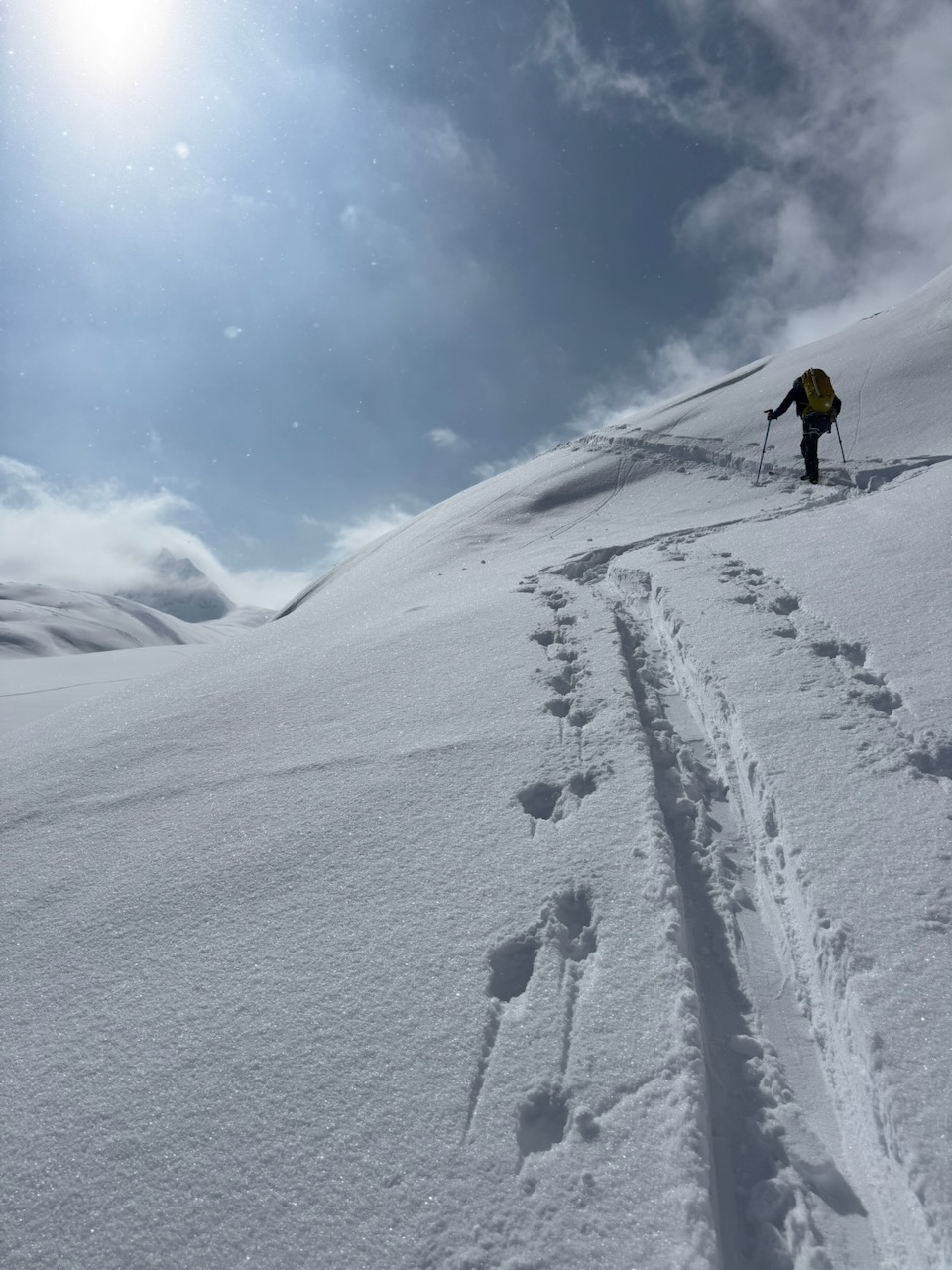
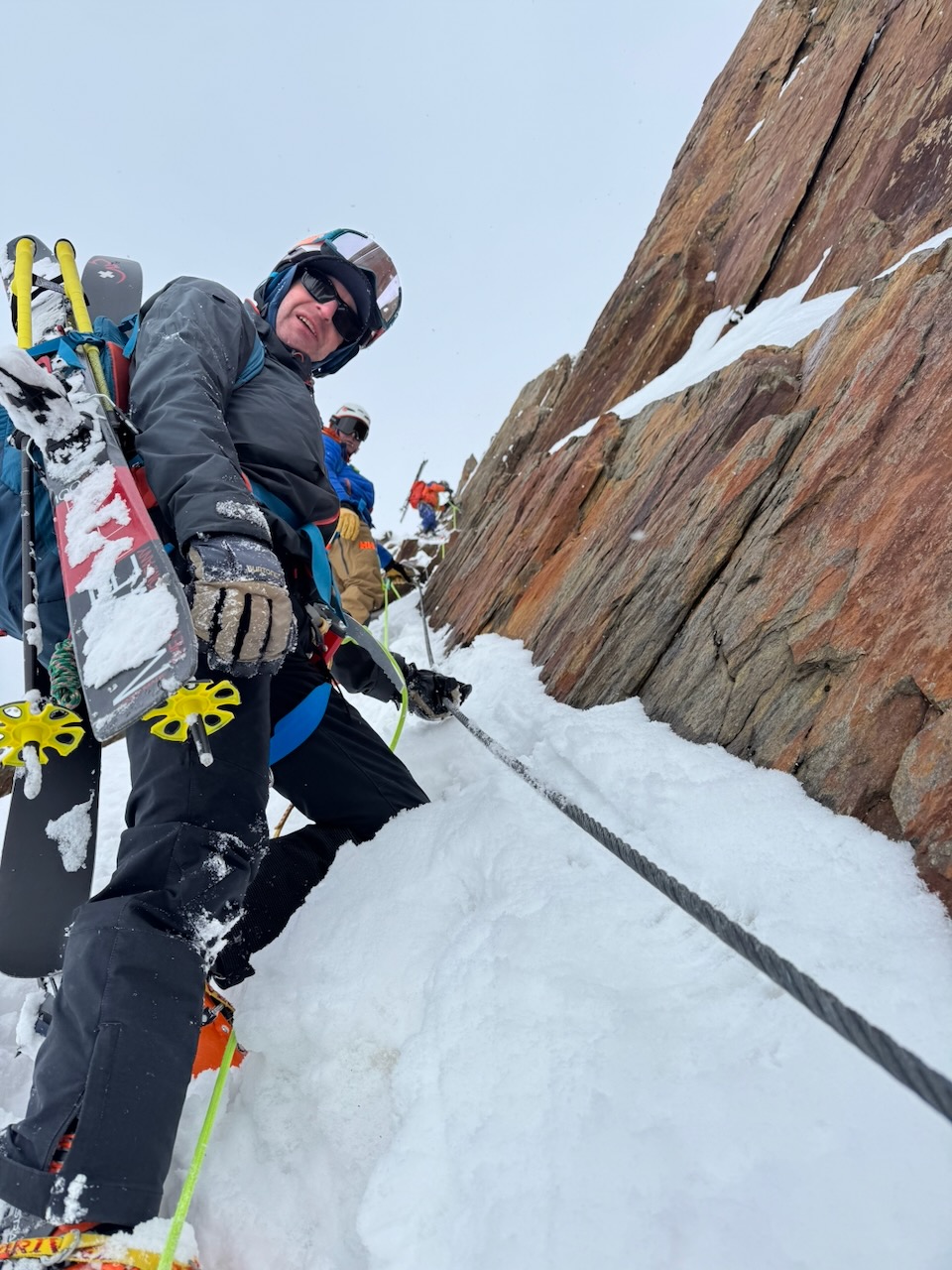
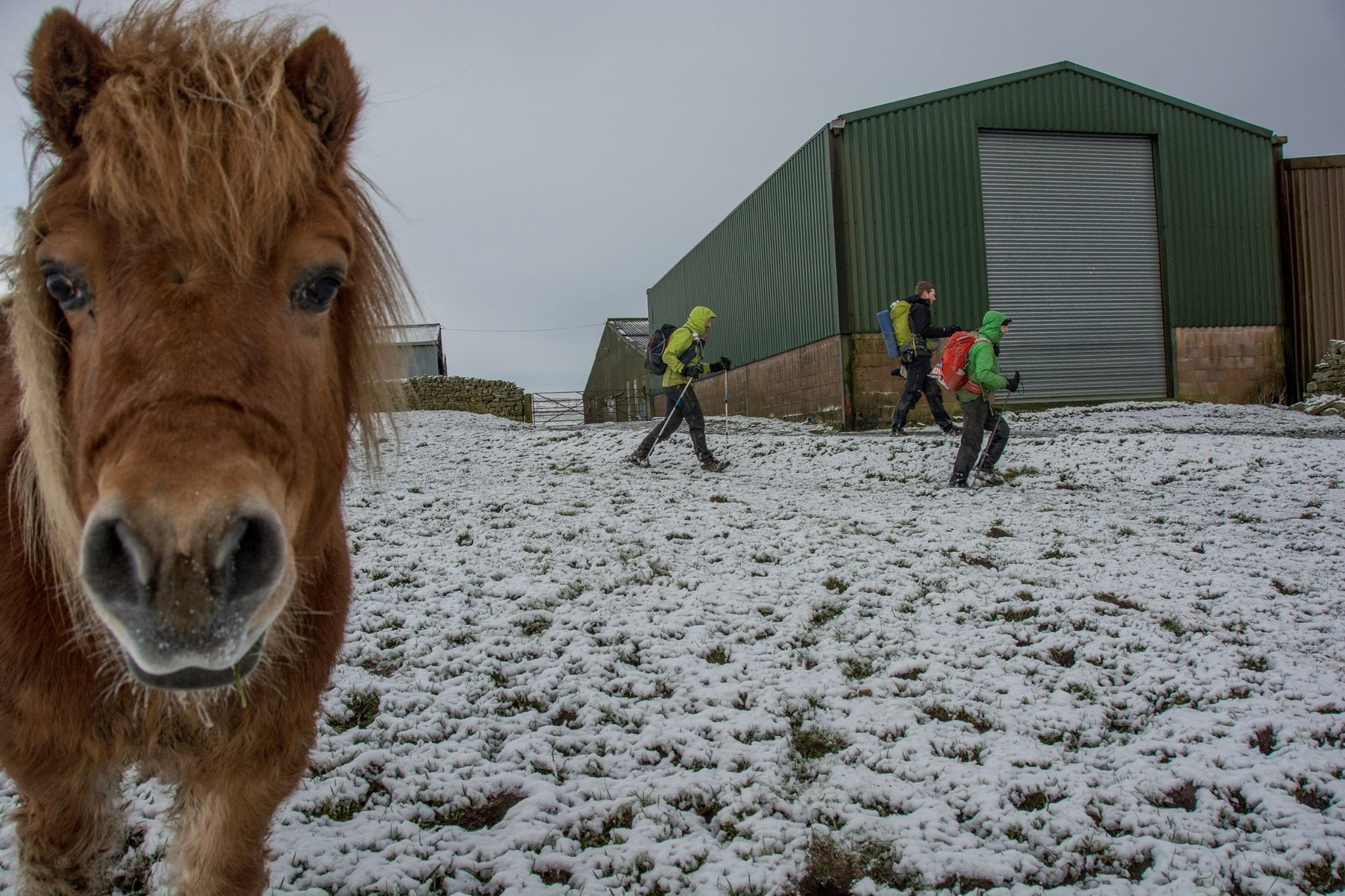
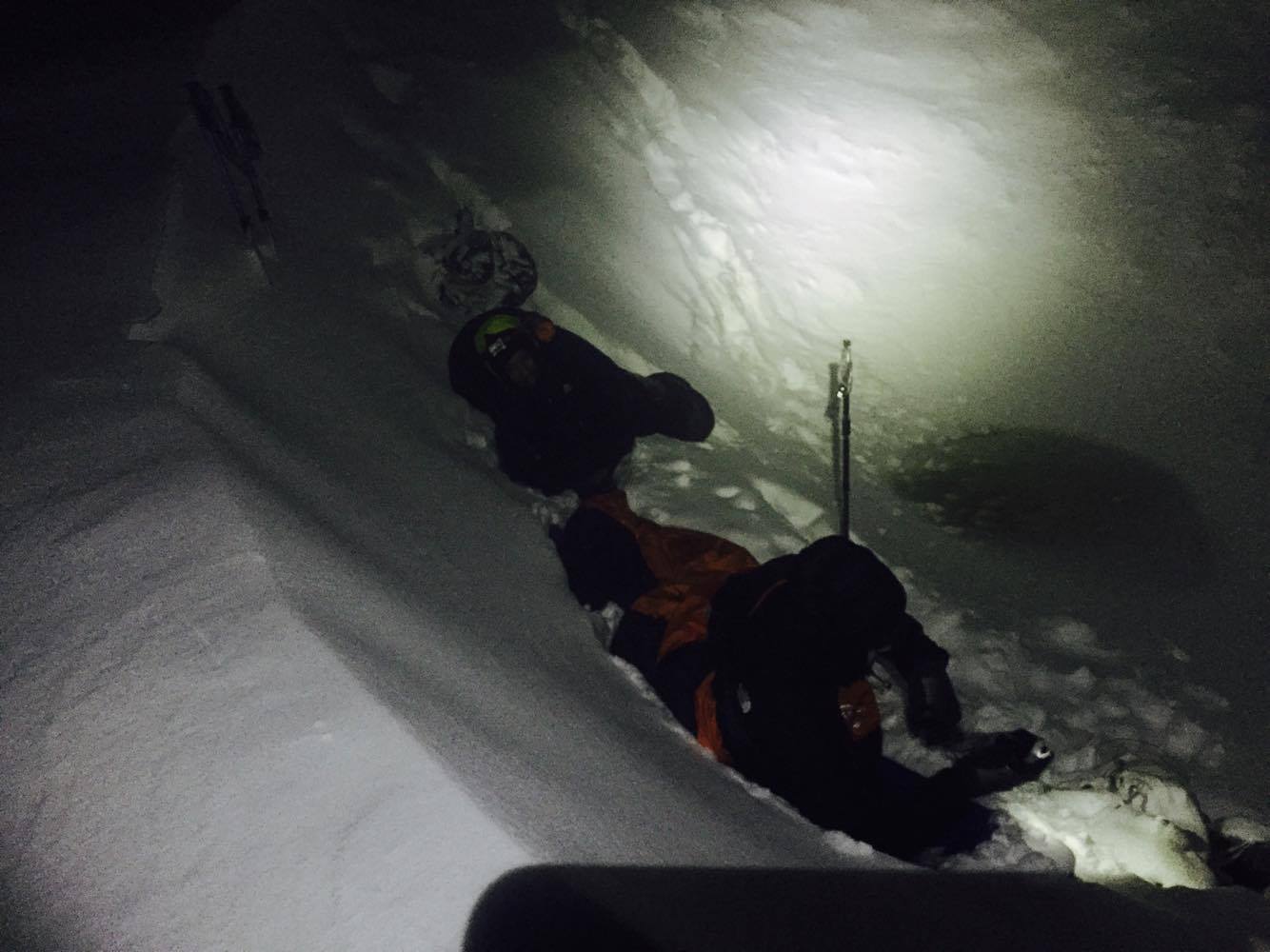
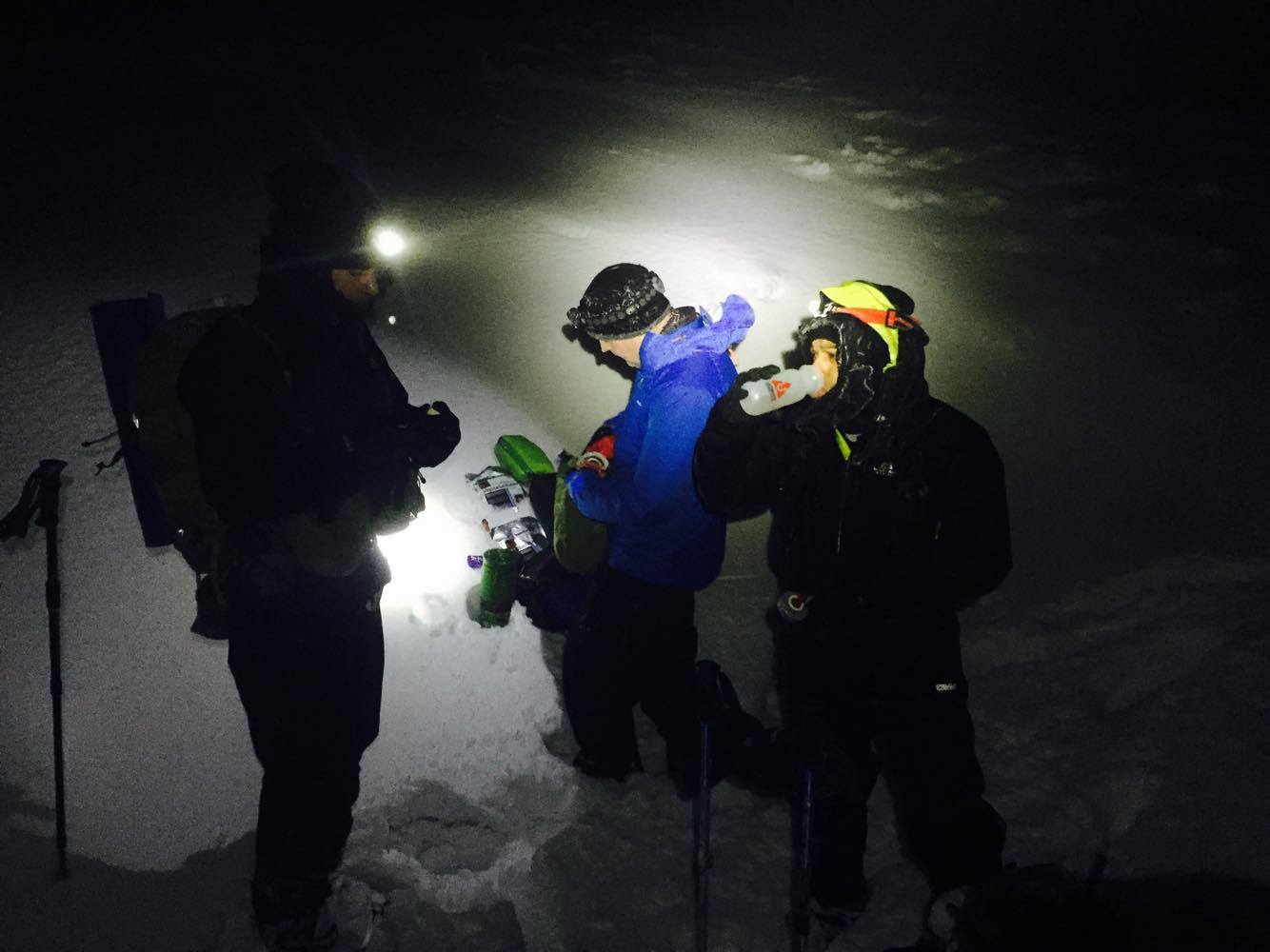
I’m almost horizontal. Feet pressed hard against a slippery rock face, crampons with just enough purchase, elbows hooked over the twisted metal wire that holds all six of us to the mountain. It looks rusty, and some of the pins have popped out of the rock. The most peculiar thing, which I’ve just noticed, is that I’m not scared. As I’m pondering this curious sense of detachment, watching snowflakes travel upwards past my face, Ewan loses his grip and dangles helplessly next to me. Ever the inscrutable Scottish investment banker, he doesn’t seem all that alarmed. I give my straining carabiner a worried look.
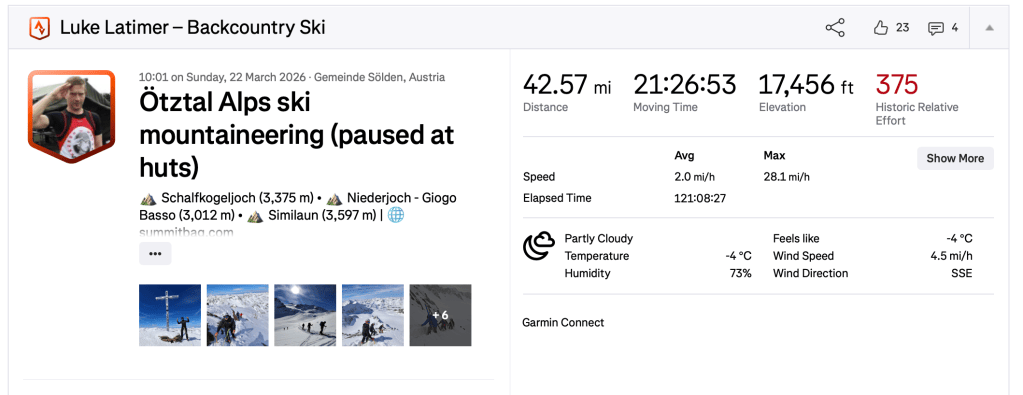
This is our annual trip to the mountains, we liked the Austrian huts last year and the Ötztal route from Obergurgl sounded like a good step up in difficulty. We don’t really know each other outside of these ski touring adventures, I’m certainly happy to not know Giles in his professional capacity (he’s a surgeon). Five of us plus the guide, off into the wilderness with a few mountain huts for refuge. The perfect antidote to modern life.
The clanking ski lifts as we set off are gradually replaced by pained mutterings from Kev. His new boots are doing their best to eat his feet, so when we get to the first hut he opts to stay and administer first aid. I suppose as a prolific ice climber he’s not usually thinking about boots. The rest of us jettison superfluous weight and are heading towards the first summit of the trip.
“I don’t see why we need to climb that today, it’s miles away,” Chris grumbles behind me. Giles and the guide are making quick progress ahead. I shrug and wipe some sweat off my forehead. “Maybe eat something?”
I’m looking forward to getting to the top of something high. Last year’s mini peak had felt like a breakthrough and I want to push myself to the next stage. From my current vantage point this looks like a straightforward skin up a valley, then a nice walk to the top. What I lack in climbing skills I like to think I have in fitness. Shame I can’t lend some of that to Chris, who’s still swearing behind me.
“Come on mate, they’re waiting for us,” I call back, while trying to decide if Giles is smiling or frowning.
“We don’t have time to get to the top and back before dark,” the guide says. Giles definitely isn’t happy. “We’ll head up there,” he points to a spot that looks worryingly close to a huge cornice hanging off a ridge. “Then ski back to the hut, the snow is nice here.”
I feel a bit of tension in my midriff ease. Giles isn’t impressed with the change of plan but we always stick together. Ewan takes a bite of a chocolate bar, he looks as unfazed as ever.
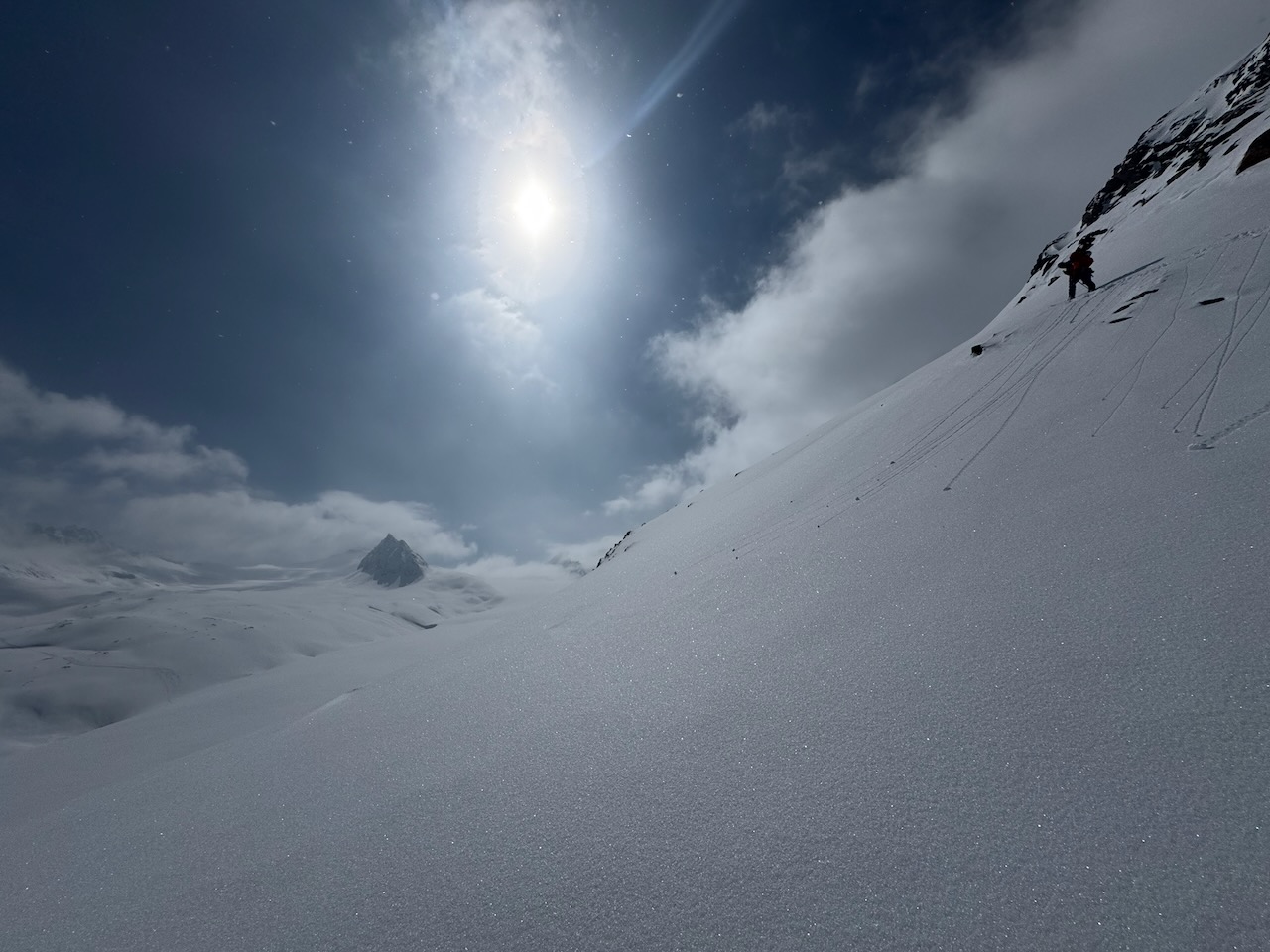
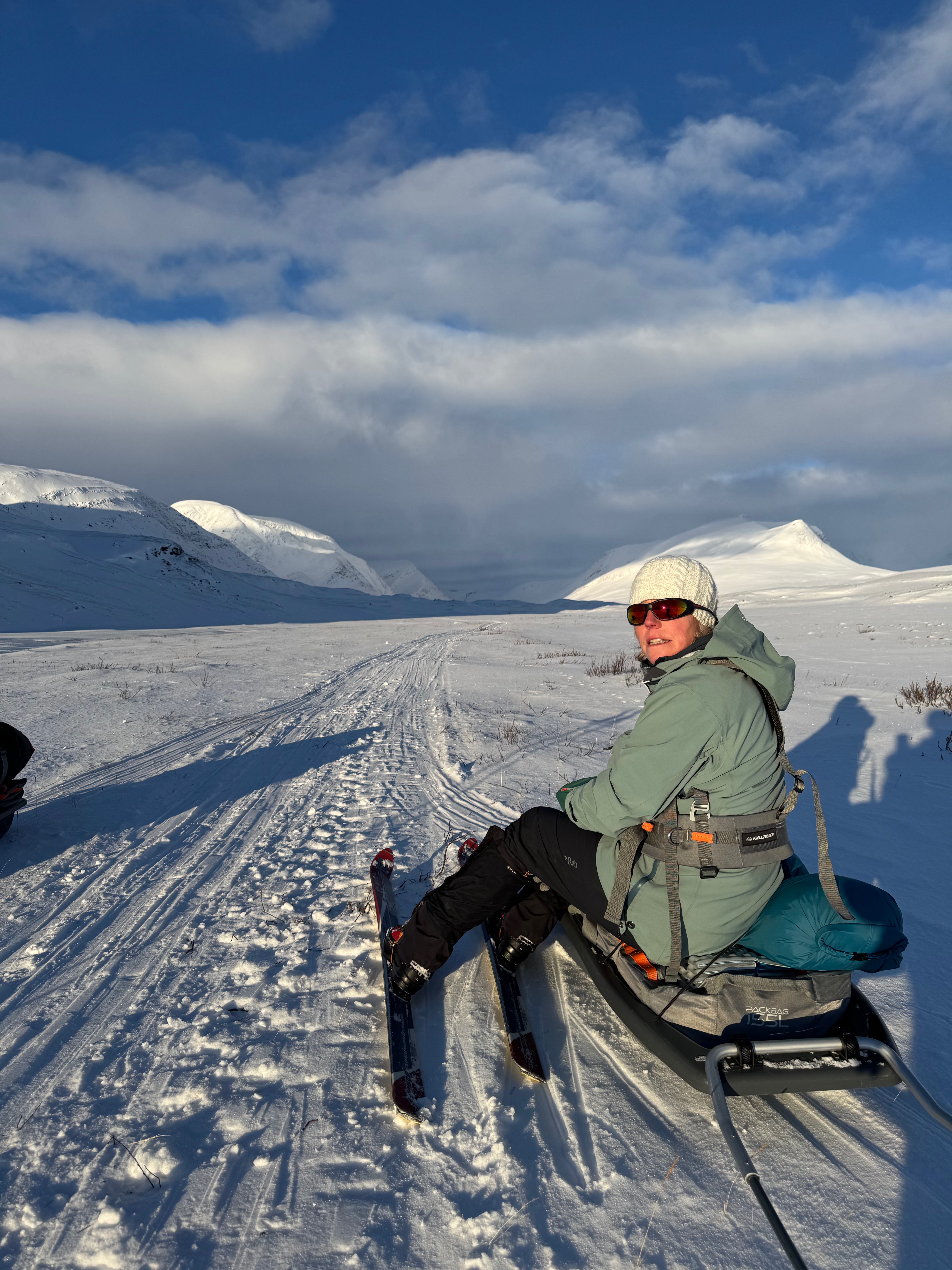
Clipping my heels into my skis and tightening the straps I launch myself happily at the steep slope below. The sun glints off white ridges and black jagged peaks around us. I bounce through soft deep powder … for about ten metres. A ski tip catches and I bury myself head down. “Keep your skis together!” Giles shouts over, “it’s bum skiing, stop trying to turn.” I give him a thumbs up and shiver as a load of snow slides inside my jacket.
The next day has no summits, just a lot of distance and elevation to cover before the next hut. Plus “a bit of a technical descent.” Everyone seems about as rested as is usual at this stage, which is not very rested at all. Altitude, exercise, beer, wine and schnapps, plus all sleeping in the same room. So we’re all a bit tetchy and rattly as we set off. A steep icy descent to the bottom of a narrow ravine doesn’t help. Once we’re moving uphill and start sweating we have other things to think about.
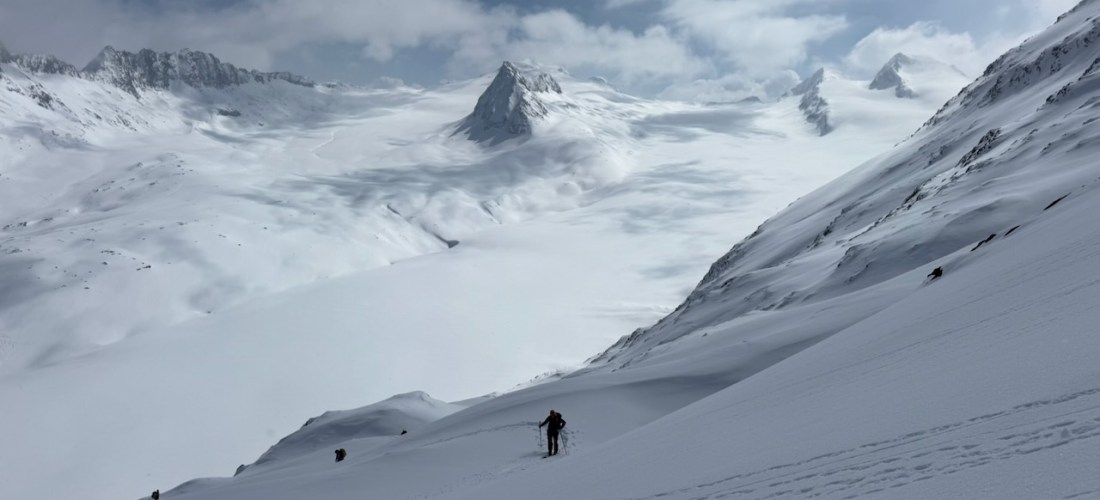
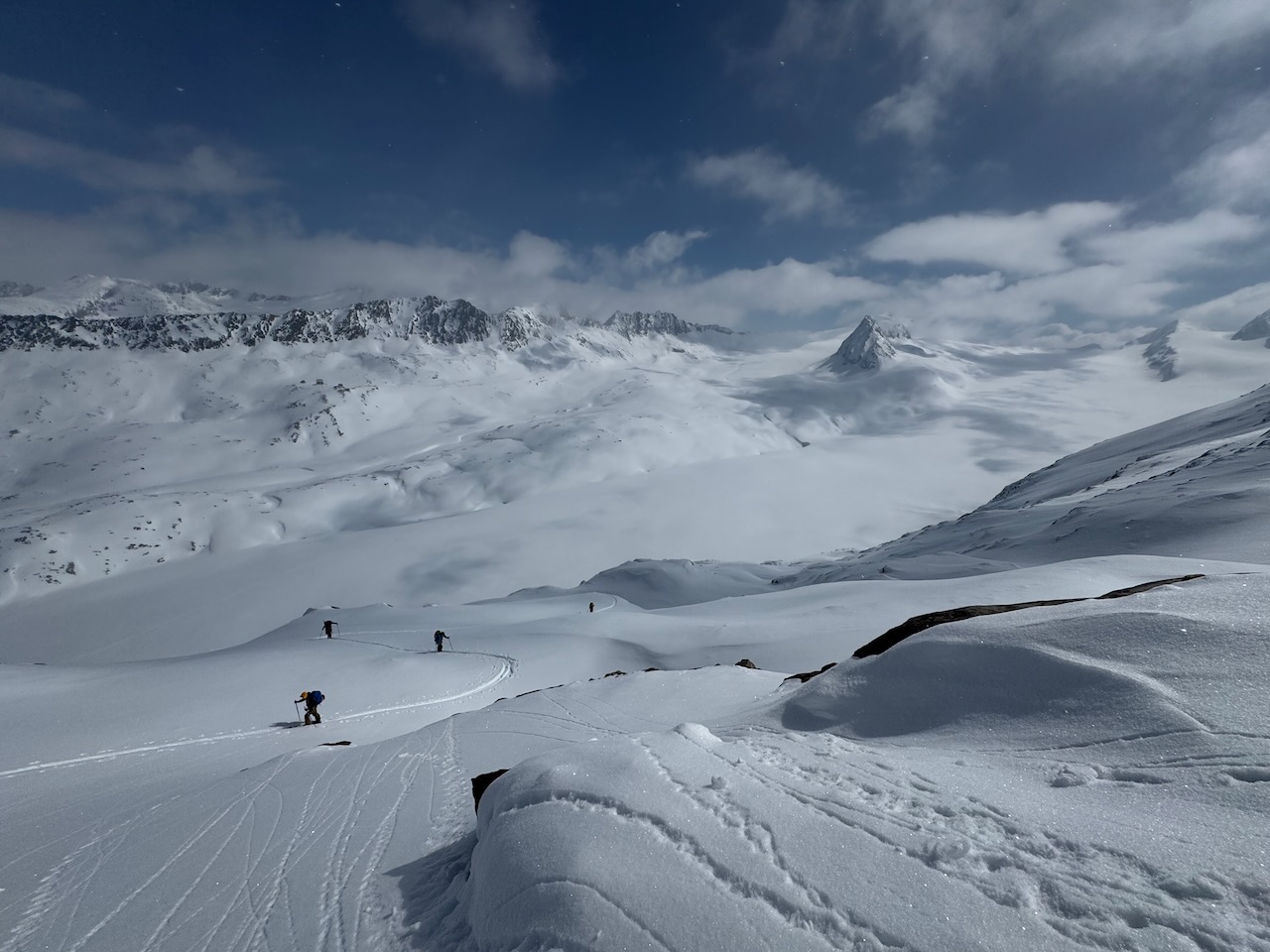
We stop for our second breakfast on a huge glacier, which always feels like the completely wrong place to stop. There aren’t any crevasses here, apparently. We keep our skis on and sit on our backpacks, admiring the view. The guide is pointing at what looks like a vertical side of the glacial valley, then upwards to where I can just make out the contours of another glacier. I’m not really listening, and suddenly we’re heading that way. There must be some mistake.
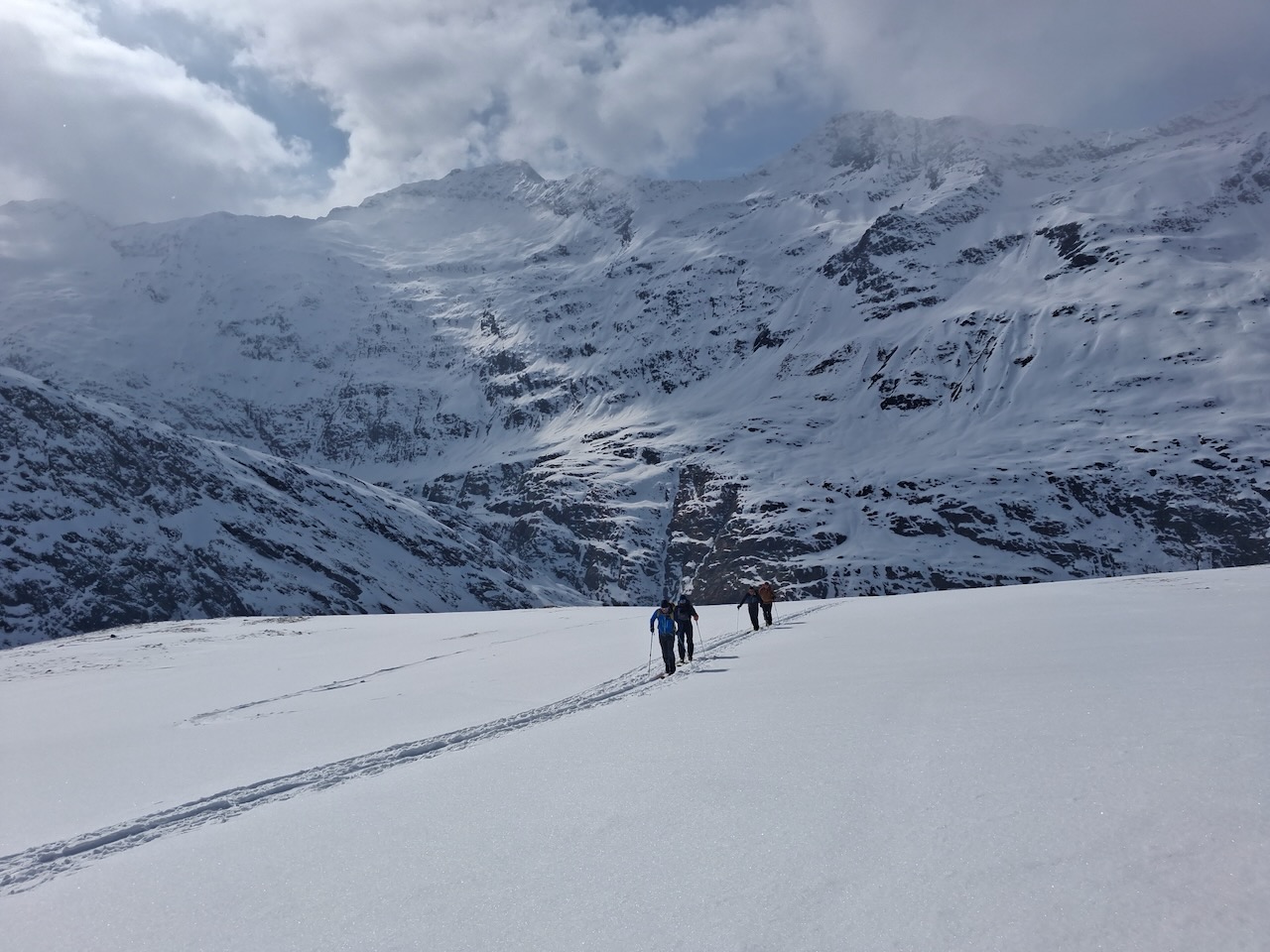
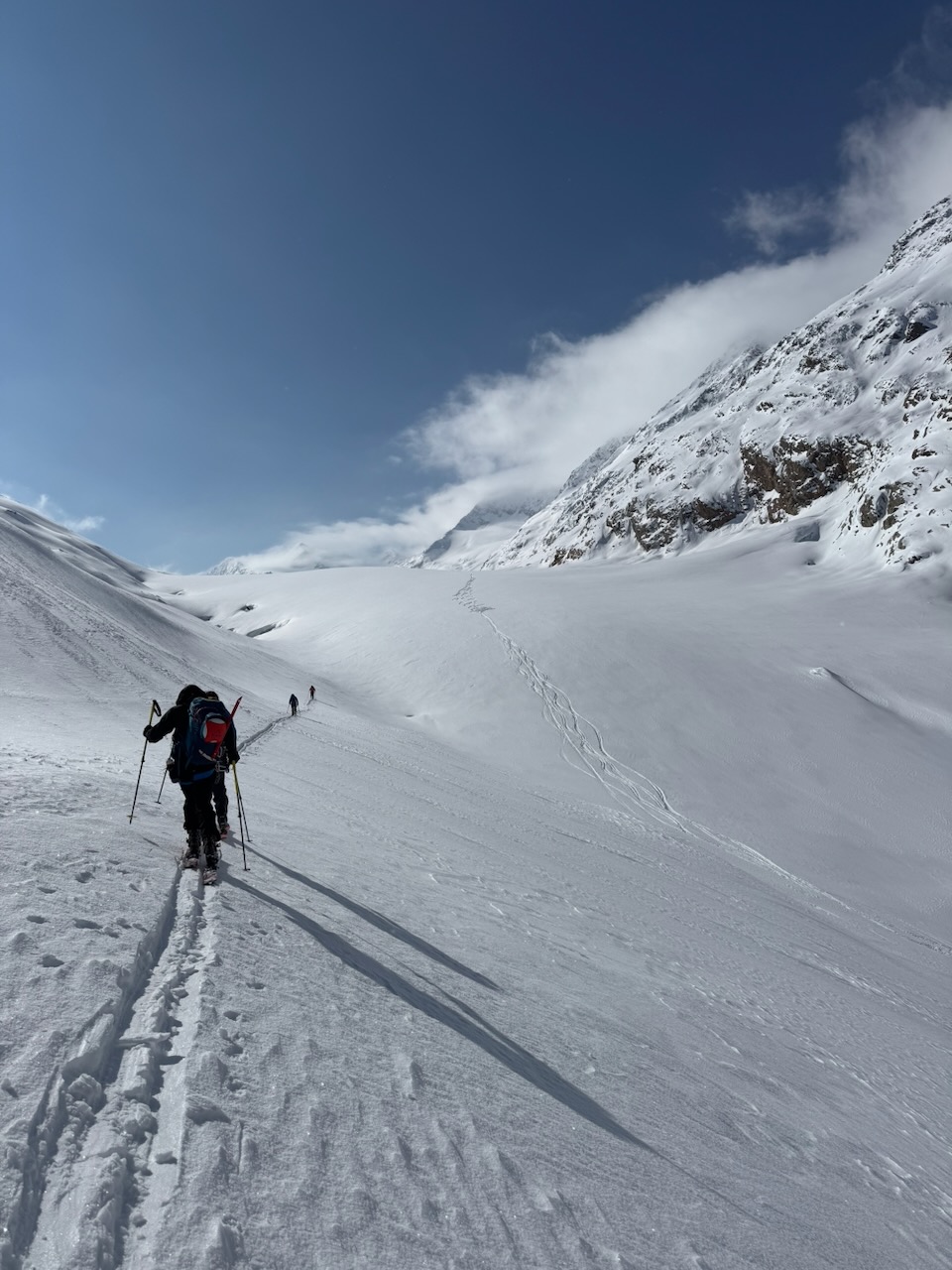
Nope. We zigzag up and up and up, each of us in our own little bubble.
I take a turn breaking trail. My skis sink over a foot into the snow with each step. It’s exhausting and I’m reminded yet again how strong and fit the guide must be to do this week after week. The sky has turned grey and it starts to snow. As we approach the top we spread out, the vertical convex curve of the glacier means crevasses. A loud “whump” sends my heart into palpitations, must have been a snow bridge collapsing. The guide just beckons us to keep moving up to the safety of the ridge.
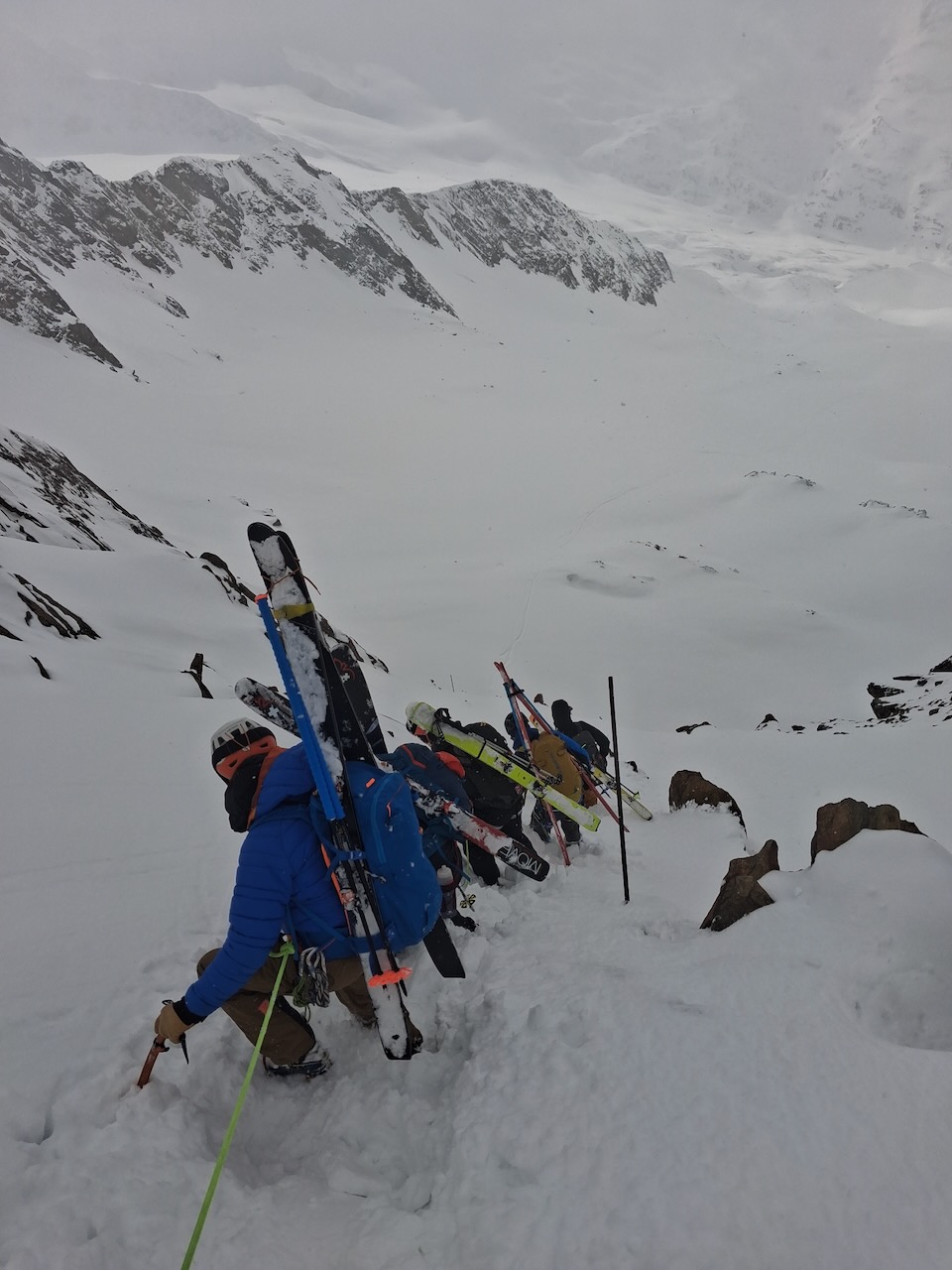
Skins off, skis strapped to my pack, crampons on. The guide pays out a rope and attaches our slings to a loop every five metres. Giles goes first, down what looks like a gentle enough slope, Chris next, then me, Ewan, Kev, finally the guide as anchor.
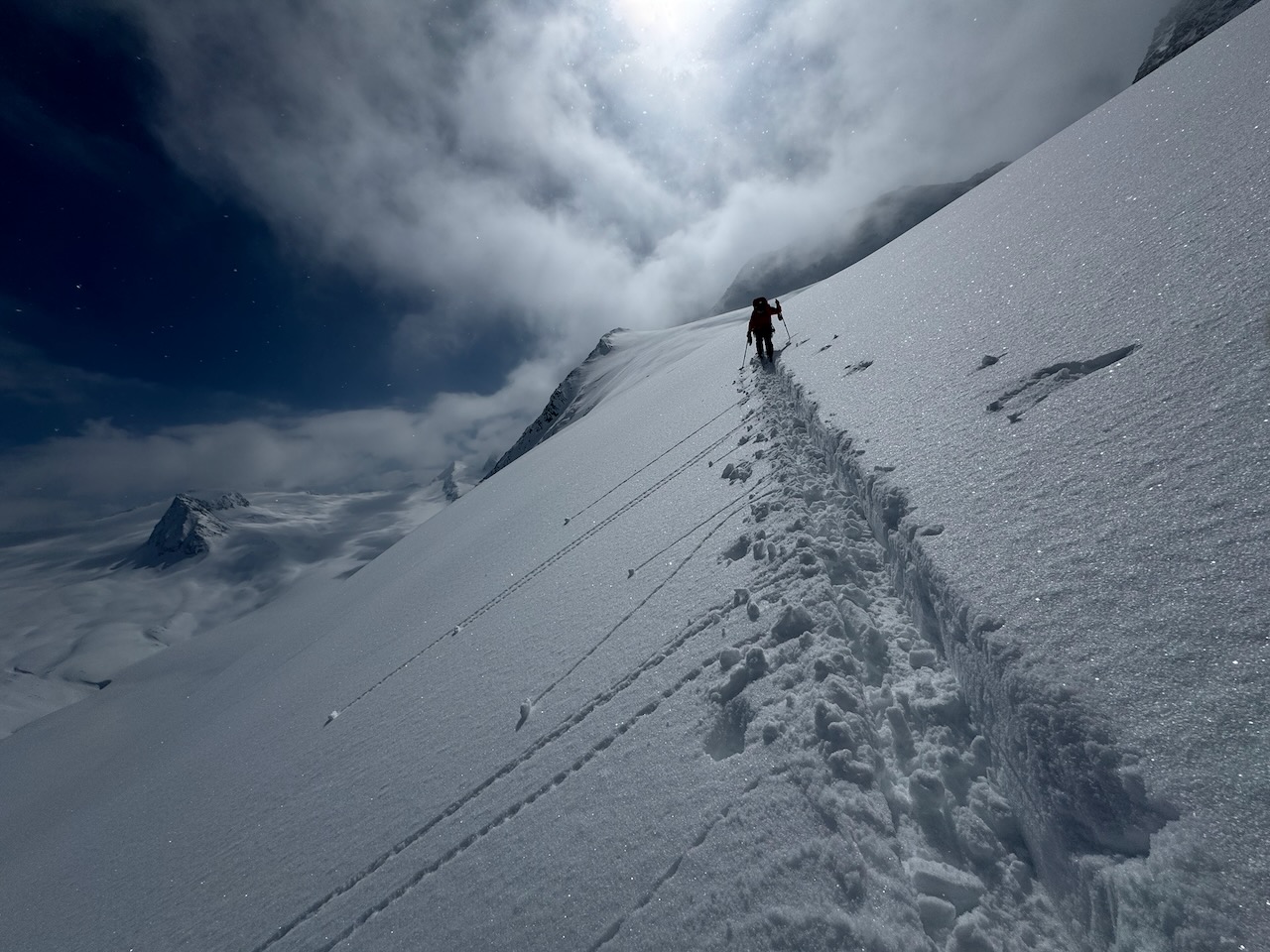
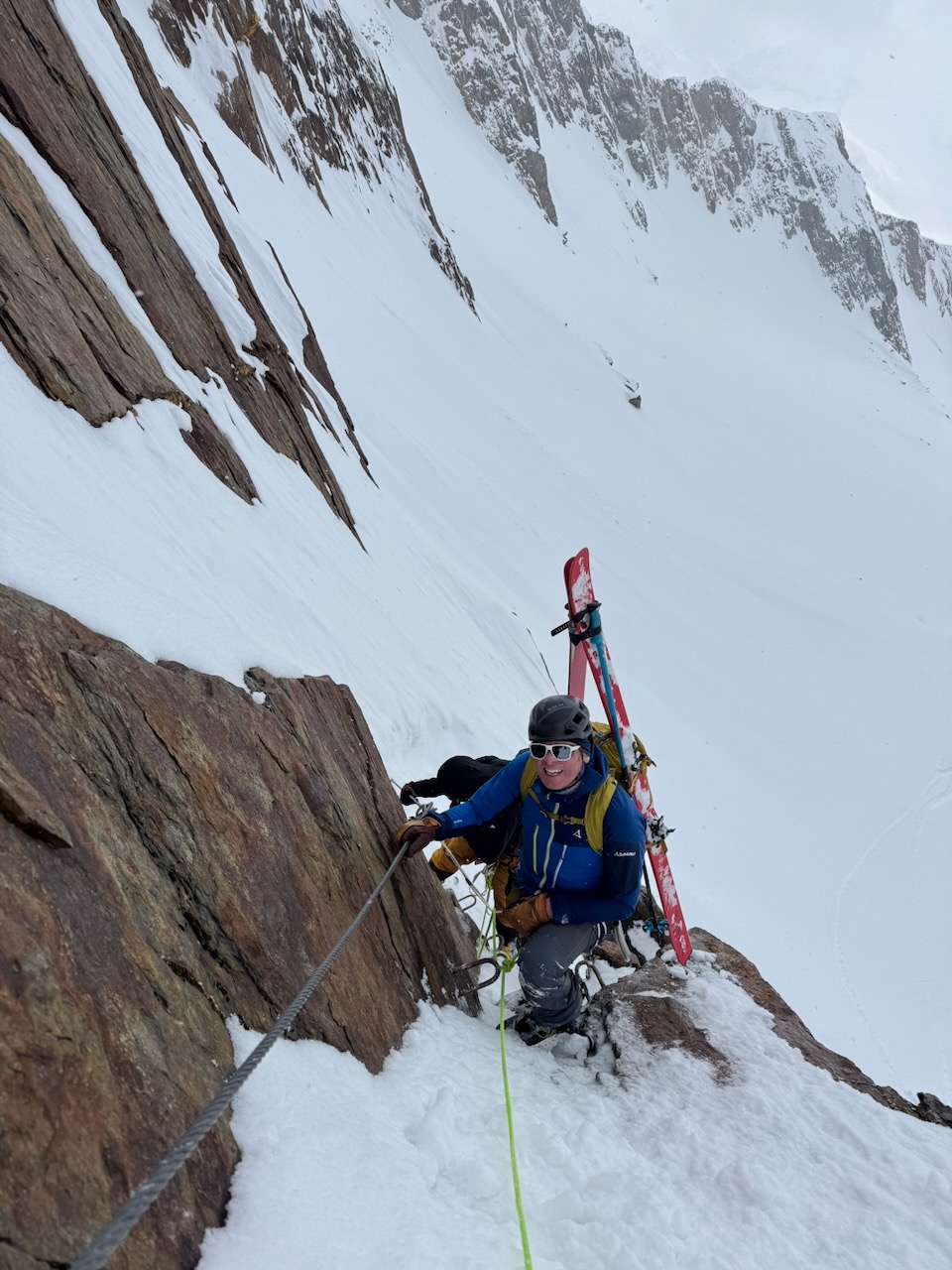
It’s not long before the snowy ground gives way to slippery looking rock. A wire pinned into the mountain disappears over the edge. I can see the valley beyond, it looks like quite a long way down. It’s too late to ask if there is an alternative route.
We inch our way down slowly, heavy packs making it even more difficult. Then the gap appears, it doesn’t really seem possible to get over it. The wire is flapping about, and the cliff is vertical. Chris taught people to climb when he was in the army, and seems to have an inexhaustible supply of lightweight kit to hand. He’s clipping on extra carabiners for the rest of us to use. We keep moving, I don’t really have a choice given I’m attached to everyone else. Suddenly a loud scraping noise makes me turn around.
Ewan is hanging next to me, then a few seconds later Kev slips. At least his body is on a ledge, with just his legs adrift.
I’m mostly keeping myself from dangling with the toes of my crampons, so there is nothing I can do to help. I’m tempted to take some photos to “capture the moment” but decide it’s probably inappropriate.
Chris shouts up to Kev, “get onto a knee and pull on the wire, we’re all stable.” Just, I think. Eventually Kev manages to leverage himself up and takes a moment to catch his breath. I look to my right, Chris and Giles are on a ledge. “How the fuck did you get past this bit?” I ask calmly. “Lean back, trust your harness, and get a foot over this way, there is more grip than you think, then I’ll clip you to this post.”
I look back to see if everyone is ready to move, Ewan has already followed the advice and has both feet against the wall. Kev nods and shouts back up to the guide, who has the end of the rope wrapped around another metal post.
A few moments later we’re all past the gap and shuffling along a gradually widening ledge. It soon gives way to a narrow chute full of snow and an easy belay down to safety.
“Scary?” I ask the guide. He shrugs and smiles. “No not scary, we had a rope!”
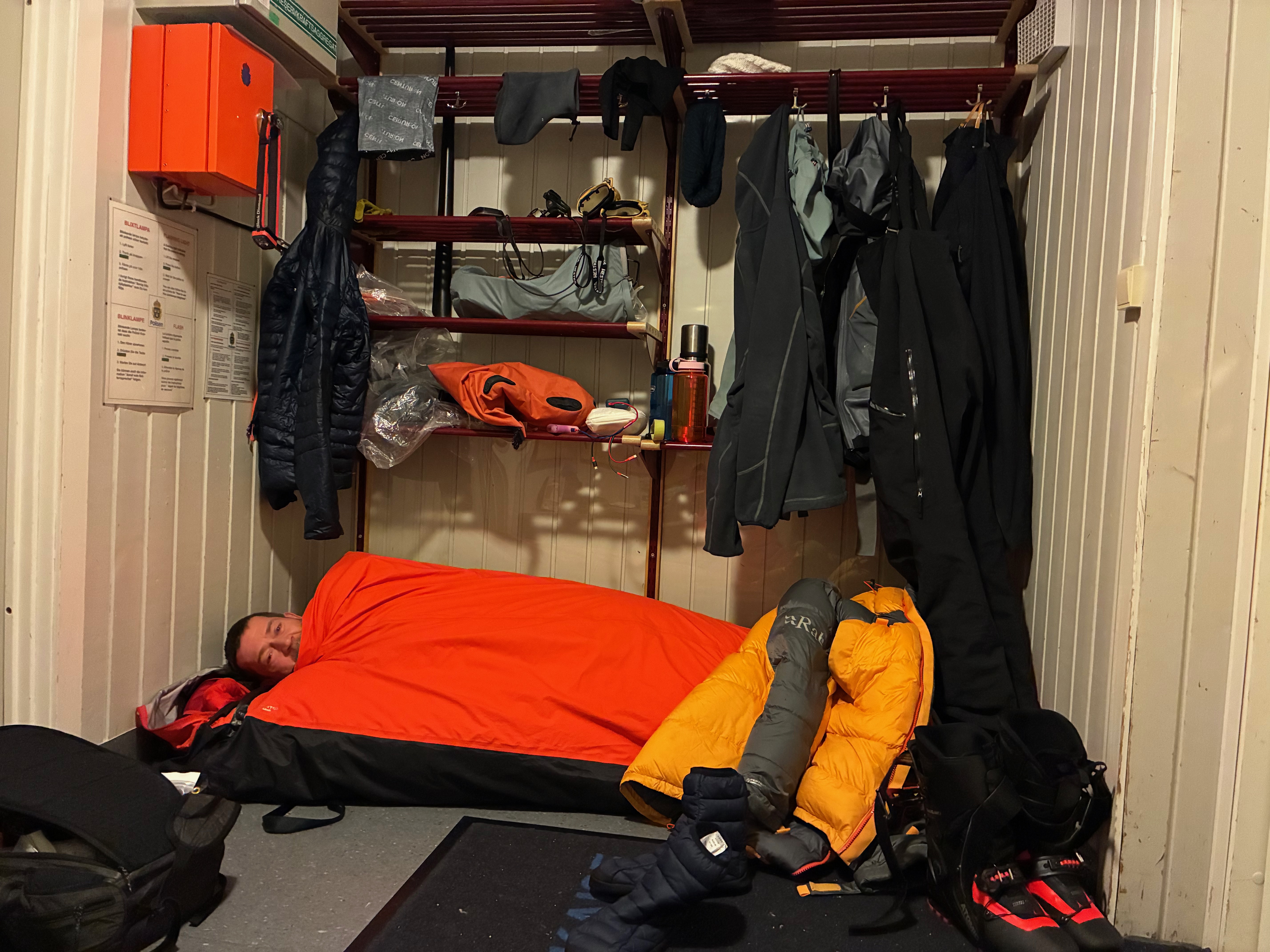
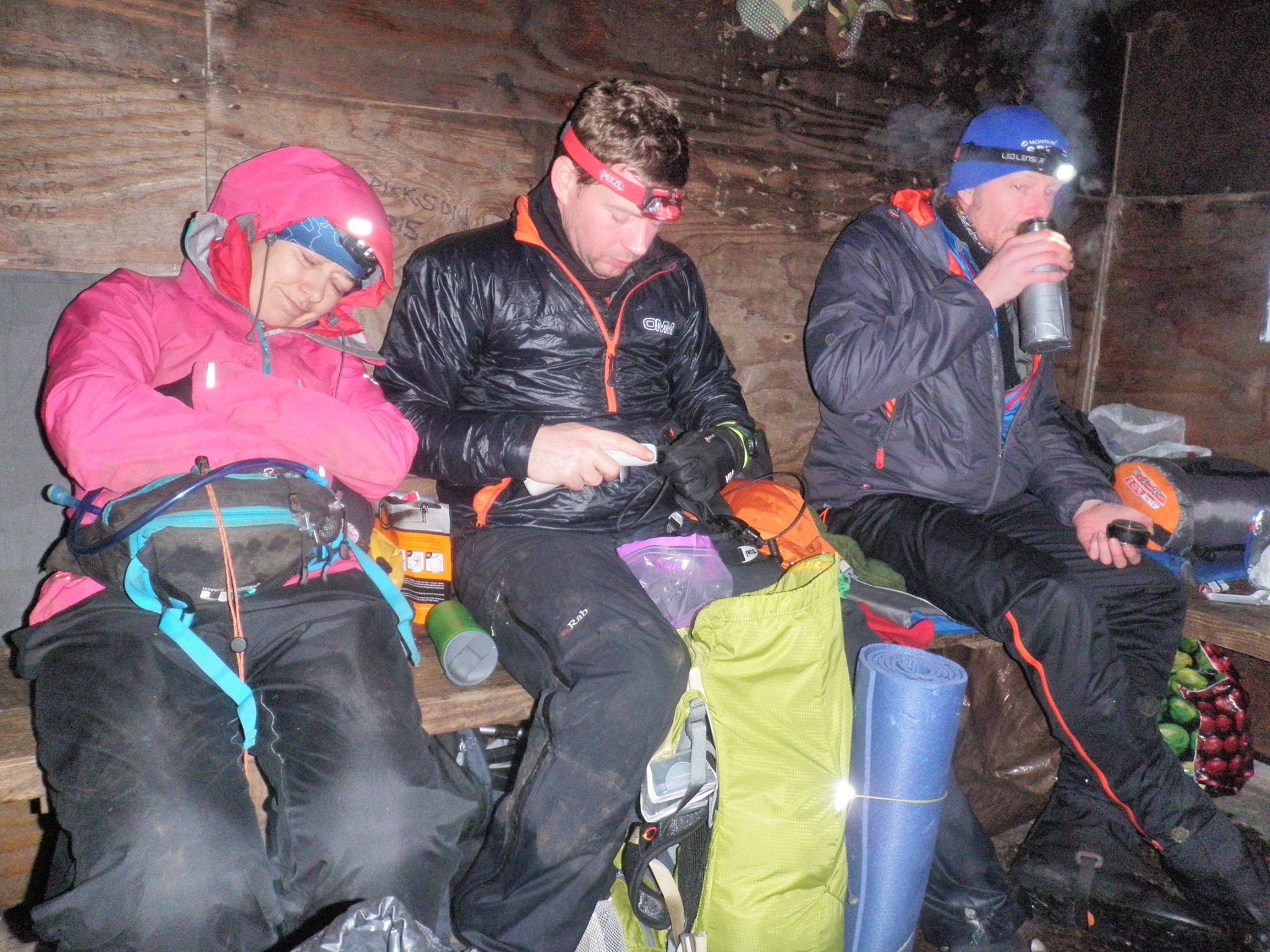
We file into our dormitory, banging rucksacks against each other and the narrow doorway. There is one very wide bed, large enough for nine. At least we won’t have to snore into each other’s faces. We’re on the top floor of the hut, the toilet is one floor down. For a group of old blokes, that’s just annoying.
Giles opens the window, even though it’s already minus 10 degrees outside. “You lot stink, and that’s before Ewan’s had his vegetarian beans for supper.”
Nobody wants to be nearest the door, but nobody wants to be pushy and claim the best spot. I’m tired and hungry and need to sit down, and throw my bag into a space somewhere in the middle. “There is a shower isn’t there?” I ask nobody in particular. Apparently not. I have a clean set of base layers for the huts and the last day. It seems a shame to put them on when I’ve been dripping with sweat all day. I suppose I’ll just get used to the stench, I usually do.
Kev and his mangled feet opt to stay at the hut, Ewan goes for a nap. The rest of us head up the nearby glacier towards the Similaun, a “very easy summit.”
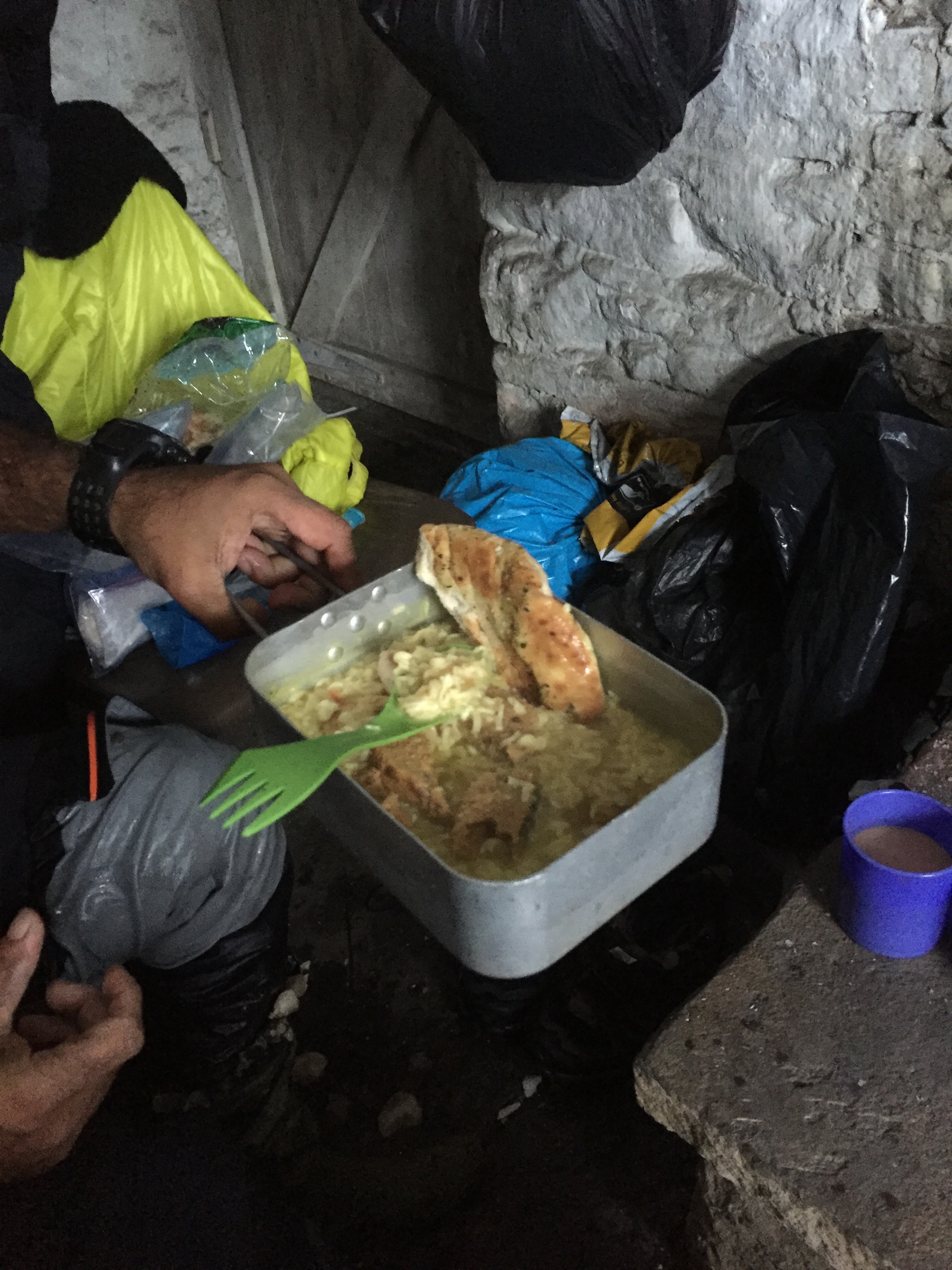
Stopping to faff around with kit I take the opportunity to eat the sandwich I made earlier. The mountain bread is not light and fluffy, it’s more like thick cork floorboards. I’d applied a liberal amount of butter to counteract the density, wedging in some cheese and mystery meat as an added treat. The guide crunches over, “do you want the rope? I don’t think it’s necessary.” Well no, you’re a guide, I’m a software engineer from South London. “Ok,” I say, glancing at him briefly, “I’ll see how I go.” I look back at my lunch, then glance longingly at the hut far below. I could be drinking beer and swapping foot maintenance tips.
The guide goes first, then me so he can keep me safe, I hope. Then Chris and Giles who seem completely relaxed. Maybe it’s practice, but I’m sure either I’m missing something important, or they are.
“Turn your feet sideways, put all of your points into the snow.” Fine, but this is making it really hard to avoid looking into the void on either side of me. I sort of crouch and twist my head so all I can see is a small area around my uphill foot. All my focus is on making sure each footstep has enough purchase to hold my weight.
I bump into the guide. He’s stopped in front of a ridiculously big rock, which is obnoxiously in the way of our route. “Rope for this bit,” he says. I just nod and clip the loop into my harness, giving it a good pull to make sure it’s tight. I glare at the rock until I hear the others arrive behind me. I follow the guide, really bloody quickly. Ridiculously fast, though it does have the side effect of occupying my entire head. “No!” he shouts, “the rope must be tight between us, so if you slip I can brace you, otherwise we both fall.” Oh … right.
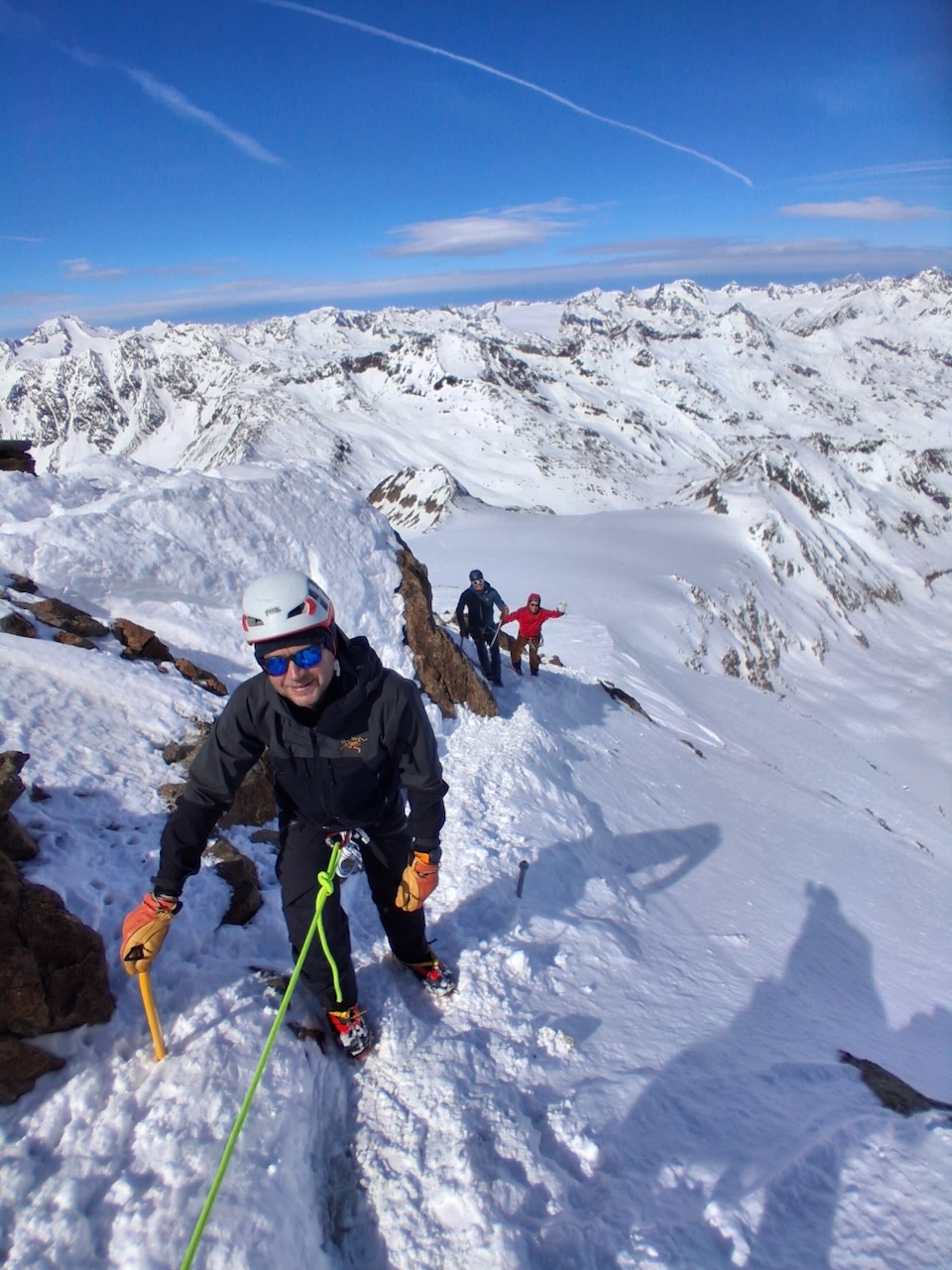
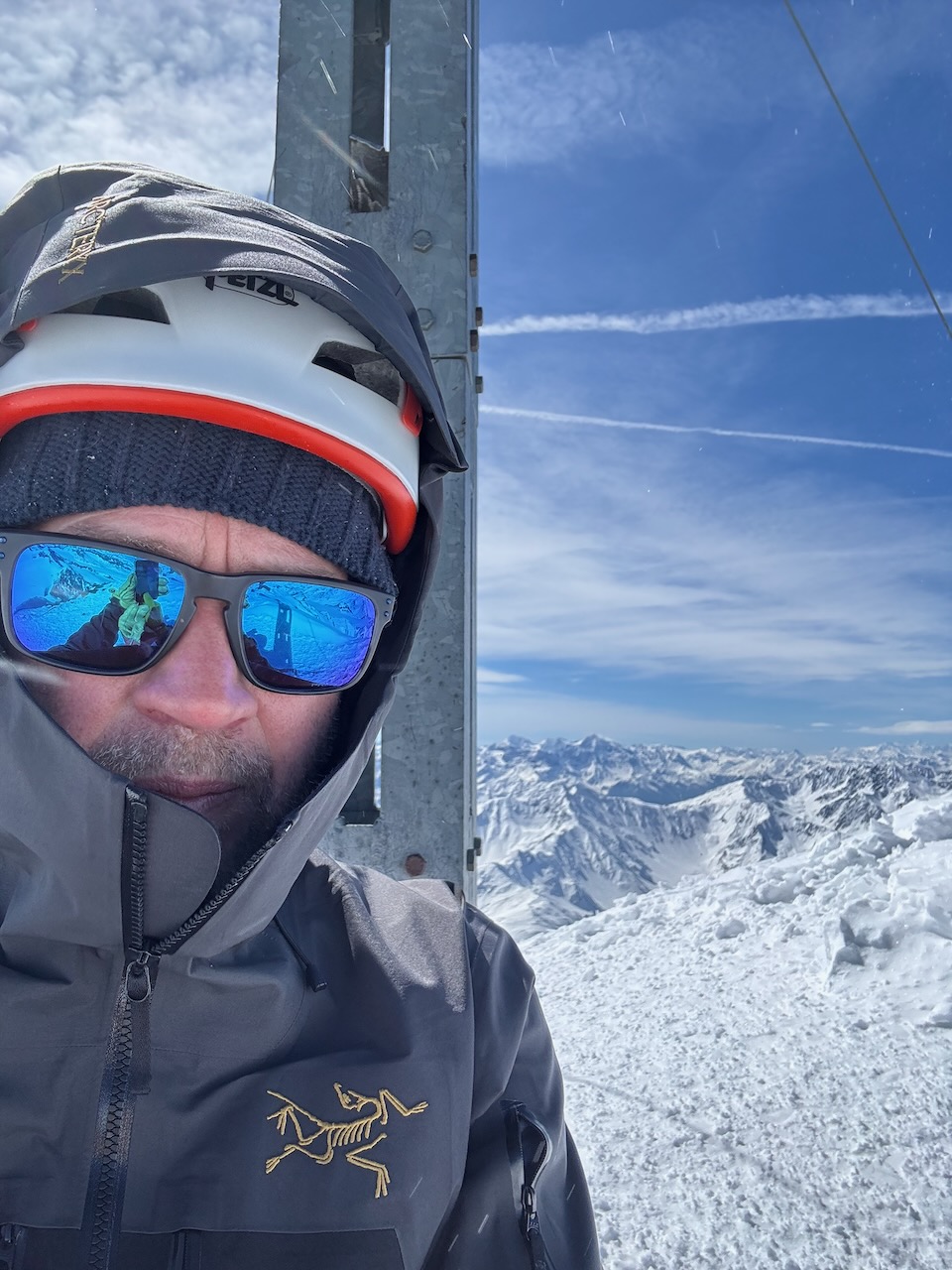
At a much more leisurely pace we continue until there is just a very narrow but almost horizontal ridge between us and the summit. For some reason it has a huge metal cross embedded in a block of concrete on it. The distraction shifts my focus from my feet and I feel slightly dizzy. I’m suddenly very aware of having nothing to hold on to but a thin green rope attached to a much lighter human.
I sort of shuffle along, which is really hard when wearing crampons, and wrap an arm around one of the taut steel wires bracing the cross. When I put my hand up for a high five the guide just grins and wraps his arms around me, “you made it!.”
There is no sign of Chris and Giles, which is weird, maybe my burst of speed earlier opened up a big lead. Without letting go of anything solid I manage to take some photos, then the guys appear. “Crampon came off!” Chris shouts. We all shake our heads, “fuck’s sake Chris, what was the point in saving 30 grams if the bloody things don’t work?.” “Yeah but I really like the colour,” he grins.
We bounce gracefully down the glacier to the hut afterwards. I manage to keep my face out of the snow, and we arrive just as the wind really starts to pick up. There is just one other group here, everyone else cancelled and is further down the valley. It feels luxurious having all this space, which is just as well as we end up being stuck there for the entire next day.
With nothing much to do my adrenaline levels return to normal, and the feeling of elation gives way to something else. The final ridge walk to the Similaun keeps looping in my head, details present that I hadn’t noticed at the time. I wouldn’t say I’m scared of heights, but I’m definitely worried about falling off something high. Perhaps they’re the same thing.
“Umm Chris, question for you.” We’re in the dorm, reading and dozing under thick blankets, there is ice on the inside of the windows.
“Go for it mate,” he says sleepily.
“You know how I get a bit wobbly on exposed bits, does that ever stop?”
He props himself up on one elbow and looks over. “It does, the more you do it, the more you trust your kit, and the more you trust your kit, the safer you feel. Like you were on that dodgy traverse with the wire.”
“Ok, so it’s normal to feel like this?”
“It is, and yesterday wasn’t easy at all, you did really well.” He smiles.
“Thanks mate.”
“Alright lovebirds,” Giles pipes up from his woollen cocoon in the corner, “is it time for a weissbeer yet?”
Eventually the storm eases off a bit, we can just about stand up without being blown over. The process of getting back to civilisation is mostly a straightforward descent down a valley. The obstacles are only avalanche debris, ibex and the occasional chamois.
We pop out in Vent, at the bottom of a ski run. Exiting our multi day wilderness bubble feels a bit overwhelming. Luckily there is a bar opposite the bus stop and the next one isn’t due for an hour.
Giles, beer in one hand, some sort of cocktail in the other, is poking at a pile of gear with one foot.
“So Chris, what unwanted kit are you selling us for next year? Kev needs some new boots.”
They creep up my chest, slip around my ribs and slide up my spine, searching for a way in. I can feel them through three layers, thin and gentle at first, then harder, testing seams, pressing zips, hunting for skin.
I stop, exhaling billowing clouds of vapour into the -30 °C air. Kirstie’s headtorch bobs around somewhere behind me. Ahead, the valley is just an empty black hole in the mountains and a faint line of snowmobile tracks. No shelter. No lights. No room for mistakes.
I pull off a glove, then the liner, and push my bare hand under my jacket. My base layer is wet.
You sweat, you die.
Phil’s voice, from a warm classroom three days and a lifetime ago. Back then it sounded like scaremongering. Right now it feels final.
The sensible thing is obvious: stop, pitch the tent, light the stove, strip off the wet layer, wait until I’m warm and dry.
The racing part of my brain has other ideas: it’s only a couple of hours to the hut, just push harder, keep moving, you’ll be fine.
I stand there, heart hammering, the cold licking at the sweat on my skin, and realise this is the first real decision of the race.
A month earlier I’d joined a guide for a day’s ski touring in St Anton. I needed to test my skis and new boots, and it seemed like a good chance to check my mountain legs too. It was -15 °C when we started. With a growing sense of trepidation I wondered if my hands would ever warm up. Walking slowly up a valley deep in shadow, I took my gloves off and tucked my hands into my armpits. This jumped straight to the top of my list of fears, up with camping and wind.
As soon as I got home I started researching mittens for arctic conditions. Normally I love hunting for kit, but this time I needed something to stop me feeling sick with worry. Eventually I chose a pair and decided price would not be a factor. It was too important to skimp.
A few weeks later I spotted some windproof ski touring gloves with leather palms and fingers. They went into the kit bag too. Hopefully they’d be perfect working gloves; the idea of putting a tent up in mittens so big I looked like a lobster was not appealing.
To enter the race you needed relevant cold weather experience, which for me amounted to bivvying in a blizzard on Cross Fell during the Winter Spine race , a worryingly long time ago. Phil, the race director, said that because I’d got through that and carried on I’d “be fine” – but only for the 100 km, and only if I joined a three day training course beforehand. The 200 km sounded a long way and I had no desire to take on the full 400 km, so that all seemed reasonable.
As the date of my journey to the Arctic approached, the unease intensified.
“Why do you do this to yourself?” Zoe asked after I’d snapped at her for the thousandth trivial thing. “…and to us,” she added.
I didn’t really know. Maybe I still needed to prove I was as tough as I pretended to be. I’d realised that what had sounded like an exciting adventure was a foolhardy distance from my comfort zone.
I’d started to wonder if I could do the whole thing in one go, avoid the stress of camping and just push straight through. Last year’s winner must have done that, finishing in about 32 hours. Physically I was capable and I could handle one sleepless night. It was the unknown that unsettled me. A hundred kilometers in 32 hours is just a gentle walk. So what was I missing?
I managed to get on the wrong carriage of the train from Stockholm. The conductor cheerfully told me I was five cars away from my cabin.
“And you really don’t want to be here because the train splits during the night.”
Fucks sake.
Laboriously and sweatily I shuttled my massive kit bag up the train, then went back for my skis, over and over. This was not the restful journey I’d hoped for. As I paused for breath another conductor appeared.
“Where are you going?” she asked, brusque but smiling – the Swedish way, I think.
“Er… car 12, Abisko.”
“You’re there. This is your cabin.”
I’d been leaning on the wall opposite it.
Shaking my head at the lack of concentration that had nearly sent me marching past my own bunk, I gratefully piled everything in and collapsed, giving my nerves a chance to stop jangling.
“We have a bistro,” she popped her head back through the door, adding with another smile, “and we have cold beer.”
Perfect. I was okay now. The cabin was tiny – three bunks and just enough standing room – and I’d booked it early enough to have it to myself. The train was old, creaking and clanking, with puffs of ice cold air sneaking through cracked seals. It was going to be an adventure in its own right, but first I wanted a beer, some food, a book, and hopefully some sleep.
A couple of hours before my stop I spotted someone in the corridor with as much kit as me, staring out at snow laden fir trees reflecting the low pink sun. He looked grim and apprehensive. I recognised the look.
“Morning,” I nodded. “Heading to Abisko?”
“I am, yeah. Just been thinking how cold it looks out there. You on the training course too?”
My shoulders loosened a little.
“Yep. And fucking hell, it does look cold. I’ve gone from thinking I had too much kit to not enough.”
We swapped stories and dug out gloves ready for the short walk to the hostel, even though it was a relatively mild -10 °C.
The first day of the course was an intense blur of talks and practical sessions. By the end I was exhausted and heading upstairs for a lie down when Alex, the assistant race director, intercepted me. He has a huge amount of arctic experience, and a way of looking at you that makes you feel like he’s reading your mind.
“Go okay out there today?” he asked, one eyebrow raised.
I nodded, not entirely convincingly.
“I noticed you had your hands in your armpits. Not a good sign for the first day here – and it’s not even that cold.”
“Yeah. I’m not sure my gloves are up to the job. I’m going to try putting my outer mitts over them tomorrow.”
He frowned.
“We had a guy here last year with a similar issue. We pointed it out early. He did nothing about it. He was out of the race before the first hut.”
There were seven of us on the course and I was sharing a dorm with four (Stuart had sensibly bagged his own room; I’d left it too late. Kirstie was sharing with the other girl). We bonded quickly – partly from the growing sense of what we’d signed up for, partly because everyone was genuinely lovely and we all looked out for each other.
Slowly, an idea I’d been trying to suppress started to bubble up: maybe I could win this. Two years of therapy had loosened my grip on big, outrageous goals, but this one had slipped through. It sat in a dark corner of my head, feeding that tense, twisted feeling in my stomach: not just surviving, but proving I was tougher and faster than everyone else.
Most people here say they’re going to take their time, use the generous time limit, a voice in my head argued. You could just go. It still counts.
But what about Carlos? I countered.
Carlos? He’s the wild card. How cold does it get in Barcelona? Is he a cold weather guy?
He’s done the Winter Spine. He must have something.
On it went, until I dragged my attention back to the more immediate problem: not dying of all the things they were warning us about.
The more we learned, the more we realised how little we knew. With hindsight that was deliberate, to sharpen our focus. At the time it felt overwhelming; I could feel important survival information leaking out of my head. I just hoped it left a trace I could reach for when I needed it. One thing I did not forget was to do my zips up after a pee. The photo of a frostbitten todger was burnt into my brain forever.
Our second day ended with a mini “exped” (expedition to you and I), pulks fully loaded, to a forest nearby. The goal was to time how long it took to pitch tents and melt snow for a brew. I opted for hot chocolate instead of tea and was pleased how smoothly it all went. Guy lines tied to trees, neat little camp, snow melting away. Sitting in my tent, I wondered if this was the moment to try bringing the stove inside.
Phil had prefaced that lesson with, “Now, forget everything you’ve ever been told about stoves and tents. There is a way, but you have to be very careful.” It sounded insane. Looking at my stove out on the snow and the cramped nylon bubble around me, it seemed even more insane.
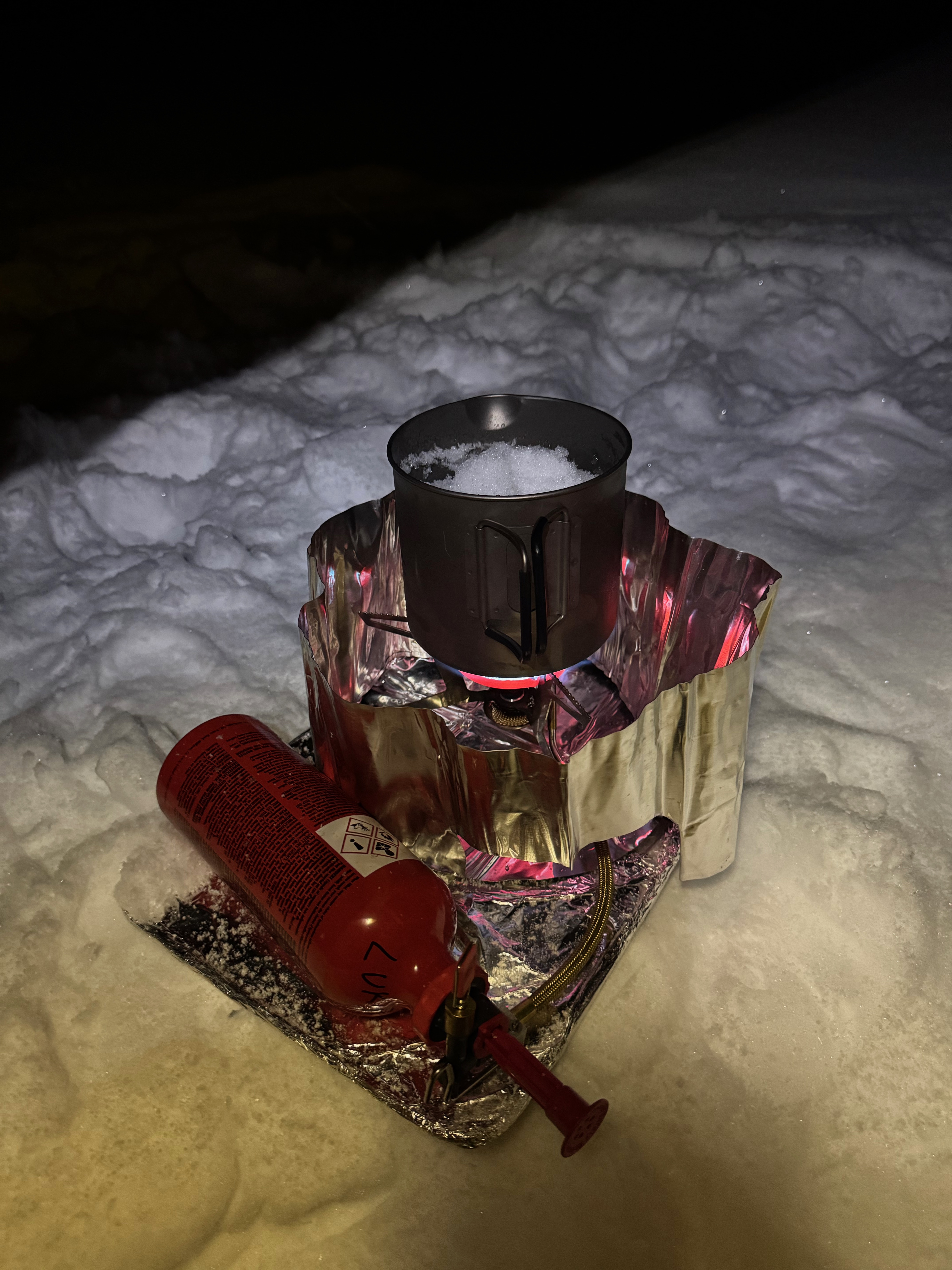
Earlier in the day I’d used some of John Bamber’s wire and my Leatherman to lash my stove to a chopping board wrapped in tin foil. It felt much more stable now. This wasn’t the kind of thing you can practice often – get it wrong and you’re left with no tent – but I figured it was better to try for the first time when I was relatively relaxed and warm, rather than exhausted and desperate.
To my surprise it was fine. Better than fine – brilliant. Within a minute I was toasty and had to take my hat off.
Taking the tent down later I ran into the problem I’d been dreading. I couldn’t do anything fiddly in the huge mitts, so I changed into liner and leather gloves. By the time my pulk was packed my hands were freezing. Jumping up and down, shaking them, doing the penguin dance, nothing worked. It felt like I had icicles instead of fingers, and the low level apprehension escalated to real concern.
I took a leather glove off and clenched and unclenched my fist. Instantly it warmed up. What the fuck? More layers are supposed to mean more warmth, aren’t they?
Then I remembered something Phil had said: air needs to circulate, and tight gloves can choke the blood supply. No blood, no warmth. You can’t wrap an ice block in a down jacket and expect it to heat up; the warmth has to come from somewhere. It’s easier to stay warm than to get warm once you’re cold.
That night Paul offered me some chemical hand warmers, saving me a three‑mile round trip to the supermarket (which turned out to be essentially a giant sweet shop). I tucked them into the “important things” pocket of my rucksack, half hoping I’d never need them, and half knowing I was bound to.
The night before the race I hid in a quiet corner of the library, trying to untangle the knot in my stomach. Admitting I was scared helped a bit, but the dread stayed. I kept picturing a grim trudge through Europe’s last wilderness: frostbite, the demons that turn up at the edge of exhaustion, the sheer effort of not stopping.
Underneath that was another image I couldn’t ignore: standing at the top of a podium, faster than everyone else. I’d never won a race before and the idea felt intoxicating. It would feel amazing. But every time I allowed myself to picture it, a small voice whispered: at what cost?
I felt drained and was grateful when Kirstie arrived with drinks and sat opposite me. She looked even more scared than I felt. Somehow we managed to calm each other down.
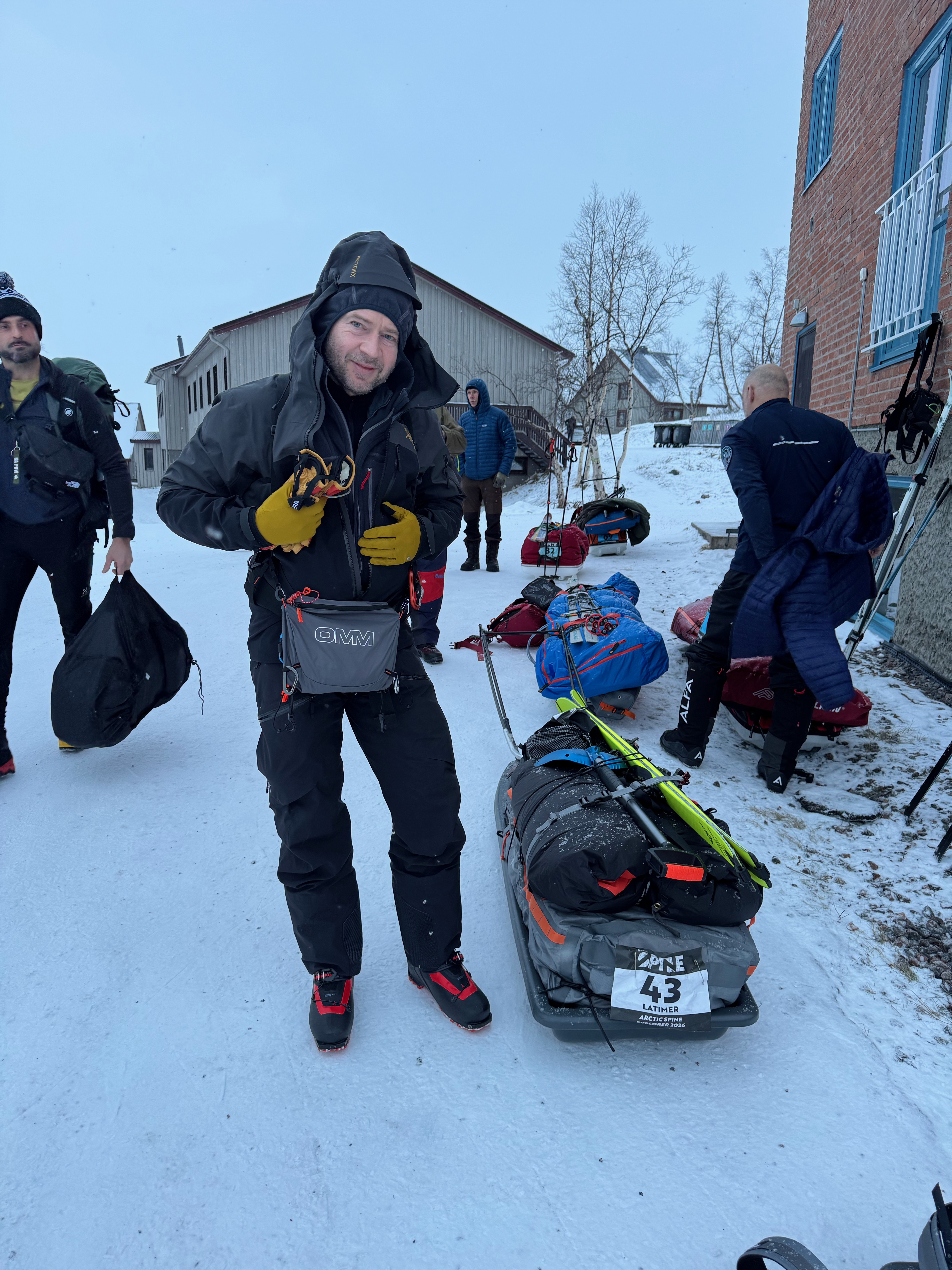
Amazingly we all slept pretty well. At last the waiting was over. We’d packed and repacked our pulks a couple of days before, so all we had to do was eat a big breakfast, make packed lunches, fill flasks, remember to pick up our stoves (two were forgotten last year), and kit up for the 9 a.m. start.
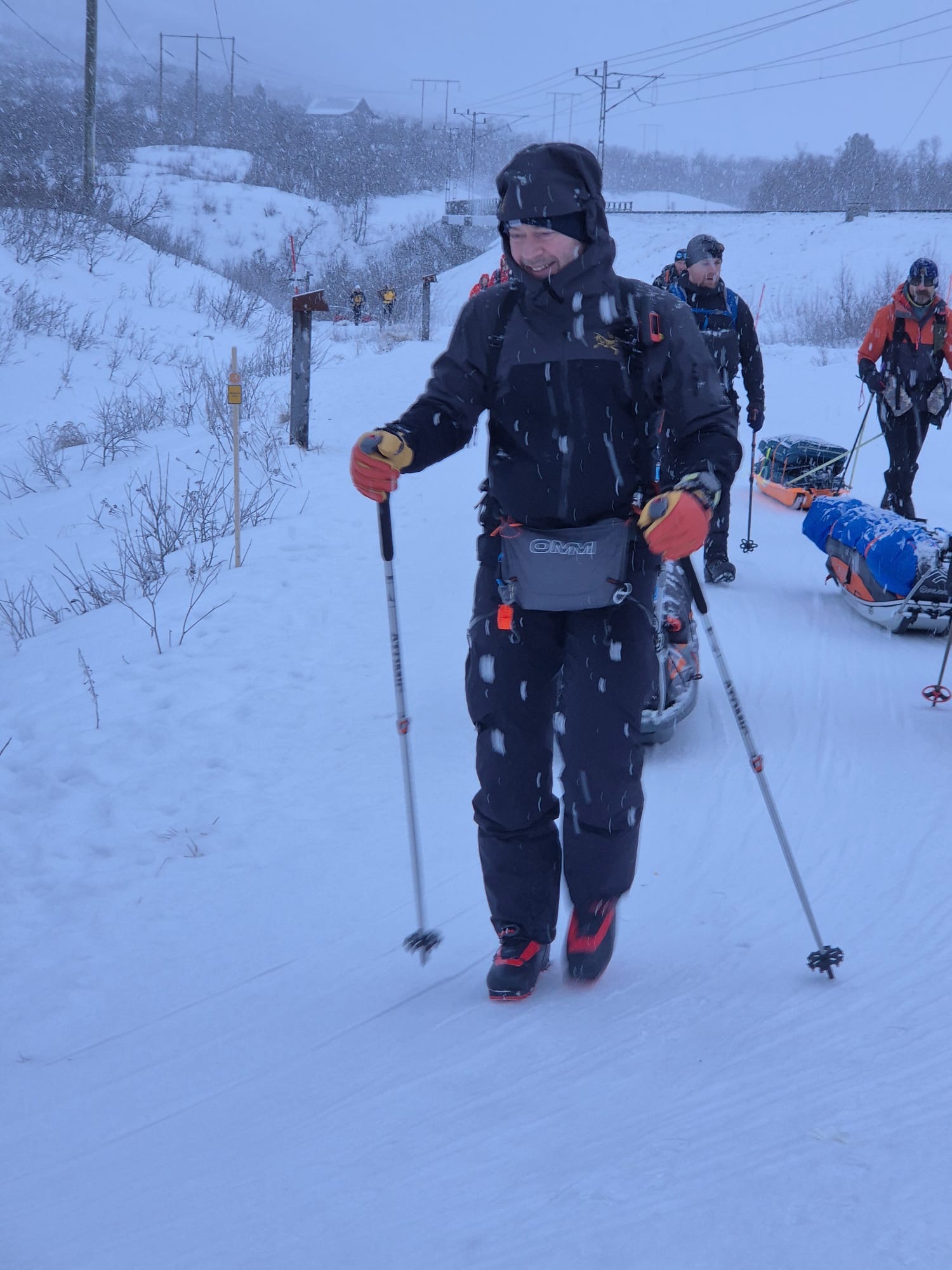
Somehow I ended up near the front as we set off into gently falling snow and the first section through the forest. It was slippery and crowded so most people walked, apart from the Scandinavians who shot off on skis, never to be seen again.
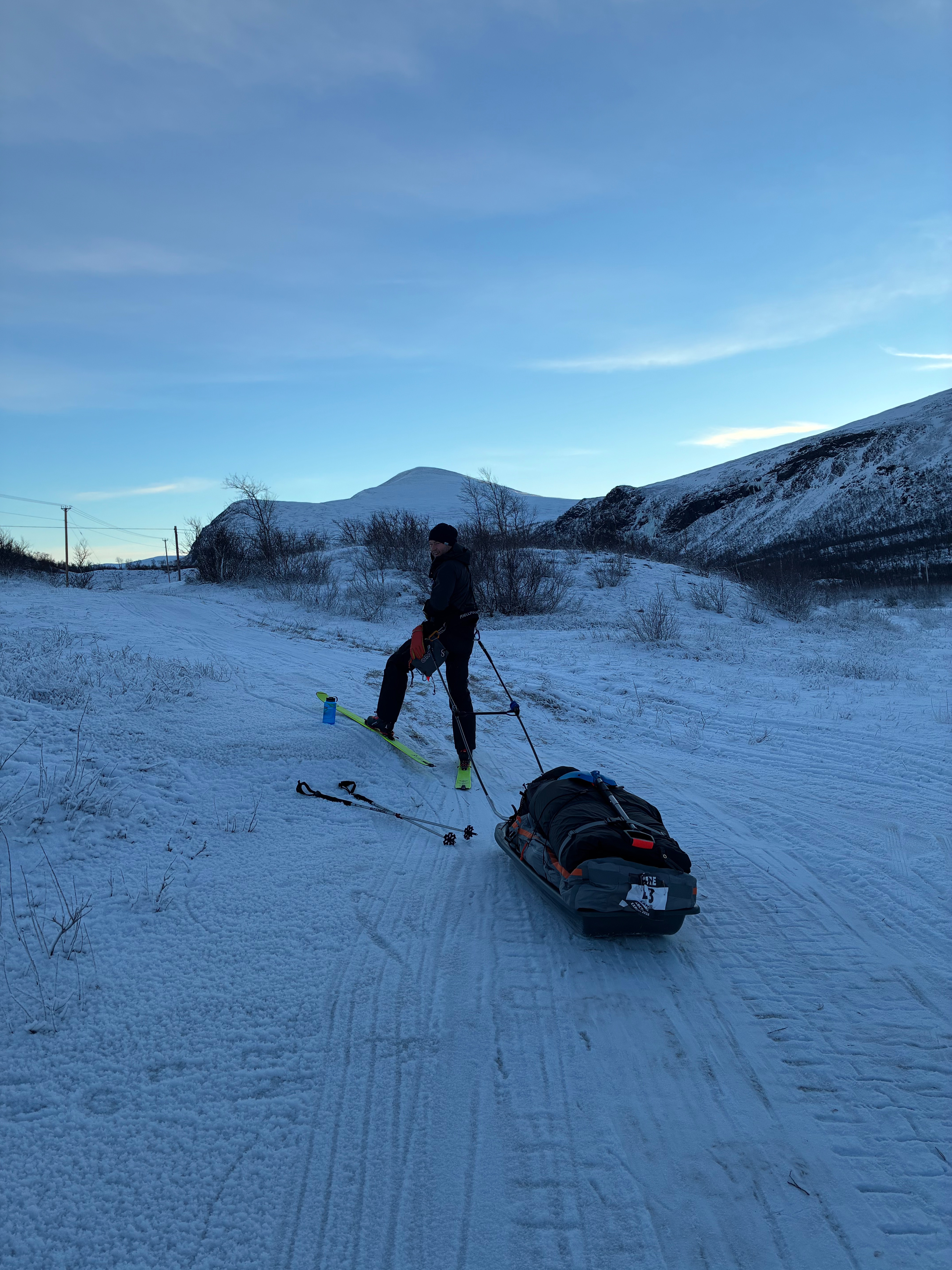
After a while I stopped to clip into my skis and strip off a layer. There’d been hanging around at the start and I hadn’t been brave enough to “start cold”, so now I was sweating – not ideal. People streamed past, which was fine by me. I settled into a gentle “all day” rhythm and decided to see what happened.
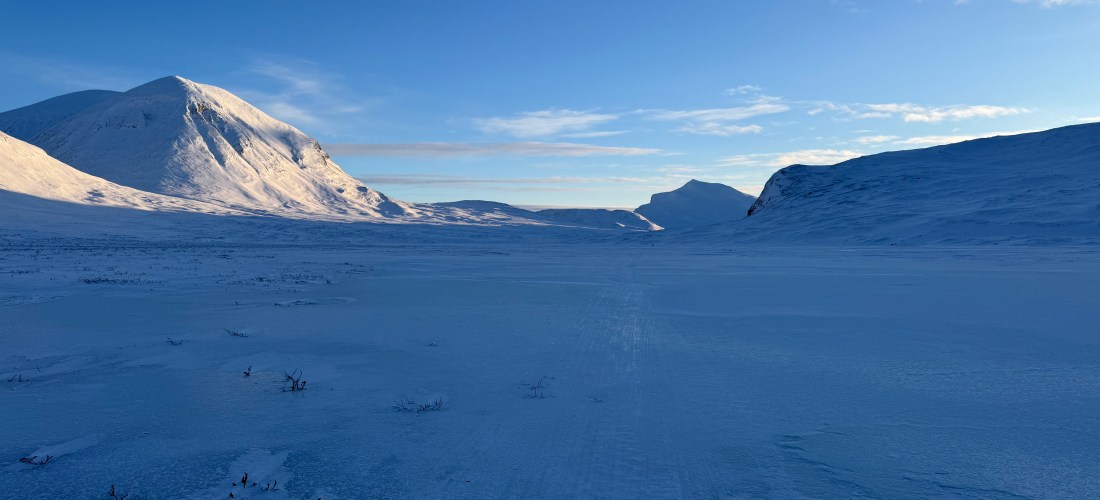
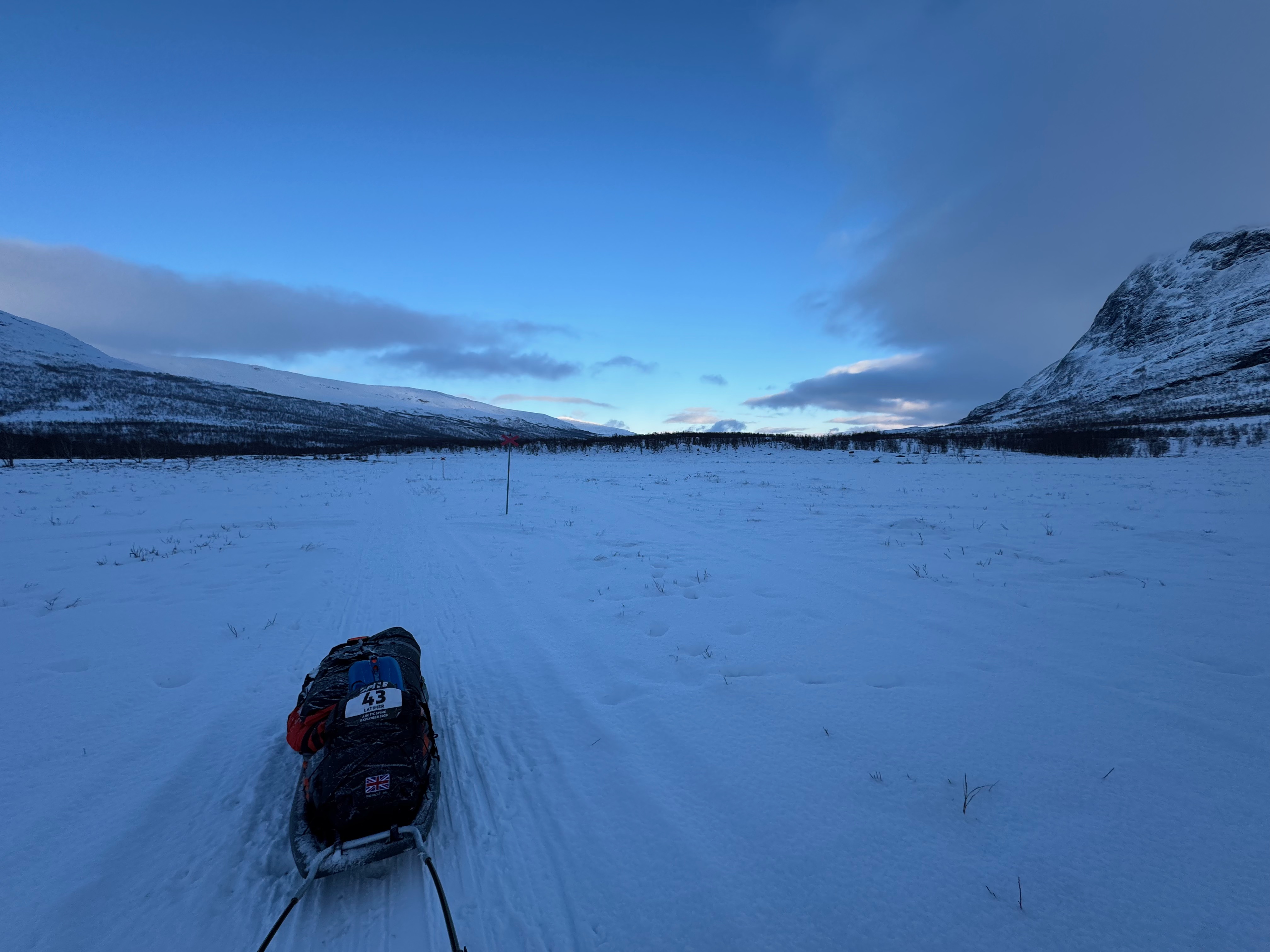
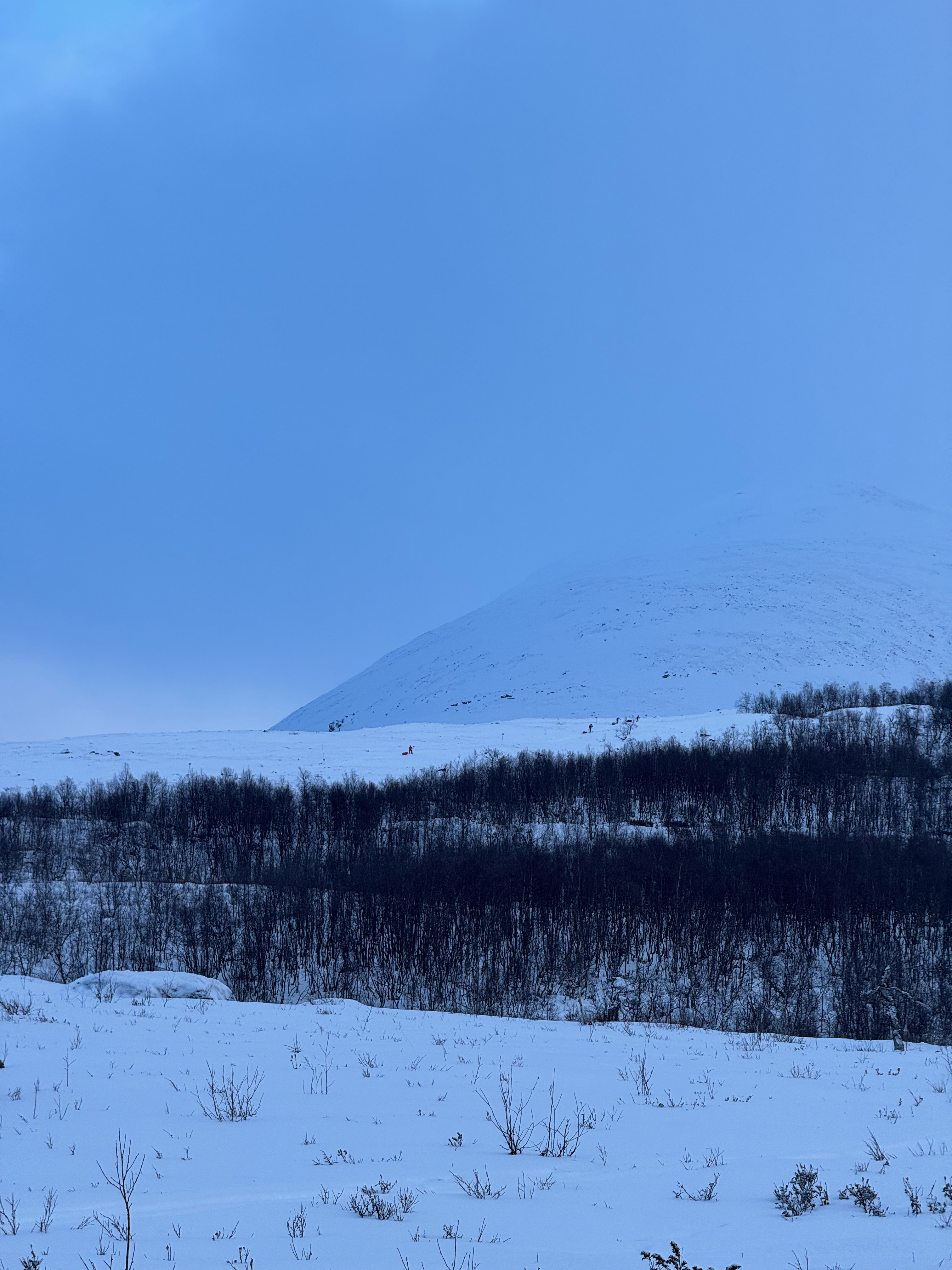
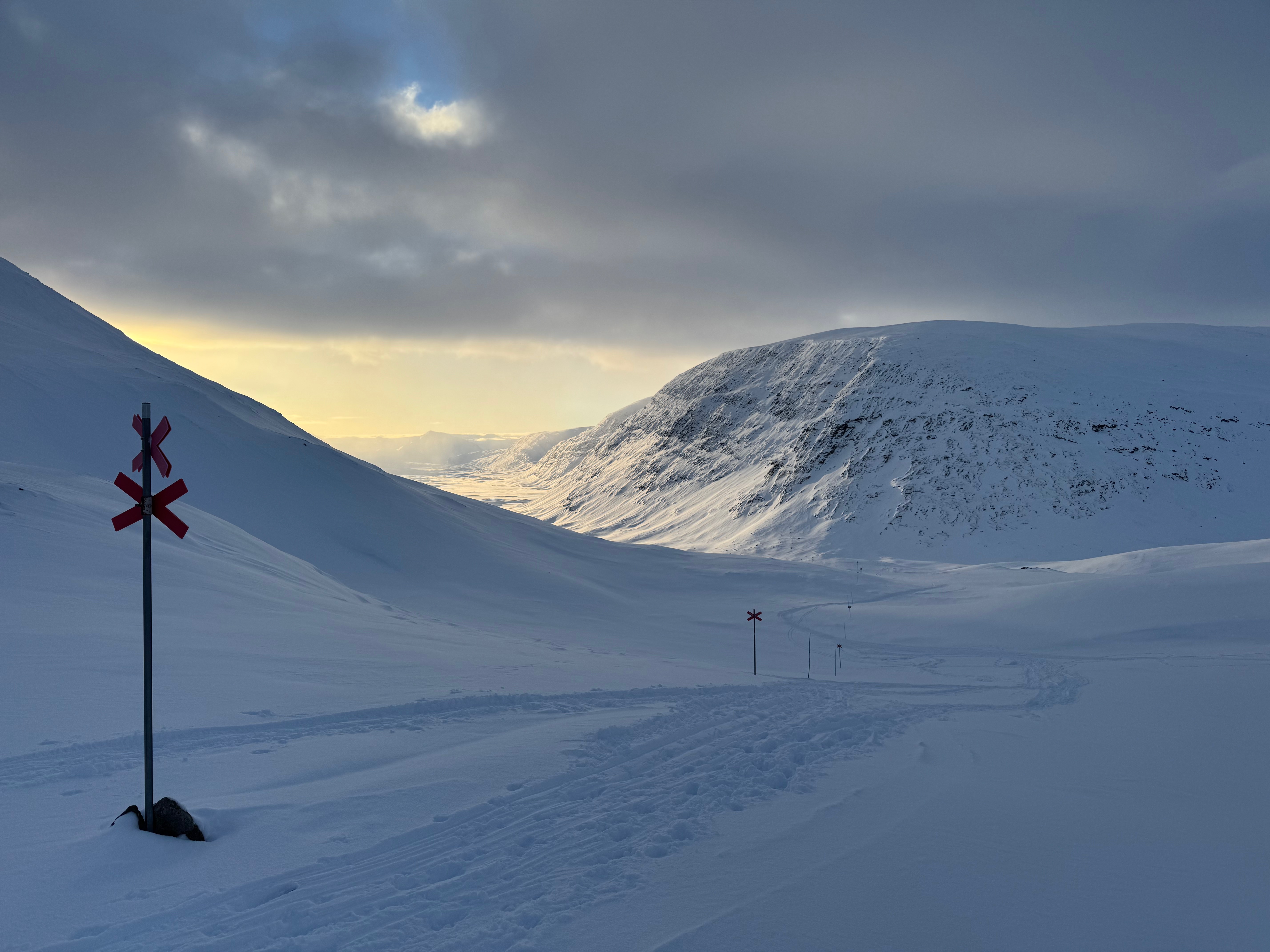
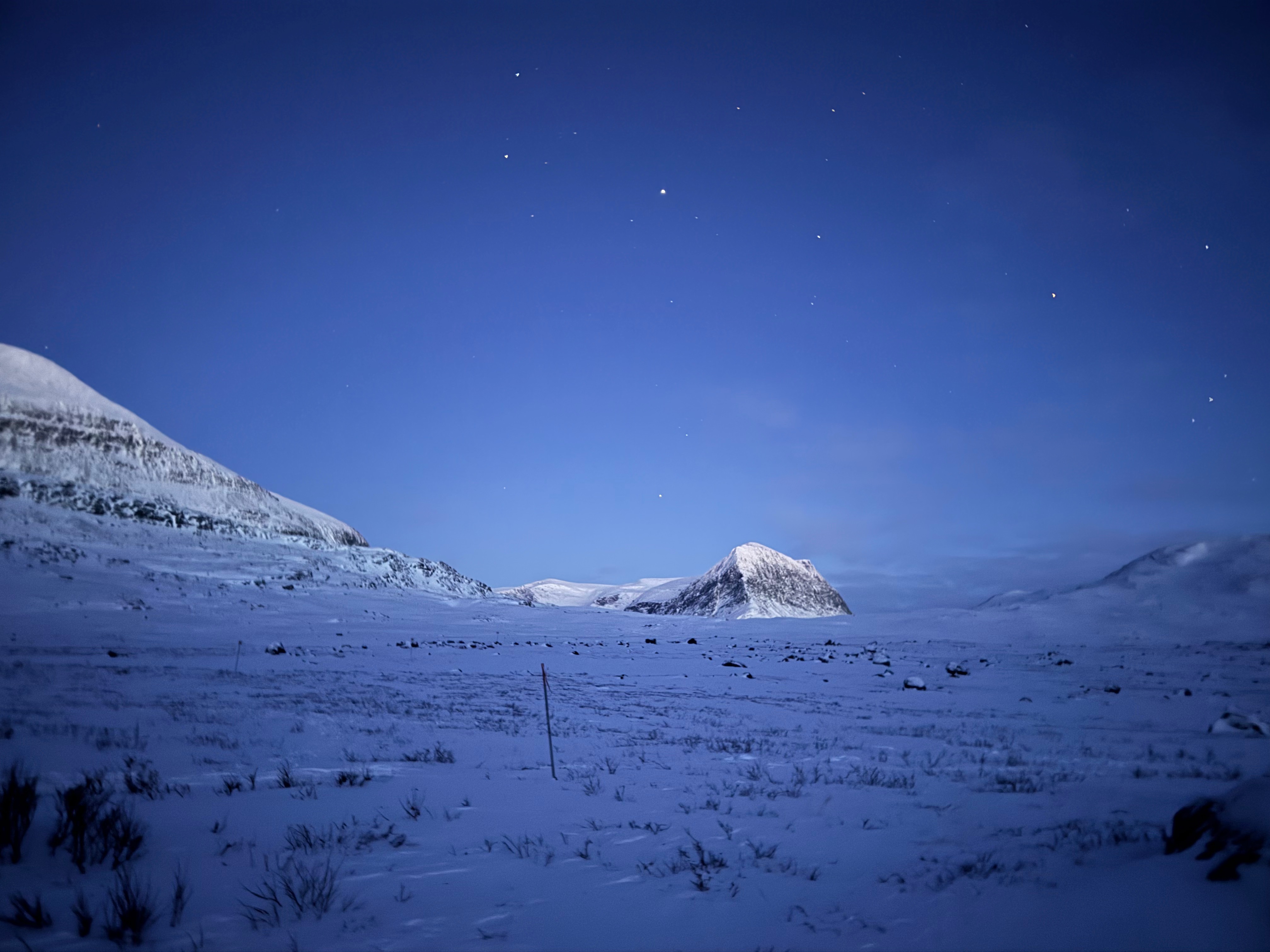
After two hours I stopped for a hot drink and some food. The plan was to do that regularly, to keep calories and hydration ticking over; it’s very easy not to bother, and there was a long way to go. Navigation and cold took up most of my headspace, but I did manage a few photos and a moment to admire the empty valley between snowy mountains.
It was such a relief to be moving. A few times I found myself grinning like an idiot. I’m actually doing this. It’s happening. After nearly a year of preparation and worry I was on skis on the Kungsleden trail, heading into the unknown. It was really, genuinely exciting.
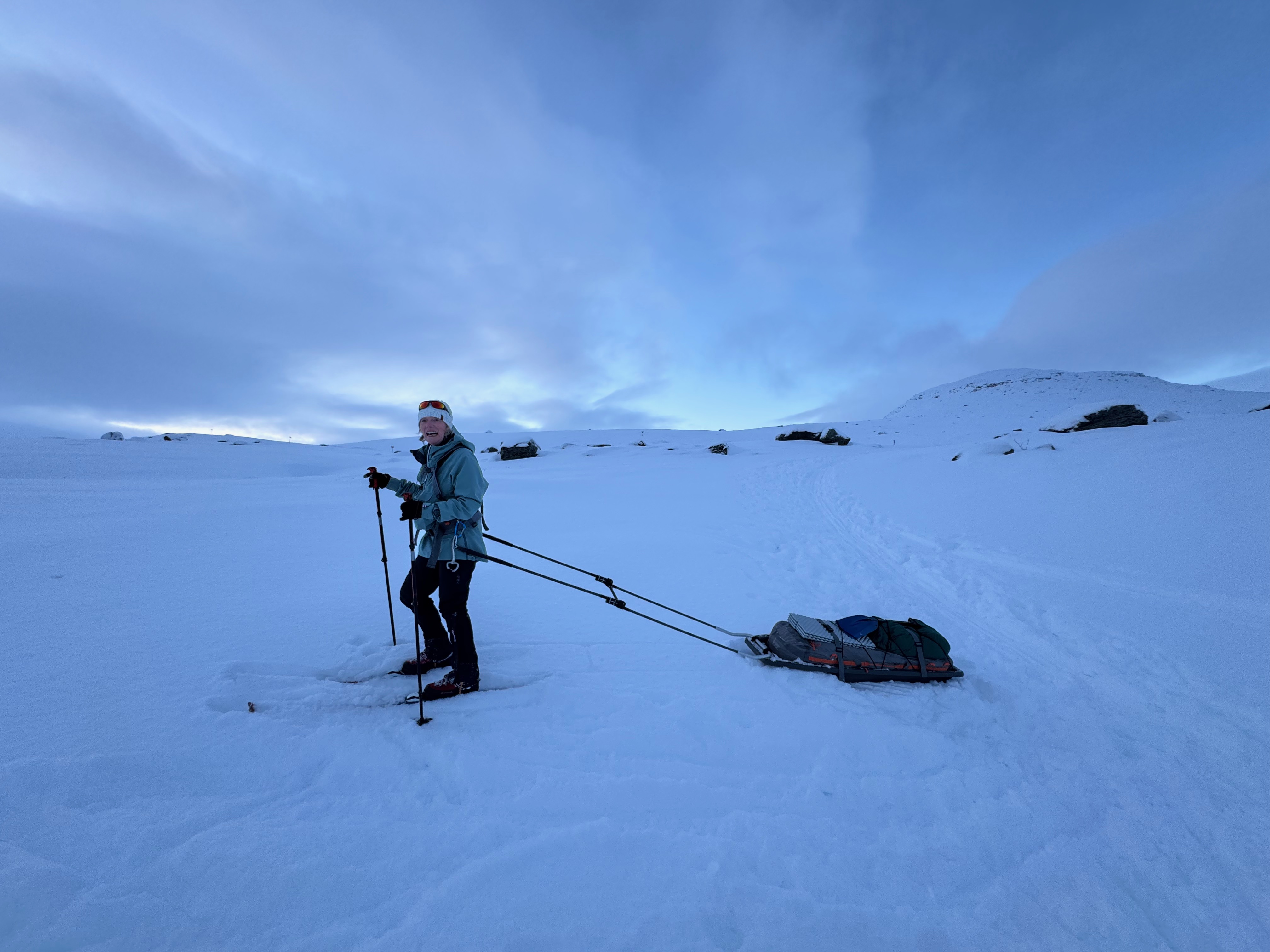
I started to overtake people. By the time I reached the first pass I’d moved far enough up the field to catch Kirstie, who had marched off in trainers hours earlier. She’d stopped to put her skis on; the snow was deep. We chatted for a bit and then moved off together, but I’d stopped longer than planned and got cold, so I had to up the pace to warm up. Thankfully I’d paused just before a climb, so I had a nice incline to work some heat back into my legs.
Part of me relaxed into my stride, happy just to be moving through this wide, white valley. Another part quietly counted every person I passed, nudging that thought back to the surface: what if I could actually win this?
The sun was going down as I headed towards a big lake, overtaking a few more people and feeling warm and positive. We had twenty-four hours to reach the first hut; I was hoping to do it in about fifteen. The real challenge, though, was avoiding sweat. I run hot and it was proving troublesome.
Gloves on, gloves off. Hat on, hat above my ears, hat off. Hood up, hood down, vents open, closed, half open. Constant little adjustments to stay somewhere between “sweaty” and “cold and scary”. I was down to a base layer and shell, even though it was -15 °C or lower. My pace was comfortable, running my own race. Not chasing, not waiting, just moving forward and hoping it was fast enough.
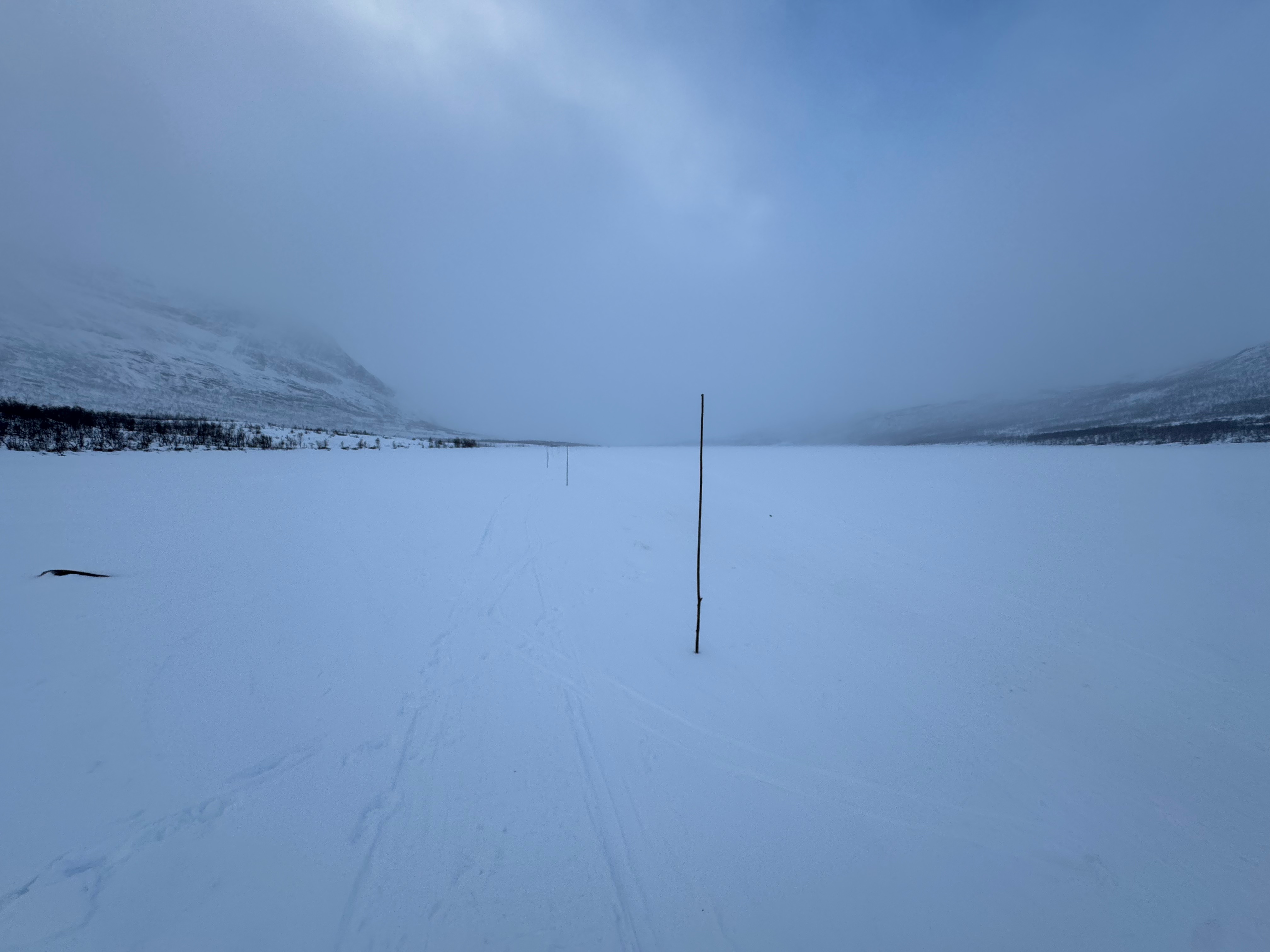
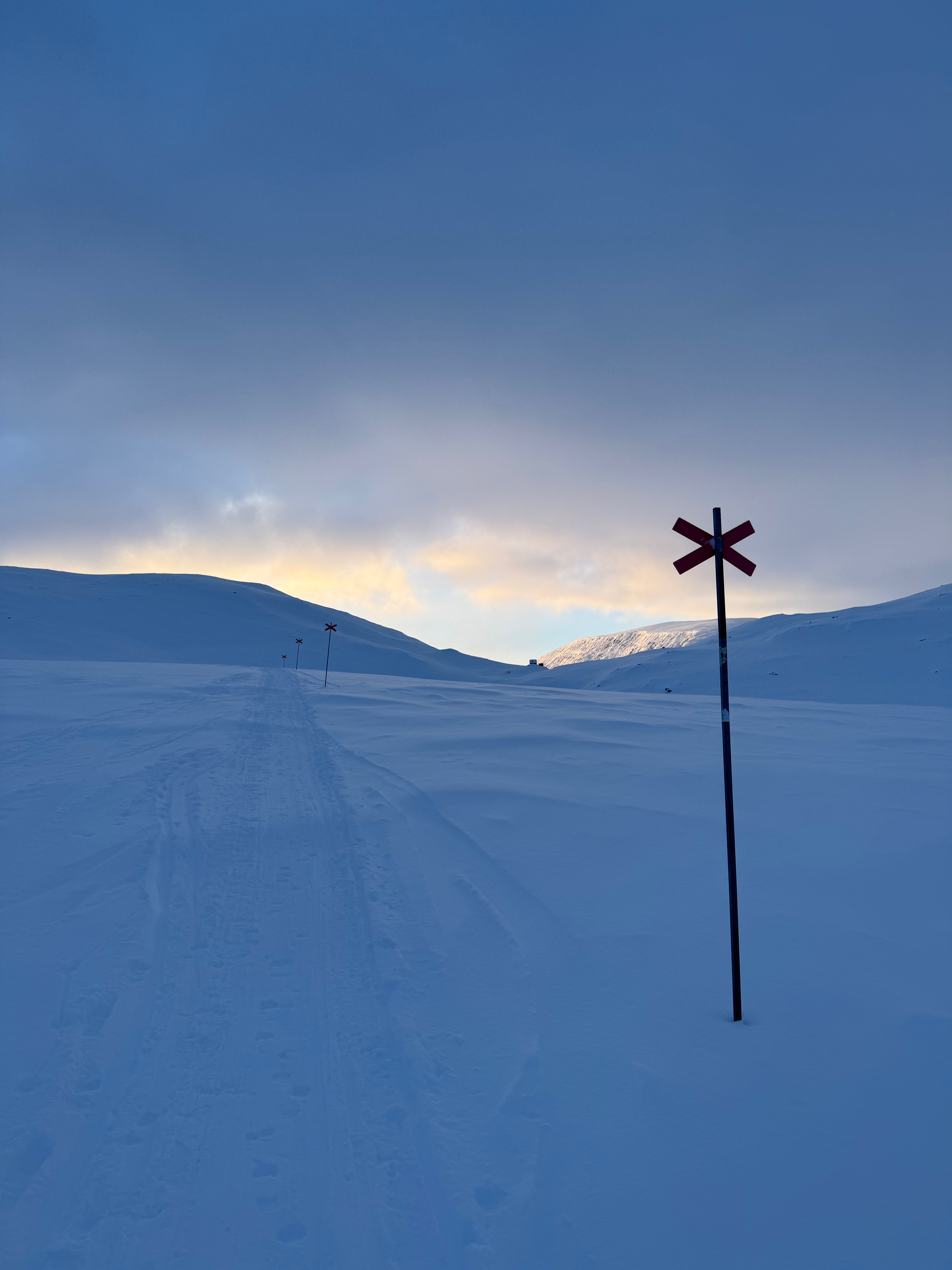
By the time I reached the lake it was fully dark. Red crosses marked the summer trail looping high around the shoreline; my GPX track followed them. On the map that route looked lumpy and hard work. I was hoping instead to cross directly over the lake, and sure enough most of the tracks of those ahead headed straight onto the ice.
The problem was, that line wasn’t marked with sticks. We’d been told that sticks indicated safe water crossings.
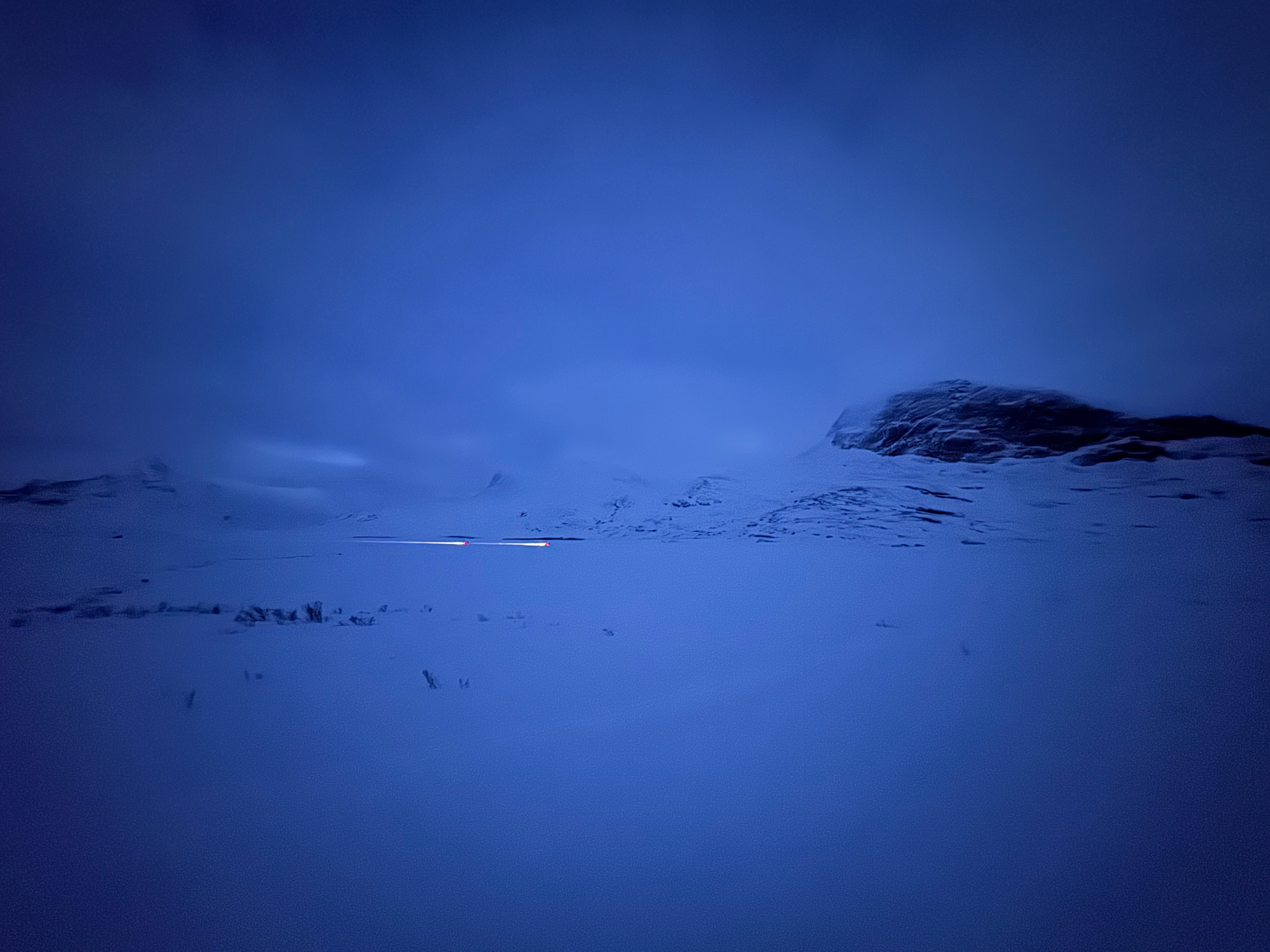
I followed the ski tracks anyway, my sense of impending disaster growing with each glide. Occasional cracking sounds didn’t help. A couple of headtorches swung somewhere high above – people who’d clearly taken the cautious line up towards the hut. Behind me, a few distant lights, at least a mile back. For the first time all day I felt completely alone.
I could hear Phil’s voice in my head, scolding me for blindly trusting a line I didn’t know was safe. Eventually I stopped and pulled my map out. Most of it was already lodged in my brain, but you can’t hold all the details. I was pretty sure I was now on the winter route; last year had been mild, which might explain why my GPX track gave the lake a wide berth. I wasn’t totally convinced, but I knew roughly where I was and which way I needed to go. I decided to keep moving, get off the lake, and stop for a snack at the hut at the base of the climb.
When my headtorch finally picked out the hut above me I felt an enormous wash of relief. It had been bitter on the lake and I’d added a mid‑layer fleece. I reckoned I could manage my heat with vents and hat for now, and if the wind picked up higher on the ridge I’d be grateful for the extra insulation.
There was a little downhill kink after the hut complex. Four or five people were milling around there and I had to do some clumsy turns to avoid either crashing into them or tipping myself and Killian – I’d named my pulk Killian, hoping that invoking someone more competent than me might make me a little more forgiving of its behaviour.
I overtook the three-man military team and the satisfaction of that small victory kept me moving briskly. They were doing the longer route, but I was faster than them right now, and that made me quietly happy.
As I climbed towards the high point the trail became faint. At one stage I thought I’d gone wrong, but the GPX on my watch insisted I was fine, so I kept grinding upwards. Way above, a flashing red light blinked in and out of view. I assumed it was the hut but it was impossible to judge the distance in the dark, with no stars to outline the mountains. Sometimes it vanished behind a ridge then reappeared, apparently no closer.
I was running low on water after more than twelve hours of near constant movement, breathing lungfuls of vapour into the dry air. I’d drained almost all the four litres I’d started with. My watch reckoned it was just a couple of kilometres to go, so I rationed the last few sips, keeping some back in case I needed to melt snow.
As I neared the hut I checked the time: about 10:30 p.m. I’d been moving for eleven and a half hours, well ahead of schedule, feeling good. Nothing hurt, I wasn’t particularly tired, and I’d reached halfway. It’s hard not to extrapolate in moments like that. With a short break, I could be out and over the highest point and well on my way to the finish within an hour or so.
Inside, John Bamber stood over a huge cauldron of hot water.
“Oh bloody hell, I wasn’t expecting you yet!”
“Sorry, can I get some water please?”
“’Course, lad, ’course. Hand me your flasks.”
I could feel myself overheating in what felt like a sauna. Worried about sweating into my down jacket, I stepped back out into the porch to think.
On the wall was a whiteboard with the forecast: -27 °C and dropping. Underneath someone had written:
> Stay safe. Keep warm. Make good decisions.
Make good decisions.
If I carried on, my core temperature would definitely drop. The route from here was mostly downhill, including a section just after the high point where I’d read about people getting tangled in their pulk lines and harness, struggling to free themselves before they got dangerously cold. Back in my warm local pub, pint in hand, I’d decided that doing that part in daylight was the only sensible option.
“How many have come through?” I asked John.
“You’re the fifth.”
Blimey. I really had been moving.
“Did you see Carlos?”
“Aye. He was third.”
I could probably catch him if I left now. I wavered.
The calm, wise voice that had been visiting more often lately spoke up.
Get some rest. Sort your kit out so you’ve enough food in your pack for tomorrow. Dry your sweaty things – they’ll be a problem if you push on. This is an adventure, remember? If you want to come back next year, wouldn’t it be better to have first hand experience of camping in -27? You’ve spent days training for this. Why rush it, be miserable, and increase the chances of dying? It’s going to be even harder to make decisions if you don’t sleep.
Stuffing my refilled flasks into my pack, I clipped my harness on and walked away from the hut into the night.
As I passed a cluster of tents I spotted a flat patch. That’ll do nicely.
I’m going to have a hot meal and a decent sleep, I thought. Good luck to Carlos. I hope he stays safe.
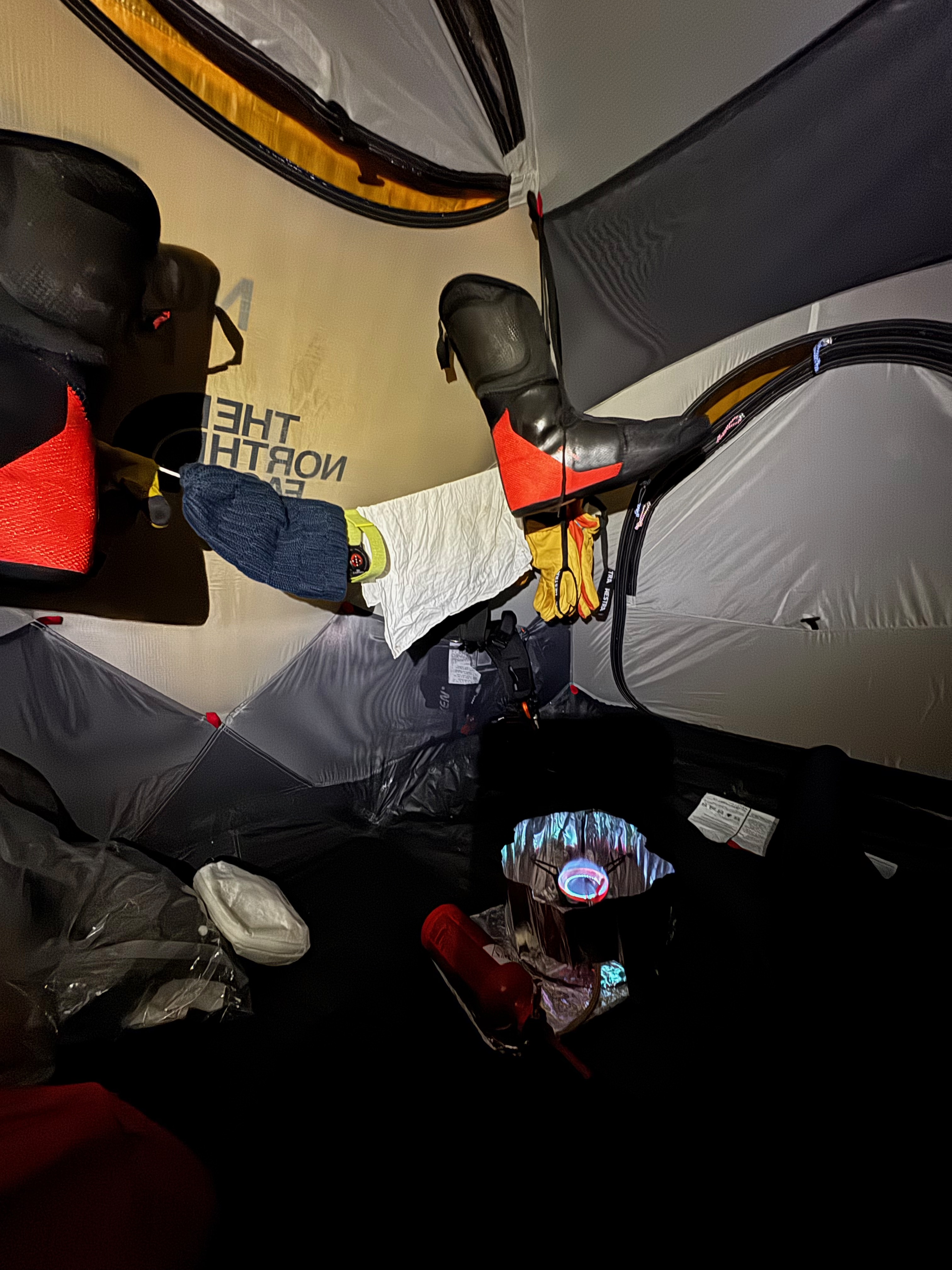
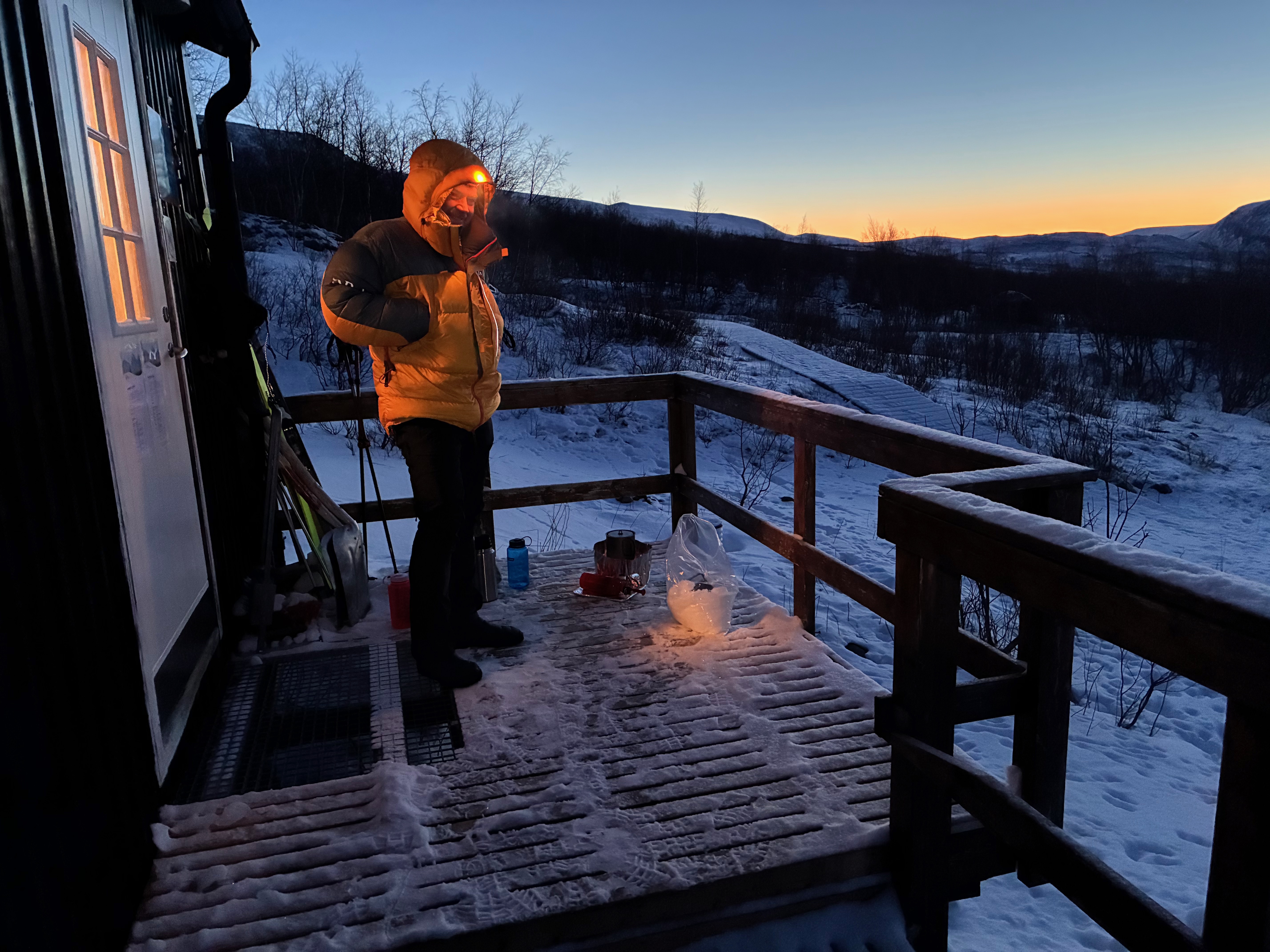
Within twenty minutes my tent was up, a little trench dug in the porch so I could sit properly, and the stove was roaring away, melting snow. I delayered, wrestled off frozen boots, then brought the stove inside to dry my hat and gloves. It was cosy, and the temptation to lie back and drift off was strong, but I forced myself to sit up, sort my bags out, and get hot food going.
I must have been more tired than I realised; everything took forever. It was nearly 1 a.m. by the time I wriggled into my sleeping bag. My feet glowed around a hot water bottle (I’d only just learned you can put boiling water straight into a Nalgene) and I cinched the bag tight around my neck to keep my breath out. As I drifted off I heard Kirstie’s voice outside. She’d made it too. I relaxed a little more. Maybe I’d see her in the morning. I was in no rush now, and set my alarm for 6 a.m., aiming to be back on the trail by eight.
I slept unexpectedly well. I hit snooze a couple of times before accepting it really was time to move. Headtorch on, I surveyed the tent. I needed a plan: once I was up I’d start getting cold, and there would be no time for faff.
My reading glasses were crusted with ice – urgh, mistake. Everything else was frosted too, but that was easy enough to brush off. One of the mantras drummed into us was moisture management. Snow and ice creep into every nook and cranny; if they melt, they ruin your insulation. Down works by trapping warm air; water conducts heat straight from the warm thing (you) to the cold thing (everything else).
My head was foggy from sleep and, as I faffed around making breakfast, the ice on the inner tent warmed just enough to let go and fall as snow. I’d known this could happen but had forgotten. Shit. I scurried around to get everything into the pulk, then brushed the ice into a pile and chucked it outside. Still warm inside my big jacket, I ate quickly, packed up, and got moving – after five minutes of swearing at my frozen boots again. Another mistake: not putting hot water bottles in them when I got up.
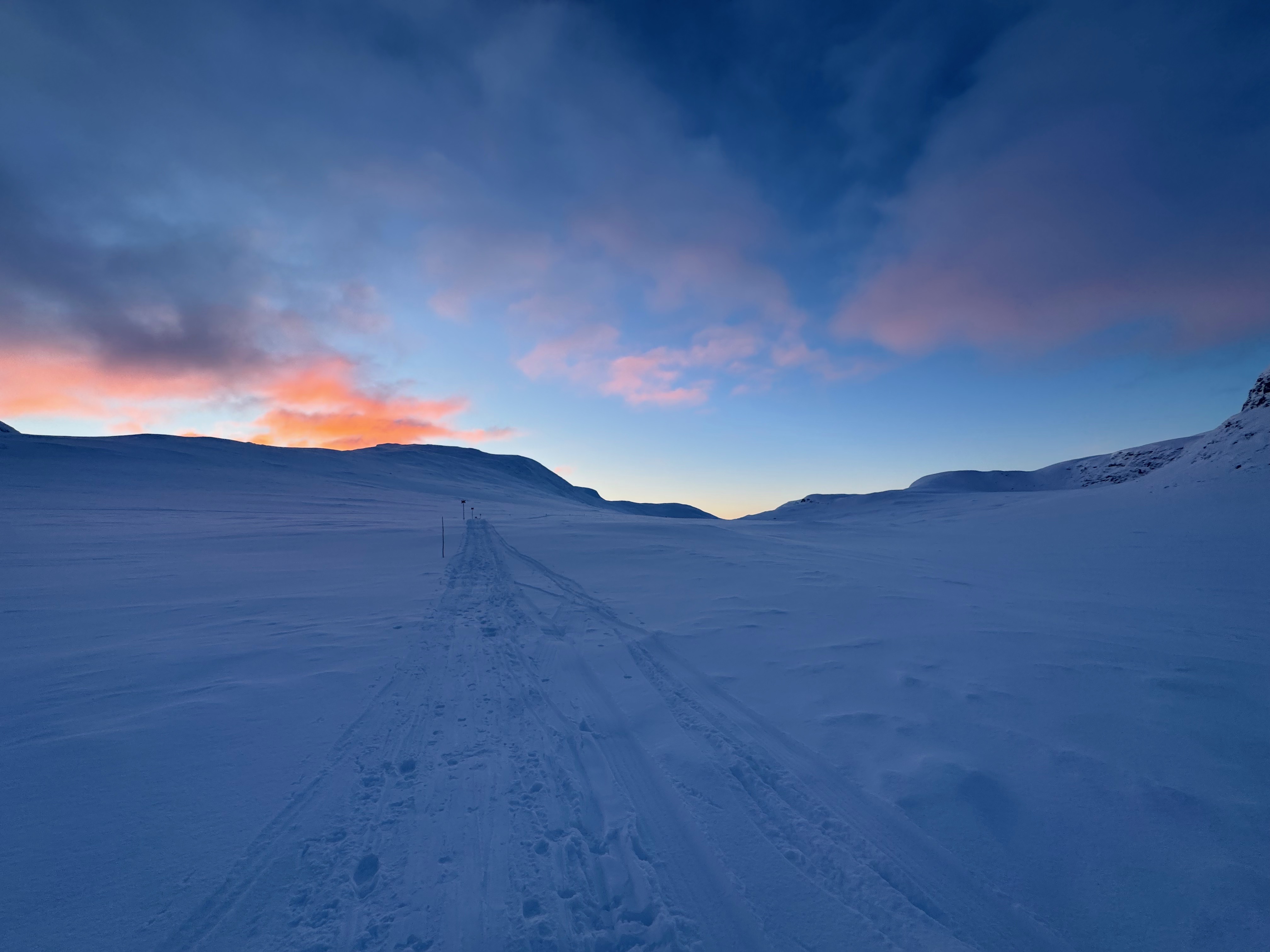
The sun wasn’t fully up yet and the sky was a pale, clear blue. It was the most beautiful morning I’ve ever experienced, made even better by the fifty kilometres I’d already covered to get there. The mountain tops glowed pink behind me. As I slid up the trail I felt rested and happy.
Something in me unclenched. For the first time since London, the knot of dread and ambition in my stomach loosened. I stopped trying to measure everything in hours and places and let myself just move – a tiny dot sliding through a huge, pristine, pink tinged silent valley.
Then I got really, really warm, pulled a layer off, and wondered how many places I’d lost overnight. There had been no sign of Kirstie or her tent; maybe I’d see her later.
I reached the pass quicker than expected and paused. Ahead lay a wide, unmarked snowfield, barely any tracks, just crying out to be skied. This might be my only chance. I whipped my skins off, tucked them inside my jacket to keep them warm, clipped my heels down, and pointed my skis downhill.
It was glorious: soft fresh snow in early sun, blue sky, just a couple of people far ahead. With wide, swooping turns I cruised down, momentarily forgetting I was tethered to a sledge full of kit.
That’s the problem with being too happy – you stop paying attention, yet another thing to monitor. The pulk flipped, threw everything out, the harness twisted, and I ended up face down in the snow. Feeling slightly sheepish, I put it all back together, grateful nothing had broken, and watched Max shoot past whooping with joy. I caught him later and discovered he was a local on a two week holiday, doing the Kungsleden on his own. That was sobering.
The next couple of hours passed uneventfully, apart from meeting another solo winter Kungsleden traveller, Yan from Switzerland. We chatted for a bit; I’d see him again at hut 2, where he’d be very disappointed to find it heaving when he’d been hoping for two weeks of quiet solitude. Oops.
Squinting into the sun, I tried to decide if the figure ahead was Kirstie. The hat looked right, and I recognised the way she moved. By the time I caught up she’d stopped for a break, so I parked up beside her.
“Alright, you badass mum?” I said.
She laughed – always smiling, unlike some of the people I’d passed the night before. “You look happy. How’s it going?”
“I’m having a great day. Time for some spaghetti bolognese, I think. Hot food in the sun – what a spot.” I messed around with flasks and pouches, then settled in to admire the view. “What are you eating?”
Her face fell. She held up a plastic bag.
“Slop. And it’s all frozen into one horrible lump.”
“That sounds a bit shit. How was yesterday? Sorry I left you – I got cold. Long old day, that.”
“It was long, and I kept fainting, which didn’t really help.”
“What the fuck, woman, that’s not good.”
“I know it sounds bad, but I can manage it. I’d just lie down for a bit, get some food in, then move on until it happened again.”
I shook my head, but didn’t tell her she needed to eat more – she knew. Still, there was a long way to go and I was more than a little concerned.
“Um,” I said, rummaging in my pack, “want a biscuit?”
Kirstie’s head snapped up, eyes suddenly bright.
“Biscuit? What sort of biscuit?”
“I dunno… these.” I handed her a blue plastic tube.
“These are Jammy Dodgers! Bloody hell, Jammy Dodgers – Swedish ones. Are you sure I can have one? I can’t believe it: middle of bloody nowhere and you’ve got biscuits. Are you sure you don’t mind? Jammy bloody Dodgers.”
“Of course. I’ve got way too much food” I smiled.
I packed up and headed off, leaving Kirstie smiling and munching. Hopefully she managed to get some calories in and stay warm. You can’t brute force something like this, and I knew she knew that.
The rest of the day passed uneventfully, in that nothing dramatic happened. It was still around -27 °C and I was fighting to keep even one bottle of water from freezing so I could stay vaguely hydrated. The plan was simple: reach hut 2, refill flasks, eat, and then push on to the finish. I’d left hut 1 just before 8:30 that morning and, if I held this pace, I should be done before midnight.
As I wound around the last few hills, skirting a Sámi village, it started to get dark and I felt more tired than I expected. The constant low level vigilance – monitoring cold, sweat, navigation – was draining. I began to question whether a long, dark valley on my own was such a great idea. Maybe I could sleep in the hut instead. There should be an emergency shelter; the safety team would be using the main one, but at least I wouldn’t have to pitch the tent.
I parked my pulk alongside a cluster of others and a couple of snowmobiles, wrapped myself in my duvet coat, grabbed my flasks and stepped out of the wind into the porch of what looked like the centre of activity.
Alex appeared with a smile.
“All okay? I’ll get those filled for you.”
I smiled back. “It’s a bit cold out there. What’s the shelter situation here?”
Behind him I could see wooden tables and chairs around a roaring log burner. Waves of delicious heat rolled towards me, melting the icicles hanging from my eyebrows.
“Sorry, mate. It would be chaos if we let you guys in there,” he said. He was right – and I didn’t really want to melt all the ice on my kit anyway. “The emergency shelter’s closed, but you can use this room here.” He pointed to a wooden door behind him.
“Okay, great, thanks.” I pushed it open, hoping for a little haven.
Nope. It was the size of a small single bedroom, with one bed and a window that seemed to have ice on both sides of the glass. A man sat on one of two stools, spooning some sort of slurry into his mouth, staring at nothing. I recognised that dead eyed, zombie stare from the Pennine Way, though it felt a bit early for that look here.
I perched on the edge of the bed, trying to ease the ache in my lower back, and sorted some food while I figured out what to do next. The smoke alarm needed new batteries and beeped every few minutes. The room was freezing; I kept my coat on.
Paul arrived, then Kirstie, and we had a little reunion and catch‑up. Paul was doing the Challenger and would be turning off onto a different route after this.
“What’s your plan, Kirstie?” I asked once she’d eaten.
“Not camping,” she said, with conviction.
“Same. I don’t really want another eight hours in the dark down that valley either.”
Jack from the media team poked his head in.
“We’ve just come up from Nikkaluokta. There’s a lot of sheet ice down there, and overflow on some of the lakes. Be careful – our snowmobile was skittering all over the place.”
Kirstie and I exchanged glances.
“I’m going to head to the hut about halfway down, Kebnekaise,” she said. That sounded ideal. I pulled my map out, saw I’d circled the hut weeks ago. It wasn’t much of a detour.
“Mind if I join you?”
“That would be great. I’m going to get moving soon though.”
“Okay. I need to brave the outdoor toilet and fix a broken bit on my pulk. I’ll catch you up.”
Thankfully I’d packed a random length of sailing rope. I used it to lash the pulk harness where an O‑ring had vanished somewhere in the snow, then tried not to rush the rest of the packing in case I forgot something important. It was fully dark now and the temperature had dropped further, so I added a thick fleece to the three layers I was already wearing, pulled on a heavy buff, and tucked a hot water bottle against my belly under it all.
Kirstie’s headtorch had already vanished over a lump in the trail. I set off quickly, not wanting to be left too far behind. My hands had cooled and I was grateful for the extra effort needed to get some warm blood moving. The new gloves I’d bought the day before the start were performing brilliantly so far; my enormous “happy mitts” still hadn’t left the pulk.
We arrived at the pass together.
“Bloody hell, I thought you were tired!” I said, as we paused side by side. “Didn’t you say you only had an hour and a half’s sleep last night?”
Kirstie shrugged through a mouthful of nuts.
There was no moon and the sky was clear, thousands of bright stars overhead and walls of darkness to both sides. Our headtorches picked out the snowmobile track easily enough, and the slope down the valley was pleasantly gentle. Ten kilometres or so to go.
We later learned this valley collects cold air like a basin. Out of the sun, it just sits there, pooling and thickening. Tonight it would be the coldest it had been so far. Even at -16 °C the inside of your nose goes crispy, it was forecast to be -30 °C.
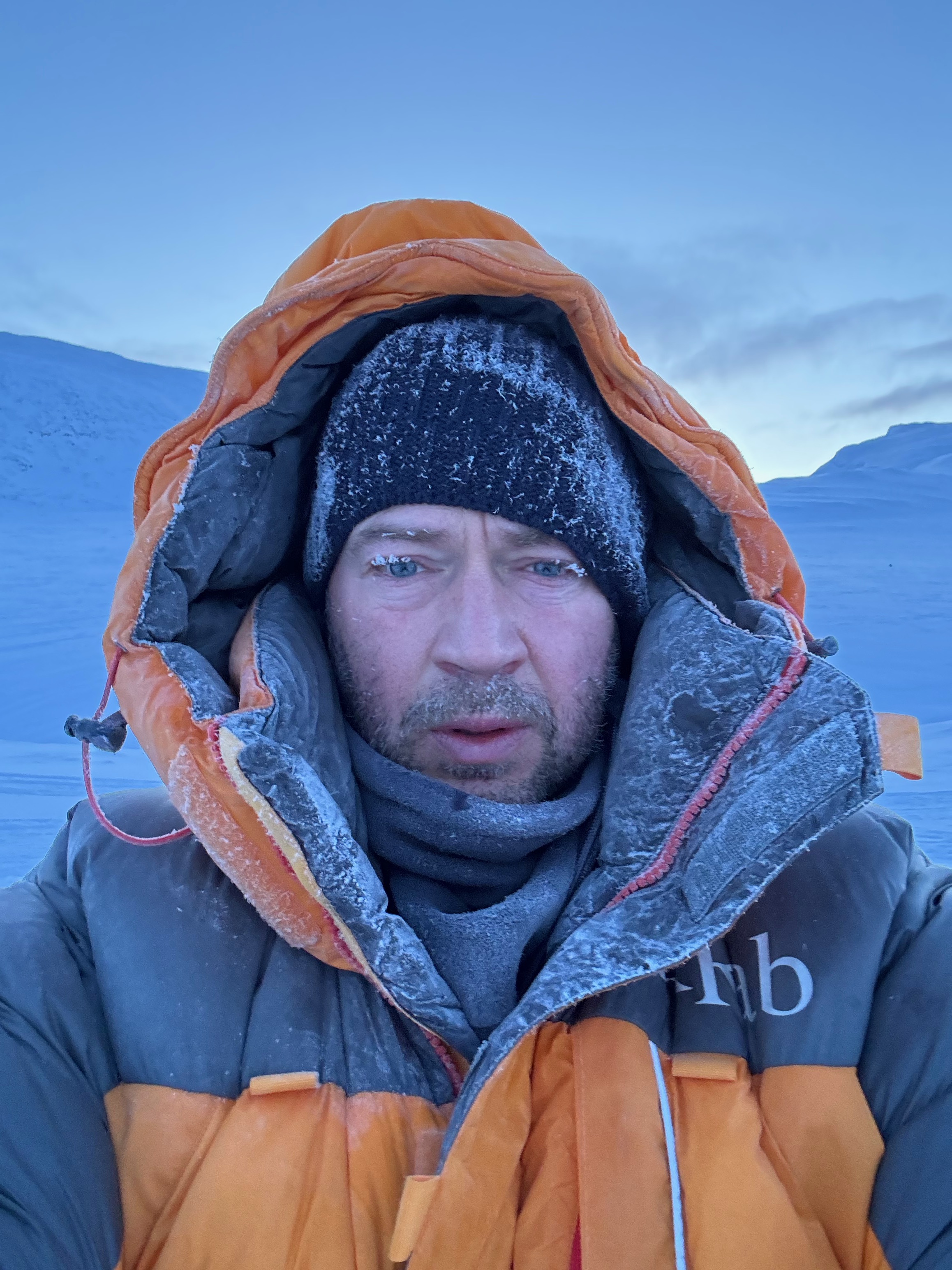
The cold felt like a malevolent presence, lurking everywhere, waiting to snatch whatever warmth it could. Any exposed skin was drained in seconds. When it got frustrated, the wind picked up, probing for cracks in your armour, stripping away any tendril of heat that escaped your layers. It weaponised moisture too. The vapour from my breath froze in my eyelashes and beard. The inside of my jacket had patches of ice where heat and sweat had been sucked through, stolen, and discarded into the dry, empty air.
So when I felt ice cold fingers sneaking up my chest, sliding around my ribs and up my back, my heart jumped. How long before they pushed into my flesh, sending needle sharp claws around my organs, searching for the glowing centre – my heart, the final refuge of my life force?
I peeled off a glove, then the liner, and reached under my layers to my base layer. It was wet.
“You sweat, you die.”
Phil had warned us that slogan tended to scare people. It certainly scared the shit out of me.
At -30 °C water freezes almost instantly. Exposed skin can develop frostbite in ten minutes. Plastic and nails go brittle and snap. The snow stays dry and powdery – too cold to melt and bond – so my snow anchors for the tent had been useless and I’d had to use skis as deadman stakes. It’s not a temperature to mess around in. You do not want to lose your insulation.
Normally, when things start to go wrong, you stop, assess, and decide on a plan. Not here. Not with the temperature and wind gathering strength, ready to strike harder and maybe fatally. You keep moving. Think on your feet.
The voices started.
It’s only a couple of hours to the hut. If we pick up the pace and push hard we’ll stay warm. Then it’ll be fine.
Yes, but we’ll be soaked in sweat, even wetter than now. Then none of the insulation will work.
It’s fine, there’ll be shelter. It’ll be warm.
What if we can’t find it? What if something else happens? It’ll get very cold, very quickly.
The quiet voice cut through.
Is this a good decision?
Silence.
No. It’s an all‑or‑nothing mad dash for safety. If you don’t warm up soon you need to change your base layer. That means putting the tent up, getting the stove going inside, and waiting until you’re warm and dry.
Yeah, but I can’t be arsed with all that faffing…
Can’t be bothered?
I could see Alex’s face, stern and serious.
“Be bothered,” he’d said.
I paused and looked back. Kirstie, head down, walked straight into the back of my pulk.
I thought of the Winter Spine, my leggings drying under a Gore Tex shell as my legs quietly evaporated the water. If it had been sunny I might have gambled on sublimation, where moisture is turned into vapour in the dry air. First, I needed to make sure everything else was ok.
“I’m going to have a quick snack and check the nav,” I said. I wondered if sleep deprivation was finally catching up with her.
“Good plan,” Kirstie replied brightly, pulling out her phone and checking her offline maps. Ninety kilometres in her legs, barely any sleep, not much food, and she was still smiling and making sensible decisions. The perfect companion.
“Trap the heat” Phil had told us. I pulled my buff over my nose and mouth and closed my hood tightly. If I wasn’t warm in half an hour I’d let Kirstie know the new plan.
Eventually we reached the cluster of huts we’d been aiming for. From a distance they looked like a small village: maybe ten buildings of different shapes and sizes, half buried in snow. We parked our pulks and pulled on down jackets.
“How do we find the emergency one?” Kirstie asked.
“No idea. Try all the doors? Maybe avoid the one with the lights on.”
“Yeah. I don’t want to explain why we’re not using our tents. And I absolutely do not want to camp.”
“It’s closed!” she yelled from around a corner.
“It can’t be!” I stumbled through deep snow to her.
“Oh wait, it says use this other one instead. Where the hell is it?”
We started working our way around the huts. Each had a name. Through frosted windows we could see glimpses of cosy rooms.
“They’ve got beds! Do you think there’ll be wood for a fire?” Just the idea of that kind of luxury felt decadent.
“Here, this one!” I called. “Door’s open.”
Kirstie appeared beside me on a wooden veranda running along the front of a single storey hut. We rushed into the tiny porch and swept it with our headtorches.
“Awesome. Let’s check out the facilities.”
Both inner doors were locked, but we found a light switch. There was a bench, some shelves, a satellite phone, a few sachets of instant soup and dried snacks, and a roll of toilet paper.
We looked at each other as our hearts sank.
“Oh. It really is an emergency shelter, isn’t it?” Kirstie said quietly.
“Yeah. It really is,” I agreed.
We inspected more closely.
“It’s warm though. Look, this little radiator is on. I think we could just about sleep here, one either side of the doorway,” Kirstie said. “I can sleep anywhere. I’m hobbit‑sized.”
I laughed and sat beside her on the bench.
“This is actually pretty nice, you know. Shall we get our stuff and have some food?”
It had somehow taken us two hours to get up from the valley and it was nearly midnight. I messaged HQ on my tracker: “Me and Kirstie (#44) sleeping at Kebnekaise shelter for the night.” The reply was almost instant: “Thanks for the update, sleep well.” I left the tracker outside where it might catch a signal, but worried about the battery in the cold.
“What time shall we leave tomorrow?” I asked between mouthfuls of lukewarm pasta.
“Six?” Kirstie said, uncertainty in her voice.
We were both shattered, and for the first time since we left I could feel real fatigue in my legs from that final climb. I remembered something Elaine had asked me in a therapy session.
“It’s about seventeen kilometres to the finish. At a reasonable pace, that’s five hours. I’ve got nothing to prove here, and I’d quite like a nice time in the daylight. It doesn’t get light till after eight. Why don’t we leave around then?”
Kirstie smiled; her shoulders dropped.
“That sounds perfect. We’ll be there in time for lunch. I’ve got nothing to prove either – this is my holiday.”
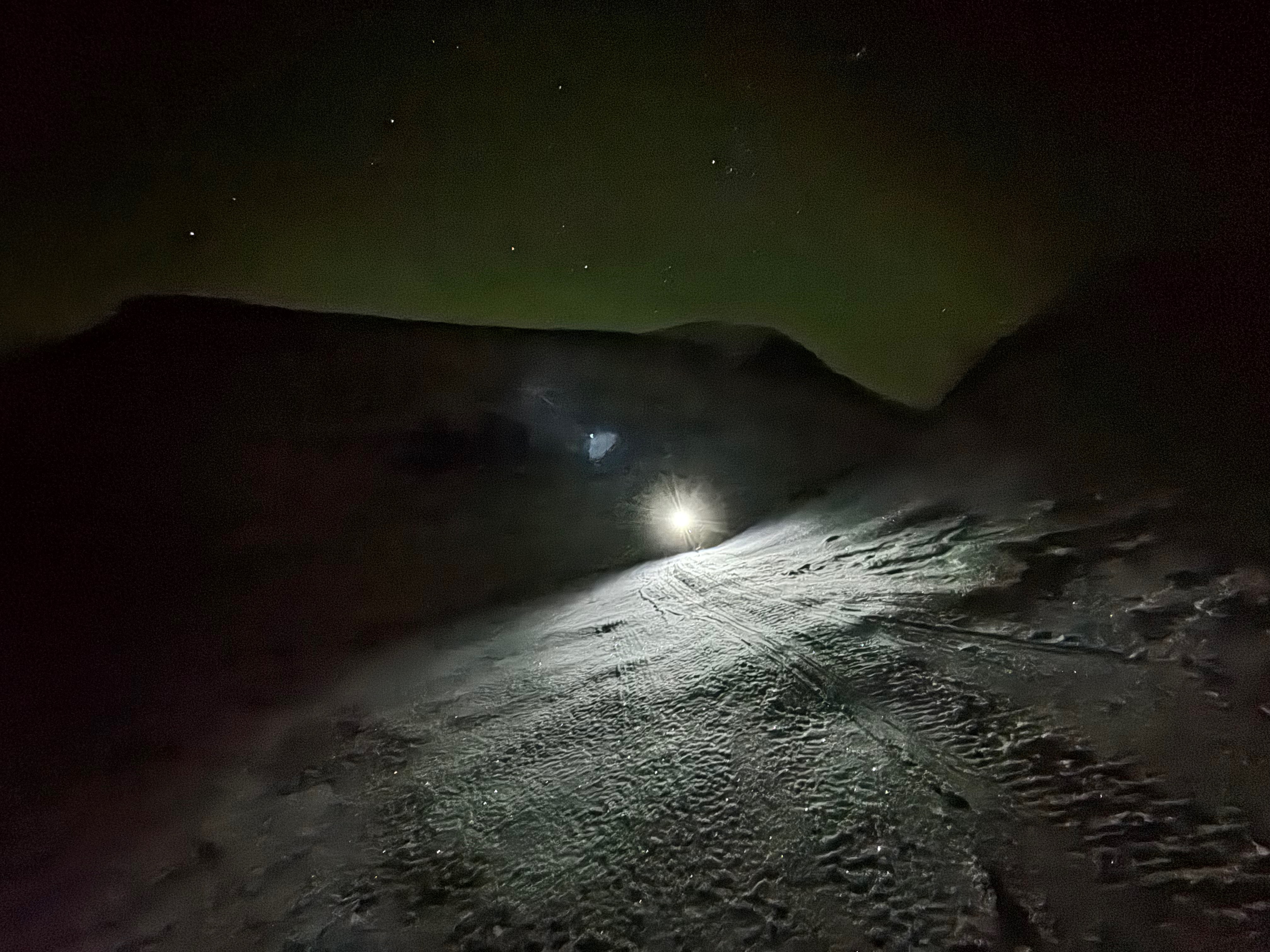
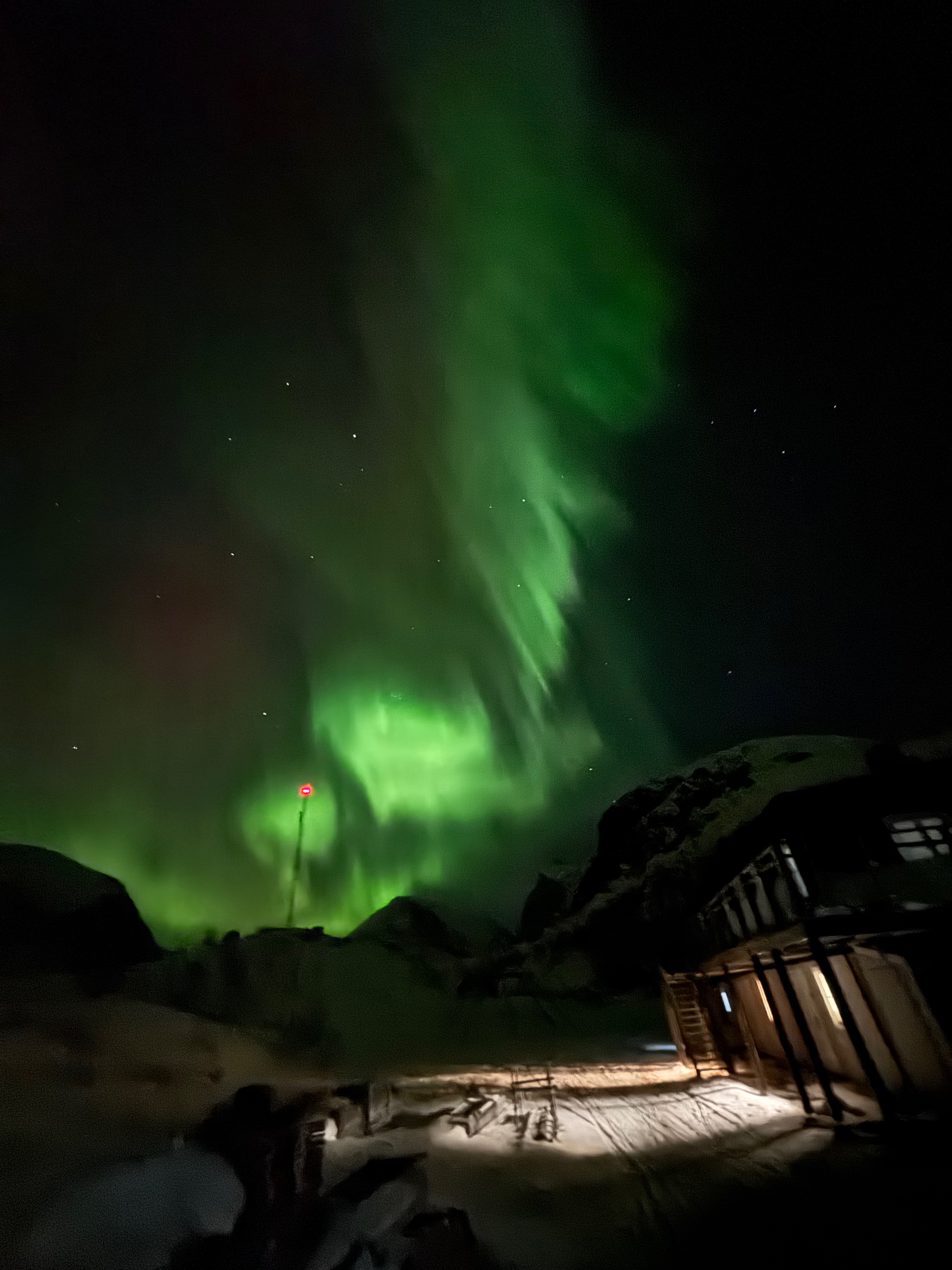
We decided to skip hot water bottles and stepped outside to brush our teeth. The sky was clear. Black mountains ringed us on all sides, bright stars scattered above. Then a green cloud drifted into view, slowly twisting and unfurling across two thirds of the sky. The best northern lights we’d seen yet, and because our eyes were fully dark adapted it looked just like it does on camera. A genuine treat.
As I settled into my cosy sleeping bag and turned off my headtorch, I could hear Kirstie making small happy noises on her side of the porch. I drifted off smiling.
It took longer than planned to melt enough snow to fill all our flasks. We finally set off about 9 a.m., happy and rested, swapping stories as we headed down the valley towards the finish.
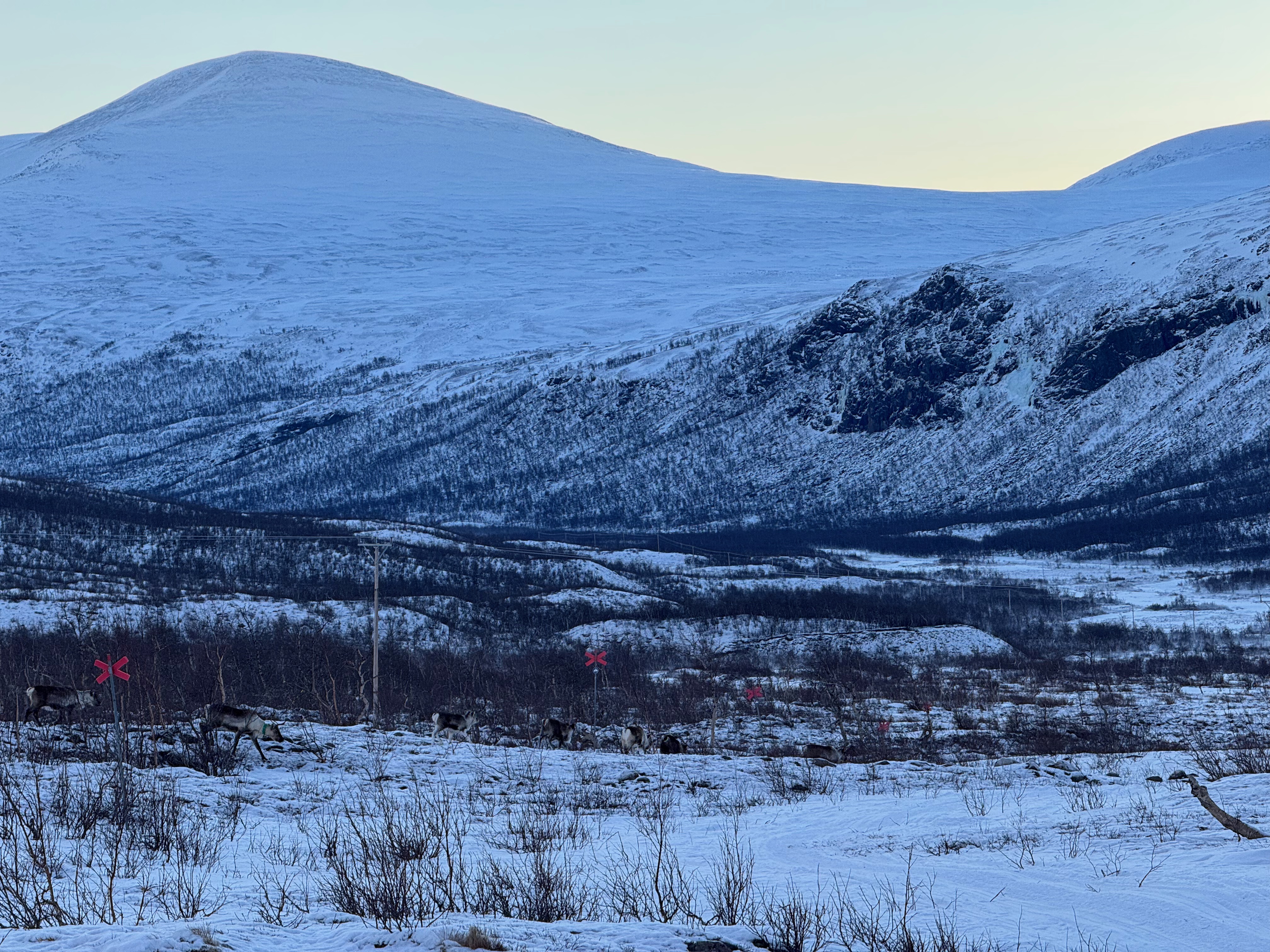
A herd of reindeer crossed just in front of us. Birds chattered loudly in the trees. We spotted wolf tracks in the snow. It was the first wildlife we’d seen since leaving Abisko more than two days earlier and, for a while, it almost made us forget it was still -30 °C and we had many hours to go.
The sun popped over a ridge as we crossed a long frozen lake, and we soaked up the brief warmth.
“Only six kilometres to go!” I whooped. “And it’s practically sunbathing weather!”
Minutes later the sun slipped below the high horizon and the lake hungrily sucked the heat from our bodies.
“We should stop for some food,” Kirstie said. “But not on this lake. I’m frozen already.”
We spotted a small wooden hut on the far shore and agreed to huddle there for a bit and try and warm up.
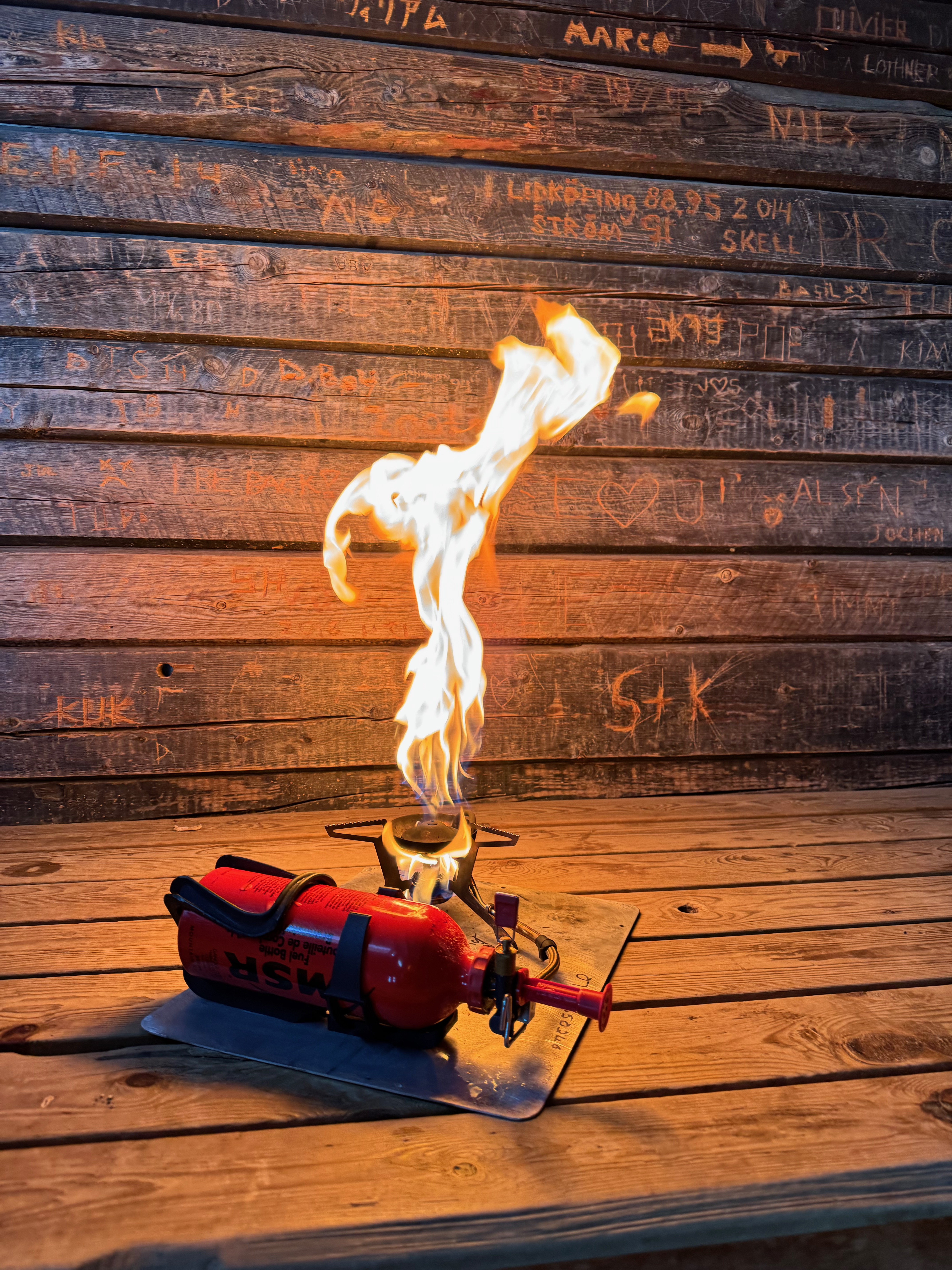
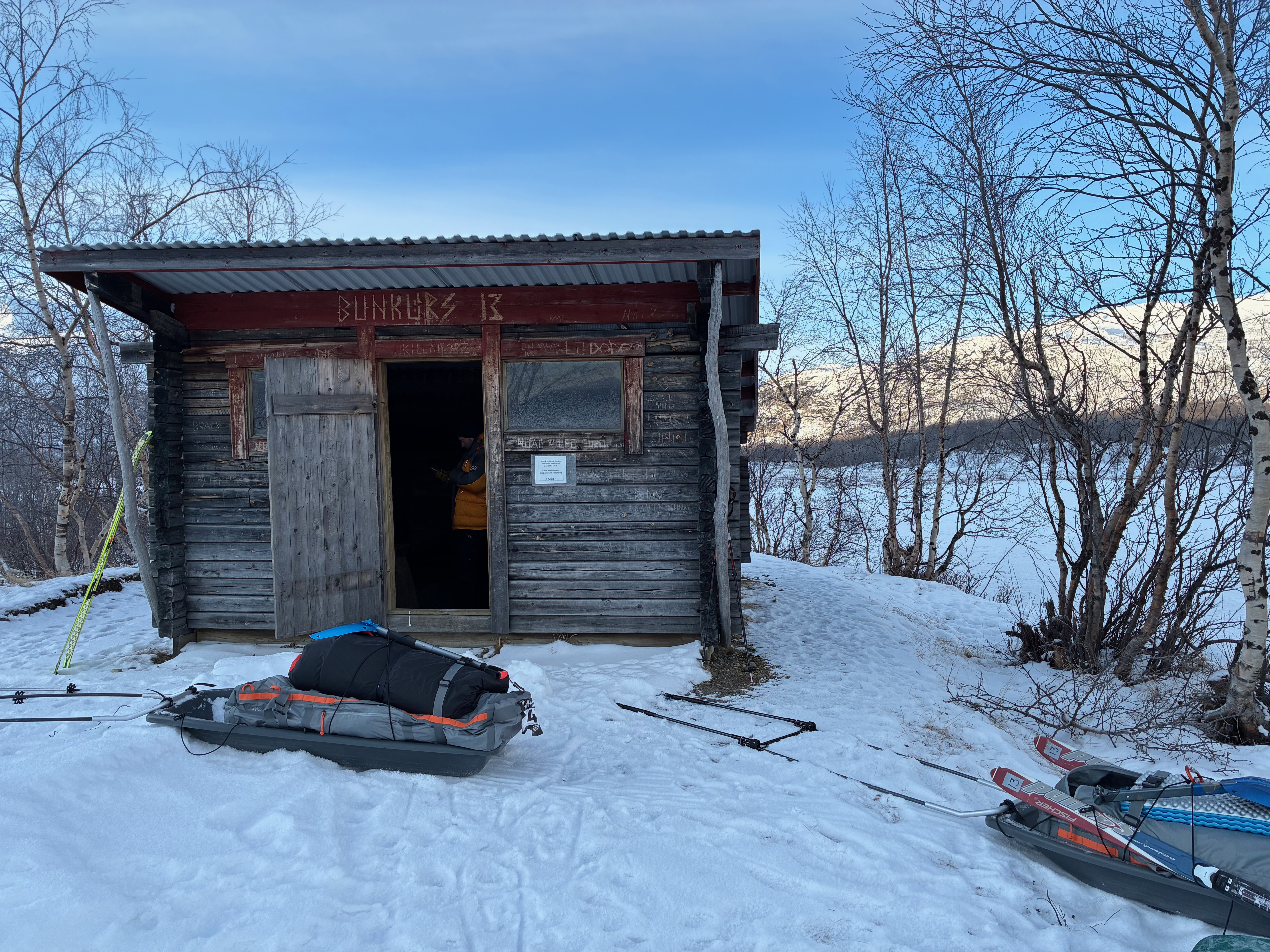
Inside it was draughty. Graffiti scribbled across the walls suggested it was a teenage hangout in the summer. A dead bird lay inexplicably on the floor. The door didn’t shut properly. We wrapped ourselves deep into our big down jackets and fired up the petrol stove. I managed to accidentally open the valve too far, sending a huge yellow flame leaping up. The stove wasn’t actually helping much; it just made us nervous. My flask produced enough warm water for a tepid dehydrated chicken curry – eight hundred calories that barely dented the deficit.
We didn’t stop for long, but long enough.
Something shifted. Kirstie had gone quiet. I dragged my attention away from the flame. She was standing beside me, pale, staring at her mitten encased hands.
“My hands are really cold,” she said, voice flat.
Minutes earlier we’d been in high spirits, joking about frostbite and sunbathing. Now the reality of -30 °C hit. At these temperatures, the second you stop generating heat, the air and wind strip away what little you have. Even a minute without big gloves can push fingers into the danger zone. We’d had ours off for too long, lulled into a sense of safety by four flimsy wooden walls.
“Keep moving, I’ve got some hand warmers somewhere,” I said. Miraculously, they were right at the top of my rucksack, not buried under random kit in the pulk. I tore the packets open and dropped them into the bottom of her mitts.
“They don’t feel very warm. Are they working?” she asked, sounding more like herself but still worried.
I really hoped they were. Without my glasses I couldn’t read the instructions.
“They usually take a few minutes to get going,” I said, trying to sound more confident than I felt. “I’m going to pack up.”
“I don’t think I can secure my pulk with my hands like this,” she said, “but I can load it and then go outside and jump around to warm up. That okay?”
“Of course. I’ll deal with the straps. We just need to get moving again.”
Out here, self rescue is everything. On skis, dragging pulks, four kilometres an hour is good progress. You can’t rely on help arriving quickly, even if you hit the SOS button on your tracker. Lose your hands and you lose your tent and your stove, and then the cold finishes you off. The constant vigilance – watching for small mistakes snowballing into something irreversible – was exhausting, and even that mental fatigue was something I knew I had to monitor.
We clipped back into our harnesses and marched down the silent, frozen valley, towards warmth and other humans, both of us wrapped in crunchy, frost covered clothes and our own thoughts. We were relying on the years of training that got us to the start line and hoping our muscles would churn out enough heat to carry us all the way to the end.
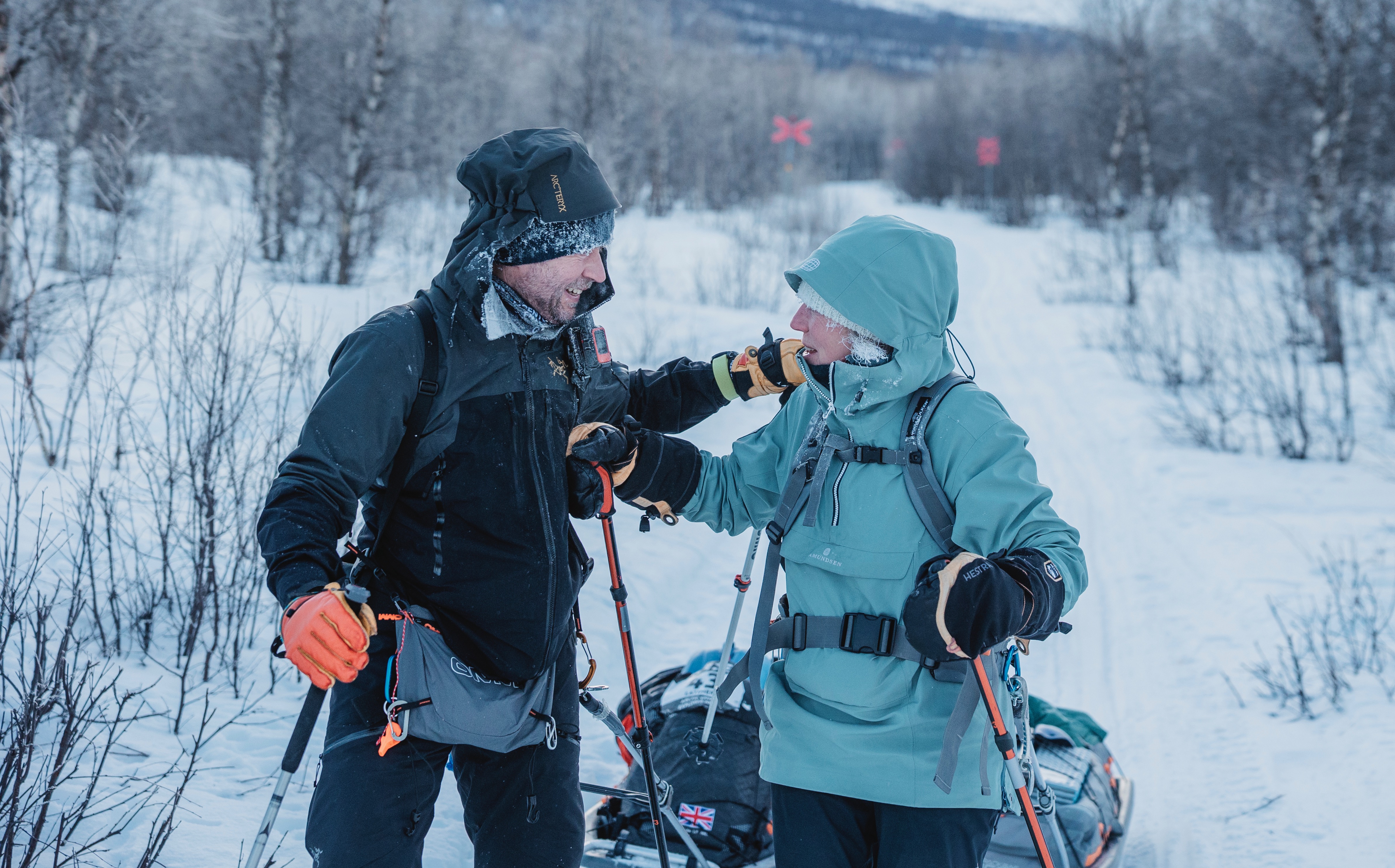
If you’d offered me the win there and then, but taken Kirstie’s fingers or our safety in exchange, I’d have laughed. Whatever I’d wanted at the start, the only thing that mattered now was that we both walked over that finish line together, under our own steam.
Once we were moving properly we set a brisk pace, willing hot blood back into her fingers.
“Any better?” I asked eventually.
“Yes, thank god. I can feel my hands again.”
What a relief.
The distance to the finish dropped steadily, and then, suddenly, there it was: the Spine Race sign. Cameron and the others appeared as we shuffled in side by side, wrapped in frost and silence.
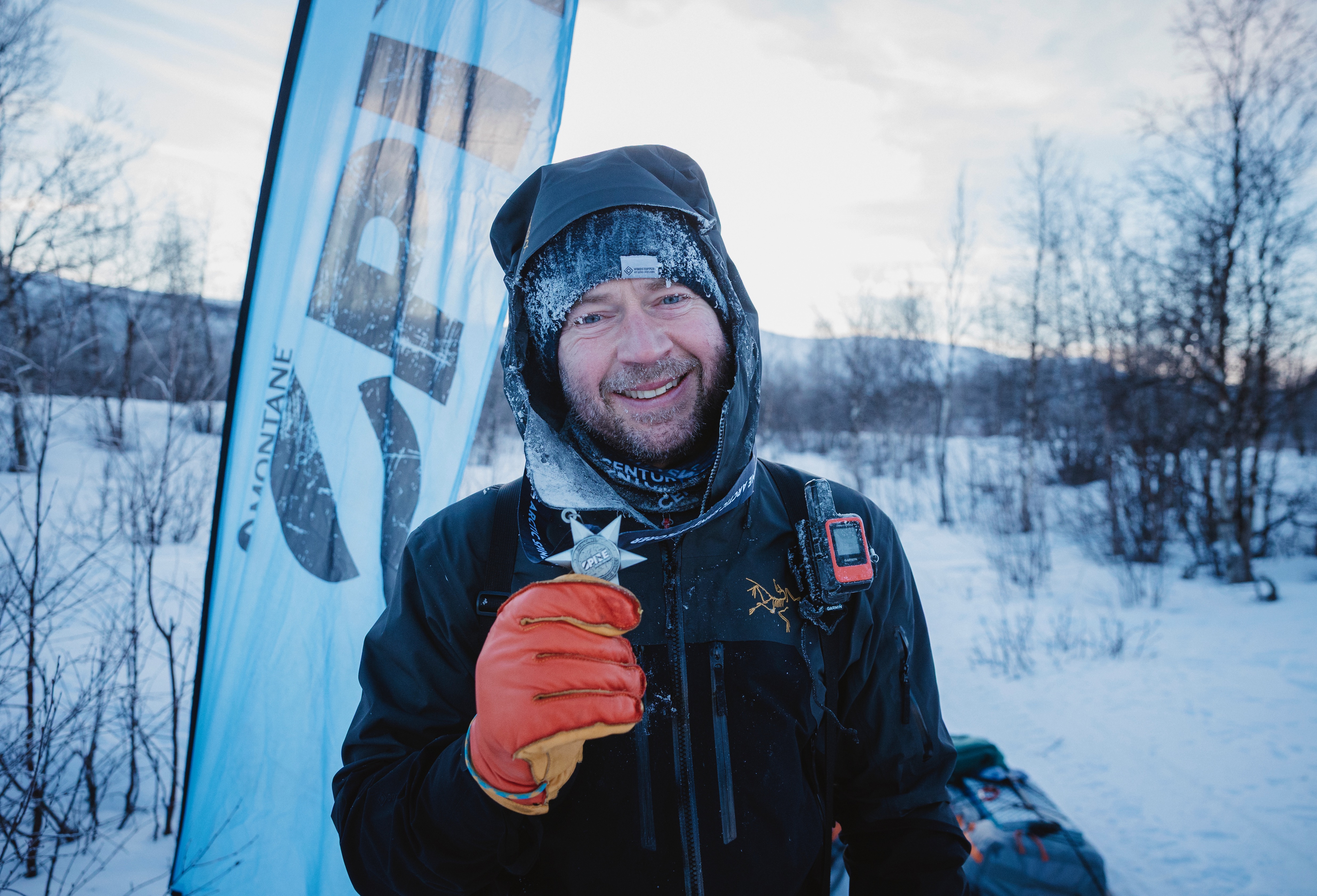
“We bloody did it, mate!” I laughed – and then started crying as we hugged. Joint second overall, first lady for Kirstie – but what I felt most was a warm, quiet satisfaction. We’d taken our time when it mattered, looked after each other, and come through this harsh, hostile place together, safely.
Within minutes we were sitting in a warm hut drinking tea.
“Want some mac and cheese?” someone asked.
“Not if it’s dehydrated,” we laughed.
“No, we made it earlier. I’ll pop it in the microwave.”
Actual hot food. A chair. Even a shower. Proper luxury, after three days of learning what ‘you sweat, you die’ really means – and discovering how valuable it it is to slow down, be bothered, and walk out of the Arctic with all your fingers, toes, your sense of humour, and a friend beside you.
You can call it whatever you want, I’ll pack the ice axe and crampons, but I really hope that we’re never in the sort of situation where I need them. Same goes for that rope I can see you stuffing into you pack.
“Ok guys, crampons on, we’ll head up to this summit”
FFS.
We’re in the Austrian alps, right on the border with Switzerland, I keep losing track of which side we’re on.
The journey here (and the day before) was a bit too stressful, the fire at Heathrow had thrown a large flaming oily spanner into our precision planning. One ski bag going missing (along with boots and crampons) had meant an early dash to the ski shop, and 6 pints of Weiss beer didn’t exactly aid a restful and restorative sleep at the hotel.
Bus to Ishgul, day ski pass purchased, then a fast crossing of the area via 6 lifts and a gondola to get out into the wilderness, nobody wanted to get to the Jamtal hut after dark (though we’d all packed head torches). My lightweight skis juddered down the hard packed piste and I was already cursing my fiddly pin bindings.
After a long and sweaty skin up to a pass at 2,960m, the weather turned ominously foggy and we bounced our way between rocks and powder down to the hut.
Massively dehydrated, but in need of Weiss beer, we dumped our kit in the foul smelling boot room, found our allocated table for the next day or so, and I worriedly listened to excited plans to summit the highest peak in the area, Piz Buin at 3,312m high.
Ropes would be needed.
Gah.
The first night is typically the most boozy, but we felt compelled to sample everything on the wine list and I started day two with the worst hangover of the week.
Straight up in the sun, of course, but amazing views, and we had a nice picnic around 3,000m.
We watched sadly as someone from another group fumbled a ski just over a steep pass, and it cruised to freedom over a pristine powder bowl, Switzerland bound.
I’m not sure if I wasn’t paying enough attention to plans, or was just wrapped up in maintaining a steady uphill pace, but when the order to don crampons and deploy our ice axes came, I quietly complied and before I really knew what was happening was slowly hauling myself up towards the top of Augstenberg, at 3,225m. My eyes kept filling up with sweat and sun cream, and I definitely had the wrong gloves on.
The guide gave me a puzzled look, my technique was generously called “unusual”, but quite why anyone would choose to stand on their hind legs instead of jamming their toes in, sticking their arse up, and clinging onto the mountain for dear life was beyond me.
“Is that a corniche?” That rounded soft snow to my left, with nothing but blue sky and distant peaks beyond.
“No”
I don’t know how he knew that, but I was giving it as wide a berth as possible. We walked the last ridge to the summit and admired the breathtaking 360 degree views.
Getting down was weirdly easy, and made me realise that it’s the feeling of being really exposed that jacks up my fear levels. I’d actually made it to a summit and was very pleased with myself, maybe Piz Buin could be tackled after all.
The next day we headed over a pass at 2,952m to the Wiesbadener hut, 90% of the time spent going uphill, as is the way with this sport, but the downhills more than make up for it. The hut was lovely and cosy, and not full, so we spread out a bit in the dorm. It’s always nice to not have to get into bed through a curtain of other people’s stinking kit. I’d like to say you get used to the smell, but you don’t.
The guide told me that Piz Buin isn’t difficult to climb, “just a hike up a steep couloir and then walk to the summit”. We’d need to be roped together though, so I’m beginning to think our definitions of what’s hard are quite different, definitely feeling anxious about it.
The next morning was crazy cold and foggy, and Piz was off the menu. I was quietly very relieved, and hoped we’d do some other peak instead so I could get a bit more practice in. There was talk of Dreiländer and I was game.
After an unusually brief uphill stint we had a beautiful clear day and some lovely fresh snow to ourselves. Smiles all round, then back to skinning up in the sun.
The guide said that Dreiländer is actually incredibly exposed, and with the fog rolling in he didn’t feel comfortable taking us all up there. Phew!
Easy descent for lunchtime Weiss beers then.
By this stage I’d realised that getting a good night’s sleep in smelly, farty dormitories was never going to happen, so I may as well just enjoy the booze. At least it sedated me and although my watch told me off every morning, it was better than lying awake trying to ignore the snoring that was so loud I had to keep checking my ear plugs were still in.
In what was now a familiar routine, we were all fed, packed, decorated with the paraphernalia of harnesses, ice screws, carabiners and of course transceivers at 8am. Most of us anyway, there’s always a straggler.
We hiked up about 800 meters to the go / no-go point for the mighty Piz, which was…. covered in cloud.
“It might clear. If we go it’ll add 2 hours to our day, what do we think, is everyone feeling strong?”
Looking back at our spread out group, and the extra effort that would be required, we hesitated. The super fit and mountaineering types were obviously keen, but it seemed a lot on day 5, and there was no guarantee the cloud would lift.
We turned right and up onto a col, away from the peak that I’d slowly started to think was achievable. It would still be there next year.
The sun came out, and after a bit of a dodgy descent around huge rocks and drops, we had the Silvretta glacier to ourselves and stopped for lunch out of the wind.
“There is another summit here, Silvretta Egghorn, those who want to rest can wait, we won’t need crampons”
Ok great, I’ll get a bit more climbing time in after all. I’d opted out of any of it last year, so although this route was generally less technical, I was definitely feeling the extra challenge.
I wish I did have my crampons, and a rope.
Bloody hell.
Scrambling up slippery rock with a massive drop behind me was… Well, I was scared, but couldn’t allow myself to dwell on it. Total focus. I had to ask the guide to help place my feet on the way down though. Some of the rocks were actually loose and moved when I grabbed them.
Fucks sake.
From 3,147 meters we had a spectacular view of Piz Buin, and it definitely did not look like a “walk to the summit”, it looked more like a steep icy slide.
One day.
The ski down the other side of Silvretta glacier was easily the best of the trip, maybe ever. Untouched powder, bright blue sky, effortlessly gliding through wide turns. Good for your soul.
Energy levels and patience were wearing thin as we approached the hut, though when one of us fell into a snowy hole and shouted “I can’t get out, I’m a fat tortisurtle. Tortoise. I’m too fat to get out!” we couldn’t help but laugh.
The Silvretta hut was a clean and shiny example of Swiss order. Shame it didn’t have any showers and the boot room was the ripest one yet, with the socks I’d been wearing for 4 days making a significant contribution.
We saved all our accidents for the last day, I could tell the guide was thrilled with that. I fell twice, whacked my head on a frozen lake, and left a decent chunk of my forearm on some now bloody snow.
At one point the guide said he “looked back and didn’t know what I was seeing, a pole waving from the snow, it didn’t make sense”
Somehow one of the gang had ended up in a river, even he doesn’t know how. Luckily we rescued his skis as they floated away towards a lake. His socks were probably grateful for the rinse, but I can’t imaging having wet feet for the rest of the day was that much fun.
It was all good though, the sun was out and despite a long long flat pole/skate, but we had snow all the way down to the village, and with some expected faffing from a load of tired and hungry people, ended up in an airport hotel near Munich about 4 hours later.
Oh the luxury. A shower! My own bed! My own bathroom! Clean towels! Sheets! Curtains! Pillows!
I definitely had moments when I wondered what the point of all the effort was, but the contrast between being scared on some ridge, and then skiing down a beautiful wide valley, balances out nicely. I’m not sure I’d appreciate it quite as much if I’d been dropped there by a noisy helicopter.
The feeling of contentment when you’re sitting in a hut after a long day, physically and mentally tired, but warm and cozy and laughing about tortoises in holes and floating skis, is really quite special.
It’s a bit like a multi day ultra, with less running, more laughing, and cold beers at each aid station, one even had single malt whisky, you don’t get that on the spine race!
I used to get scared on chairlifts, and the first time I did an icy traverse on skins I honestly thought I was going to die. Something has shifted, maybe everyone is right, and the more you do these things the less you suffer from paralysing fear. Being fit and strong makes a huge difference too, 6 months of being brutalised by the HPT team paid off.
Having the right kit, and knowing how to use it definitely helps too.
A daft activity or not, we’ve already booked the next trip…
I’d arrived at Malham Tarn, checkpoint 1.5 at too-late-pm on Sunday. So far behind my rough and ready schedule it was borderline depressing.
So, so tired, it had been a long hot day after leaving Hebden Bridge at 5:30am that morning.
Colin’s words from years ago were ringing in my ears:
“I always forget it’s a nice first day and then a week long painful slog”.
I wasn’t in the best place, and it was still early.
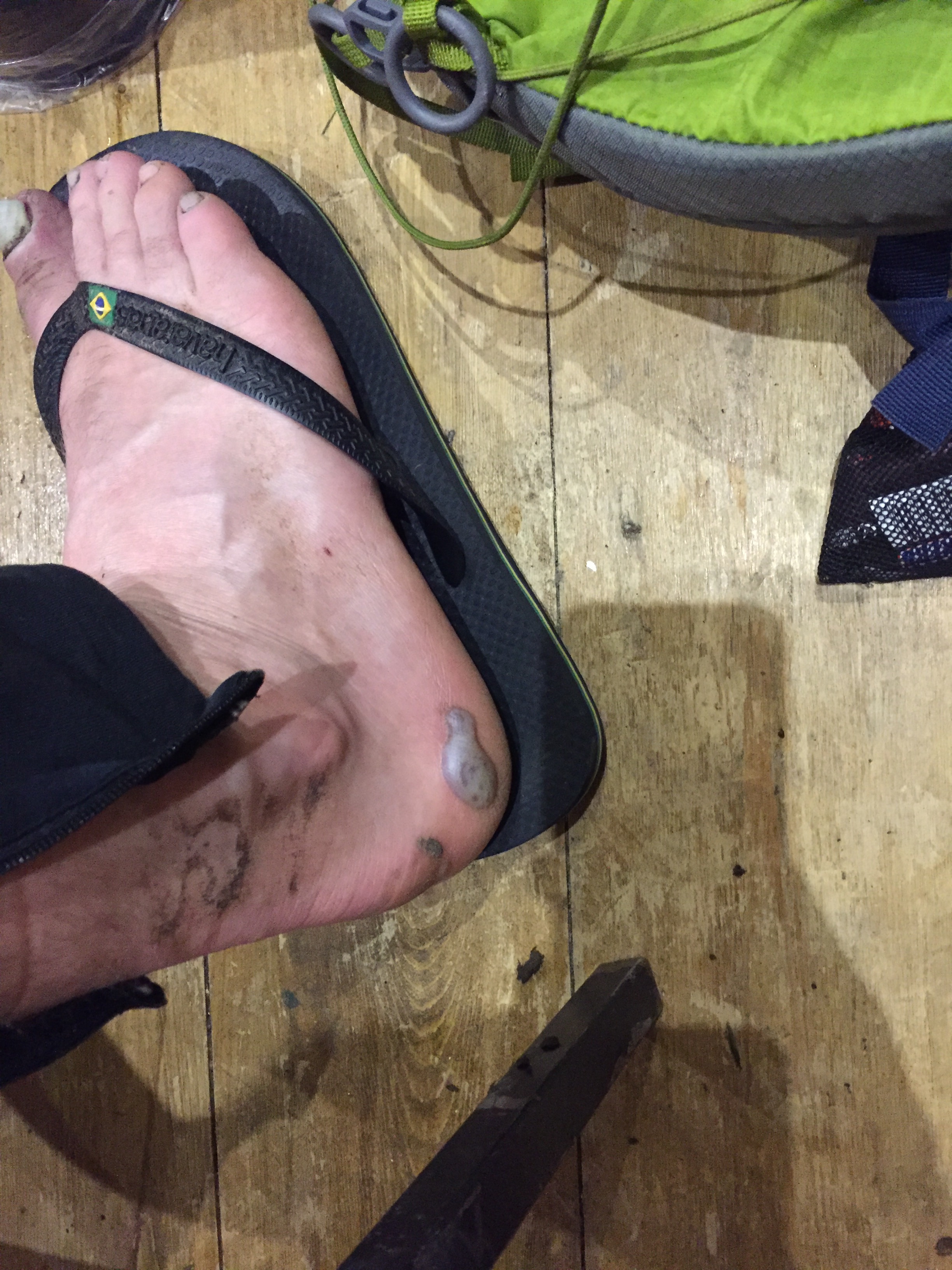
My feet had developed deep blisters on the soles of my feet, over one of the many fields or moors I’d run/walked across that day. By the time I realised that my shoes were a bit loose and the movement was causing hot spots it was too late and the damage was done. Not much I could do at this stage but grit my teeth and think of nicer things.
When I got here I’d tentatively asked if there was somewhere I could sleep for a bit and fully expecting to be knocked back. The relief at being offered a camp bed in a midge free tent was incredible.
I seriously couldn’t believe that 20 minutes had passed already, most of it was spent twitching and trying to not think about how little of the route I’d covered.
No point being depressed though, and it looked like a lovely evening (ignoring midges) so I grabbed my refilled water bottles, my bag of steaming Mac & cheese and trundled off towards Fountains Fell.
It’s amazing how a brief rest and some hot food can sort you out and I focused on catching those ahead of me, for the challenge as much as the potential company for the impending night.
Joining up with Kirsty (who was doing the challenger) at the sheltered spot just before the Pen Y Gent climb was nice. We put windproof jackets on and knocked back some painkillers, and swapping stories slowly headed up into the increasing darkness.
At least it wasn’t covered in ice this time.
Somehow I ended up on my own again and began the long painful trudge towards Hawes, desperately trying to ignore the dark place I was in 3 years ago at the same spot.
Going into a second night wasn’t too bad, being in the middle of it was torture. I was shouting at myself to stop dreaming, and keeping a running commentary of where I was and what I was doing almost managed to keep me from falling headfirst into the ditch off cam fell Road.
Even when it got light it was still torture, and a few times I just lay down on the trail and went to sleep. There were plenty of people at this stage so it was never long before “hey there – are you ok?” Woke me up and set me weaving onwards with a “yes thanks, thanks for waking me”.
Eventually I’d had enough of the trudge and the road sign that said Hardraw and the checkpoint were still 1.5 miles away was too much, I just picked up my sticks and ran. Anything to make this stop as soon as possible.
As I walked the final grassy approach to the aid station tent, my feet were in agony, I felt exhausted and honestly couldn’t see a way to deal with the suffocating weight of the 160 miles I still needed to cover before the end of the race.
Things were looking grim.
The first day had been great, first evening anyway. I’d been very apprehensive before the start, as is right and proper for such a seriously long undertaking, and loitering around Edale for a few hours didn’t really help. It did give me time to fix up my (ridiculously small) pack, and to eat a load of my food that had to be removed from my overweight drop bag.
Looking back to Kinder scout as I headed towards Snake Pass the view was of a lovely sun tinged green landscape, and one of those moments when you can’t think of anywhere else you’d rather be. I literally skipped along the flags marvelling how much nicer everything was when it wasn’t ankle deep in icy water.
That did come though, a surprisingly nasty storm hit at 3am, strong wind which blasted rain and the top layer of reservoirs at us sideways. It felt like winter and everyone had full waterproofs on.
Arriving at Hebden I was soaked and very awake, so grabbed some food and swapped my kit for something dry, which somehow took an hour and a half. Noted that I needed to faff a lot less, Tin would not have approved.
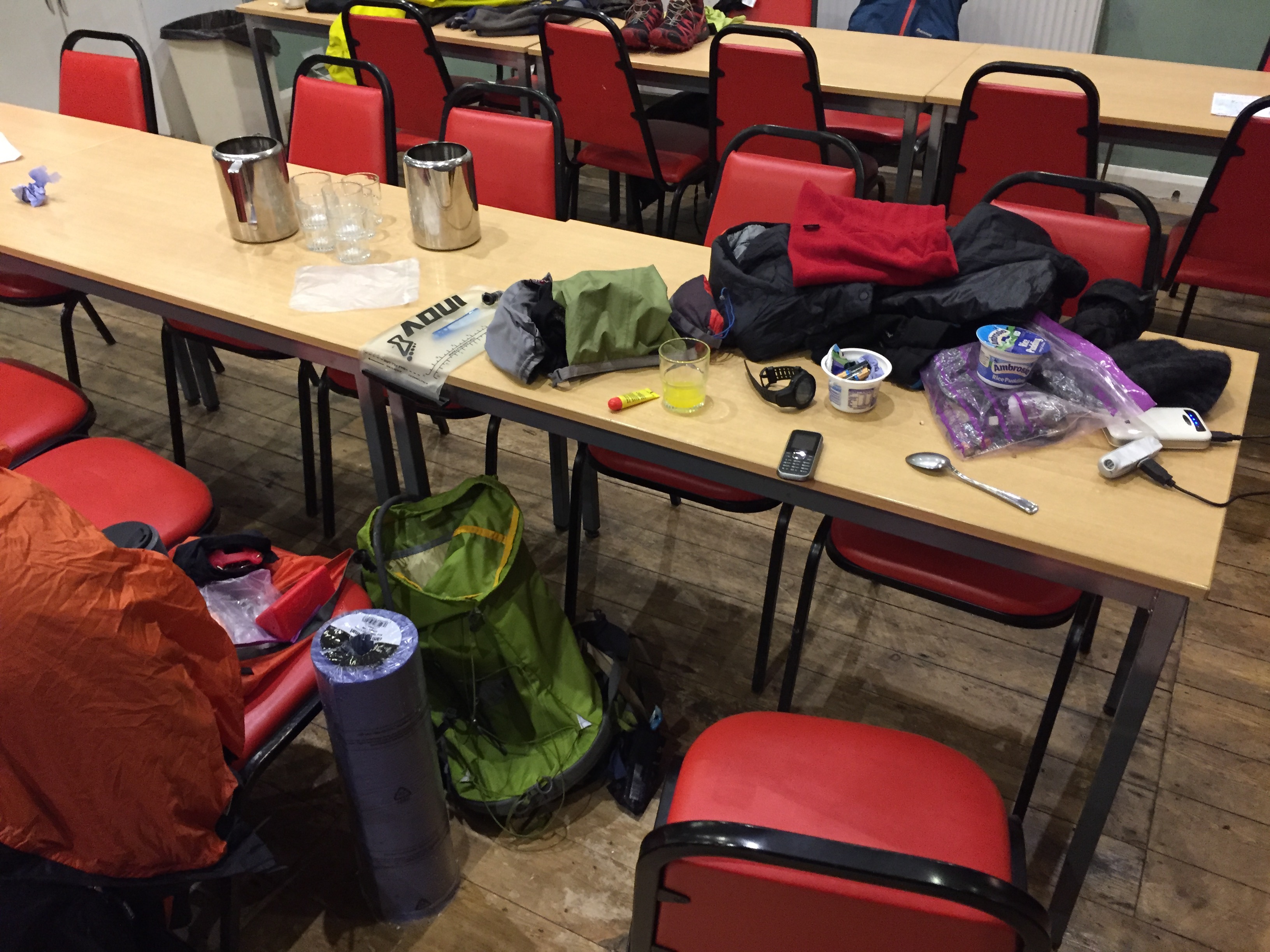
Minor kit explosion
Back at Hardraw, I staggered into the tent (checkpoint 2), sat down and tried to sort myself out, without quitting there and then.
The only thing I could think to do, was to think about my immediate needs, and to solidly, wilfully, ignore what was ahead. Dimly aware through the haze of sleep deprivation that it had worked before.
Maybe if I focused on my feet, having some food, getting a bit of sleep and re stocking my pack with food and water, I’d forget that I was miserable and everything would miraculously sort itself out.
It did, kinda.
Before I really knew what was happening, I was doing it, I was carrying on, eating an apple and hiking the long climb to the peak of Great Shunner Fell (also nicer when not covered in ice), over the back and into Thwaite, where the cafe was open.
What a treat, I was actually smiling with a toasted tea cake in hand (all of the butter and jam thank you) as I set off happily chatting to Alex and wondering what treats the Tan Hill inn had in store.
There will be ups and there will be downs. Many of them, so many that you have to just accept how you feel and keep eating and moving. It really became that simple.
No treats at Tan Hill, not without a pandemic enforced pre-booking, but they did have hot water for our dehydrated food, and coffee and chocolate, so all was well.
Alex and I pretty much stayed together for the rest of the day, chatting about the usual stuff (ie everything!)
At one point we passed the half way mark. How could that be true ? It was though, and we had a lovely sunset to go with it.
Alex slept less than me and I set off towards Dufton on my own early Tuesday morning. On the way to cauldrons snout I passed Robert Cullen for the first time, this guy was to keep me entertained for hours to come but neither of us knew it then (I’m not sure he ever knew it!).
Towards the end of the interninably long and rocky track that leads to high cup nick I put on a burst of speed to catch up with someone , anyone, that I could talk to and distract myself from feeling sorry for my poor aching feet.
The tattoos creeping up his neck were a little daunting but races like this tend to attract similar people, regardless of what’s on the outside, and we spend a pleasant half an hour talking about other events we’d done and generally not thinking about our feet.
I unwittingly stopped in the “do not stop” zone and sat down for a mini picnic and rest for 5 minutes (precisely where my tracker didn’t work and I’d nearly fallen off the cliffs in the fog a few years ago).
Then the long hot trudge down to Dufton. Very long, very rocky so no running, no wind so it felt like a furnace. I promised myself a sleep and at the very least a nice long cool down at the bottom. I needed some promise to keep me moving along. It was probably around midday and a beautiful day, some of which I’d appreciated, but was now looking at through a veil of sweaty eyes and grinding jaw.
Someone told me that the cafe had opened especially for us, what a wonderful surprise! Not sure how long I lounged around on some shady grass, being fed a grilled panini (with a side salad, fresh food!), coffee and a toasted tea cake (food of the gods those are).
Chris was there too, and Ellie, all in much the same ruined situation. Somehow we laughed and joked a bit, mostly at the ridiculousness of our endeavour.
“It’s basically a brutal first two days, to weed out the weak, and then it’s a straightforward stage race”
Ellie pushed on and I asked Chris if he fancied doing the next section together. We’d had plenty to talk about earlier and I really felt that I was in need of some human company now. Solitude was a big part of my motivation for signing up, but I’d had a good enough dose of it already thank you.
Feeling that I had to purge it from my head, and prefixing it with “I’m not going to be negative the whole way”, I expunged the story of when I was last here, wading through deep snow in a midnight storm.
Very different today.
Up up up and over, and up and over, a few times, and then we were starting the long descent past Greg’s hut and another rocky bloody road to Alston.
The miles kept ticking by. I kept eating, mostly Huel bars, they turned out to be almost perfect fuel. Not too sweet, packed with accessible carbs, and easy to get down. I didn’t get bored of them (unlike chocolate covered raisins, which I went off after the first mouthful).
As we neared the main road a familiar face leapt out from behind a sign. Only bloody Dave! We worked together a few years ago, actually not together but close enough to spend much time talking adventures by the water cooler. His wife Anne was there too and wow it was so nice to have a blast of familiarity and fresh smiling faces.
I hadn’t realised at the time but Chris had stopped eating a while ago, and was seriously struggling. To be honest I don’t think he knew at the time and it was only with hindsight that he figured out why he’d felt so totally ruined.
Neither of us was in any rush to get to the checkpoint, as weird as that sounds. With a limit of just 6 hours I was so against being awake during the zombie hour again I would rather lose race time than go through it again.
On the other hand lots of people had been banging on about lasagne, and it had been a long old tiring day. There was also pretty believable reports of showers and warm beds (the first since we’d started) which did sway our anti zombie meters a bit.
I’d resolved to try and nudge the aid station towards extra time, with all sorts of clever ideas about them not writing my arrival time down straight away, to the plain old “ah it’ll be fine if I’m here a bit longer eh?”. Nope, I was deposited on the outside step, with my pack and essentials, in my bare feet, at 3:02am – exactly 6 hours from when I arrived.
No hard feelings, and it wasn’t raining, but yeah, nice try.
Chris waited patiently while I sorted myself out, a cup of jam filled porridge quietly distracting him. We hadn’t explicitly arranged to team up, but it just felt very obvious to and I was reminded of the winter race where I’d headed off at this point with Dan Connors and we’d stuck together for the rest of the distance. Our pace was similar, and the ability to have a laugh most of the time rather than sink into painful introspection was the perfect way to make this as positive an experience as possible.
The sun came up, we walked and jogged over some moors, dodged some rain and almost before we knew it were hiking up onto Hadrian’s wall.
Someone was gaining on us, but not quite catching up. We got a good look and decided that “they didn’t look very happy”. Eventually Ade caught us up, as we caught Ellie, and sort of set off together, though they were solidly “not very happy” whilst we were more than chipper but seriously in need of some sort of sustenance.
“How far to the next aid station?”
“About 20 miles mate”
“What?!”
Ade (now known as “Ade Station”) looked so crestfallen I couldn’t help but laugh.
“There is a cafe about half a mile off the trail about 6 miles ahead though, but no other water stops till Bellingham”
Poor lad, but I’m glad I’d asked before we left Alston, it’s not nice to have nasty surprises like that. We had hoped for a big fat breakfast in Greenhead but nothing was open, so the joy at finding a little van selling coffee and snacks in the car park near the turning for Twice Brewed was very real.
A traditionally grumpy Scot sold us one each of everything he had, gave us hot water for our food and sent us off with some free energy bars. Such a treat and we didn’t even leave the trail. Fully powered up we picked up the pace with a plan to get to the checkpoint around 6pm.
Neither of us wanted to get there that early, but with just one more section ahead the end was within smelling distance. Not really, it was at least 50 miles away, but we were feeling good and sprightly and made the most of it.
Ellie caught us just in time to negotiate a huge herd of cows (I’d seen her take massive detours around others earlier in the week). There was no way I was going to add unnecessary distance so ploughed through the middle of them keeping up a constant stream of friendly chatter.
“Thanks girls, coming though, mind your babies, that’s right move aside, thank you.”
No dramas.
The day was by now a familiar pattern. Leave somewhere. Get up on a moor for ages. Drop down somewhere after about 20 miles. Get water and if lucky some food. Climb up onto something for another 20 odd miles. Drop down and painfully cover the last few miles to a checkpoint.
As we walked in the last mile or so, Ellie was deliberating whether to sleep and risk being overtaken by Sharon Gayter (ultrarunning legend) in third place, or to push on after a brief pit stop.
All I could think about was sleep, and I’d been doing a lot more of it than Ellie had. Sleep deprivation is truly horrible and I’d been getting as much as I could (which ended up being about 9 hours in total, not much!).
Ellie was asking for advice, but I was clearly the wrong person to advise on sleep denial, so I used the future self approach.
“Fast forward to yourself 5 or 6 weeks from now. If you look back and are annoyed with yourself for not just pushing on, then there is your answer”.
Part of her ploy was to put pressure on Sharon and hopefully get her to ease off and get some sleep (even though she’d told Ellie that this race was sleep deprivation training for reclaiming her John O’Groats to Lands end record).
Anyway it paid off and Ellie literally staggered her way to a second place finish in 120 hours and 35 minutes.
A few short hours later Chris and I were on the move, a midnight start and the final big push. Still lots of mileage to go and the Cheviots to tackle, along with the emotional baggage I would realise I was carrying late that day.
Right now though I tucked in behind and yawning whilst chucking back caffeine gels we got up onto yet another moor, this one dark and misty for a bit of summer novelty.
Coming down towards a road crossing there was a light ahead, which seemed to be coming towards us. Someone was on the trail, wtf.
“Bit of a god forsaken hour to be out on the hill eh mate?”
I got closer and realised it was only bloody Angus! He’d driven down from Edinburgh!
I’m getting emotional just writing about it, I was genuinely touched, it wasn’t just that my emotions had stopped working properly by then.
Massive covid unfriendly hugs and he joined us for a little way while we chatted and caught up with all things spine race and our respective families.
Having done the Scottish island peaks race a couple of times we’d had plenty of good bonding time, not to mention several long forays in the Lake District retracing the footsteps of a certain Mr B Graham.
It was getting light and Angus had three children to get ready for school not to mention a long day lawyering for a multinational bank, after starting his day at 1am.
What a bloody hero.
Hugely bouyed and very awake now we skipped over the last bit of moor (hurrah!) and climbed up into a huge pine forest, the last part before the Cheviots.
After a brief savaging by John Bamber’s midgie hordes we marched on filling our bellies with hot rehydrated mac & cheese and contemplated the final big push ahead.
It was 7ish by now and it looked like it was going to be a lovely day. Probably a bit too lovely for 20 odd miles without shade but we had some water and it would just have to be enough. Only a few hours till KY (as it was now known, thanks to the medics at Bellingham, made me laugh every time).
Hut 1 delivered a lovely surprise of water and hot coffee, worth a sit down for sure. The volunteers didn’t seem very happy, maybe it was something we said, but when Robert appeared from around the corner and set off, we fell about laughing.
“OMG, we’ve overtaken that guy so many times! What the actual fuck!”
“Oh yeah Bobby Cullen? He’s a machine, does it every time – doesn’t sleep and just keeps on going, this must be his 5th spine”.
Machine? He’s a goddam trail ninja is what he is!
Chris pulled ahead by the time we got towards hut 2, partly as he was chasing a sub 5 (days) but mostly because I massively slowed down to contemplate the scene of many nightmares and a probable dose of PTSD.
Everything is so much nicer in the sun it’s true, not buried under hillocks of snow with monsters lurking in every shadowy blemish. I was surprised how strong the emotional memories were, and sat down for a while to contemplate the whole thing.
You can really see how the snow drifts here, there are huge gaps with deep heathery fringes that would trap anything. Coupled with reasonably high altitude (for the UK) and exposed sides, it was just perfect for making human sized traps.
It was good for me to see it again, I realised that we’d done incredibly well to drag ourselves up that crazy steep slope, no wonder it took hours. Then when I almost ended up in Hell (Hen) Hole, and Colin actually did, it was clear I’d just made a bad decision and it really wasn’t life threatening, I had just been really really tired.
Snapping back to reality and my sore feet, there was still 7 miles to cover and I’d had enough now. Eating the remainder of what I’d packed last night, which by this stage was caffeine gels and shot blocks, munching on pain killers I decided to leg it and see how early I could get in. It was only early afternoon which meant that pints in the pub later was most definitely ON!
Of course my body had other ideas, despite my head feeling more suited to a nightclub than a sunny hillside.
My right shin had been a bit achy since the long descent on a rocky forest road early that morning, and had slowly gotten more achy through the day. Now it just gave up and cramped. Cramp in my shin? This was a new one. A really bloody painful new experience.
What would you do? What could I do? I spoke to it that’s what. Spoke nicely and stroked and massaged it. I told it about how well it had done and how we were all tired and sore now. I listed the lovely things that waited just down the road for us, lots of rest, food and massage. It just needed to keep it together and we’d all soon be able to sit down and not get up again until we wanted to.
Of course it worked. Why ever would you think it wouldn’t.
I don’t know why it does, but I’ve done that a few times over the years with different muscles. The best theory I have is that by focusing my attention on the area that needs it triggers my brain to send in whatever reinforcements are required to sort the problem out.
In much the same way that I don’t know how to move my hand, but if I focus on what I want it to do then it just happens, somehow. It’s clearly not magic, and it works for me so I’m going with it. As bonkers as it sounds.
Sprint finish and over the line in 119 hours and 48 minutes. 14th place. Very happy.
A surprise shower near the finish line, a plate of food and two bowls of oh so delicious fruit salad, then I dumped my kit in the village hall and hit the local with Chris.
What a way to finish the week. This was no 4am dark and miserable end, with nobody to meet us and just a bowl of nasty soup and a cold floor. This was glorious lager and seats and crisps.
That was magic.
Guess who else was there? Oh yes, ninja Bobby!
The aftermath was surprisingly benign. Yes I was tired for a couple of weeks and had to sneak off for afternoon naps at work. It took me over a week to have a decent nights sleep and not keep waking up thinking I was on the trail .
My weight and body fat took a pleasing tumble, despite constant snacking, and I’m losing toenails every few days.
Oh my hips are a bit stiff, but I didn’t even have DOMS. Weird but I’ll take it.
One thing is for sure: I don’t have any desire to return to the Pennine Way again, I’ve made my peace with it and have more than enough memories now. I’m glad I got to see it in the daylight, there are some truly beautiful parts and they’re well worth a visit.
Of course if they did a race from north to south, that would be a different thing altogether…
Started well. Faltered. Stumbled. Stopped. Didn’t finish.
Did Not Finish. DNF. My first (proper) one.
I’ve run enough races and read enough race reports that bailing out before the finish line was not something I took lightly. I’ve got enough buried regrets without adding to the pile, especially when doing something so inherently selfish.
On my way home from Yorkshire (I at least managed the fun run distance of 110 miles) I wrote down what was in my head, knowing full well that time always softens memories, especially bad ones. My notes are pretty fresh and raw so I’ll add them in a separate post. They still make me wince now, 5 months later.
It really wasn’t all bad, in fact quite the opposite. The first day was actually rather a jolly affair; motoring quickly along and making remarkably good time. I didn’t really talk to anyone, or rather nobody really wanted to chat (to me at least), and somehow the race seemed different to the one I ran 2 years ago.
There were a lot more people for one thing, and for some reason they all had various stuffed animals hanging off their rucksacks. One chap was wearing a velvet top hat (the technical version presumably).
For a supposedly brutal race this all seemed very frivolous, but maybe I was just even grumpier than usual. Having to ditch a load of stuff from my drop bag on race morning may have had something to do with that.
The marshals were a lot stricter than before (actually weighing bags) and I felt much more of a number than a person, which is always a big turn off for me in any kind of event. I do understand why they needed to be less lenient with weight, twice the number of runners means a lot more effort behind the scenes.
Once we were off it was all good, like it always is, nothing like some fresh air in the lungs and a few miles in the legs to get your head back in the right place.
I sang songs and smiled at anyone I saw. It was a good day.
Normal service had been resumed all round, with super friendly people at road crossings and checkpoints. I was even intercepted by a friends sister Lucy, who walked with me for a while and gave me chance to have a nice chat over a bag of haribos.
I got to the first checkpoint feeling really good and didn’t plan to spend much time there: quick kit change, some food and off. Which is exactly what I did, as well as making a small silly mistake which was to have a huge impact about 12 hours later.
On the face of it, chucking my iPhone in my drop bag seemed perfectly reasonable. I had my small Nokia for emergencies and why carry all that extra weight?
Erm, because it’s got that awesome playlist on it. The one that you knew you’d need when you felt really miserable in the cold and dark. The music that you’d spent hours and hours choosing to be as uplifting as possible.
Oh yeah. That’s why I was supposed to keep it in my pack.
Oops.
Fast forward 12 hours and I was indeed very miserable. The euphoria of the first day had quite literally been wrung out of me by continuous lashing rain and howling wind.
Oh and I think my jacket needs reproofing.
I was properly wet, and very cold. My sense of humour had long since seeped into the omnipresent mire, leaving me barking helplessly into the wind.
At one point I caught myself swearing loudly at a particularly large muddy puddle.
“Oh come on! You have got to be FUCKING joking! FUCKS SAKE YOU COCK FUCKING MUD. Fucking FUCK BAG! SHIT PISS CUNTHOLES!”
It was so ridiculous (and such rubbish swearing) that I almost smiled, shame I didn’t have a nice piece by Paul Simon to take the edge off things. Or a good 90s power ballad.
Instead I gritted my teeth and marched onwards, obsessively projecting pace and timing to the next point where I could legitimately stop for a brief distracting moment to eat and drink something, preferably hot.
Long events have ups and downs, events that span multiple days with severe sleep deprivation have many highs and lows. It’s all part of the fun.
Actually it’s all part of the challenge, and how you manage both of these emotional states is a large factor in the eventual outcome.
It’s very easy to get carried away and go too hard when you’re riding a high. You can inadvertently damage muscles and/or cause hot spots. Both of which are easily missed beneath the delicious endorphins sloshing around your system.
It’s equally easy to slip into a self reinforcing downwards spiral when everything isn’t quite going to plan.
If you don’t manage your mind properly it can fester on the smallest pain or problem, blowing it out of proportion and crowding out all other thoughts. Sometimes it can even cycle through a load of these, and the overwhelming feeling becomes one of despair and hopelessness in the face of such insurmountable barriers.
You can know all that, and still fall foul of them. I didn’t really notice I was going too hard on the first day (though being in the top 20 was a bit of a giveaway), but I was fully aware of what a depressing pit of doom I’d sunk into.
I just didn’t seem to be able to pull myself out, and I tried. A lot.
It didn’t help that some more things went wrong, mostly due to overconfident planning, and mostly avoidable (or at least a backup plan should have been ready to kick in).
Ultimately I chose to stop, some might say refused to continue. I know I could have finished, I had before after all, so knew it was physically possible. The spark from the first day had gone out, and the prospect of dragging my painful arse (literally) to Scotland with gritted teeth just wasn’t something I was prepared to do.
So I failed to complete the whole thing, but interesting it didn’t, and doesn’t, feel like a failure.
The jolt to my complacency, and realisation that my body needs a lot more attention than it’s been getting has really changed my attitude.
I’ve been reflecting on my notes, which cover various aspects of both race preparation and the race itself. Physical and mental.
It’s been very beneficial and I honestly feel like I’ve learnt a lot more about myself and ultra distances than I expected to.
The lessons have already manifested themselves in positive ways, the Thames Path 100 went exceedingly well (more on that another time). I’m looking forward to the South Downs Way 100 in two weeks and I’ve entered my first triathlon.
My watch says I’m moving at 1.4 miles an hour, I glance ahead through the swirling snow and mist at the fence and hill visible in the dimming light of my head torch, and doubt I’m even moving that quickly.
This was supposed to be an easy section, just 4 miles between refuge huts somewhere in the Cheviots. I’d even allowed a small amount of optimism to trickle through the barriers.
No food left in my pack, not much remaining in the group (I’d already done a few rounds up and down the line asking people to share anything they had). Breaking fresh trail through deep snow drifts was sapping dangerously low energy levels. The biting cross wind snatched all warmth as soon as movement ceased.
I’d been on the go since 2:30am yesterday morning, a long 18 hours with a brief stop in Bryness for soup, mince, potatoes and a perplexing mandatory foot check.
I hoped my torch battery would last, it was tucked under 4 layers next to my chest, but even fully charged and warm I’d be lucky to get 6 hours out of it.
∞
This is of course the Spine Race, a foot race that takes on the Pennine Way from Edale in the Peak District to Kirk Yetholm just over the Scottish Border.
It takes place in January, primarily to make it harder; the unpredictable but guaranteed variety of weather turning the easiest trail into a quagmire / river / non-trail under a blanket of snow.
Oh and the 268 miles of mostly rough and occasionally unmarked trail.
Mustn’t forget the hours of darkness, 4pm until 8am, and the time limit of 7 days.
Throw all that together and you’ve got a real challenge, so it’s no surprise that over 60% of the field drop out or get timed out before the finish.
It’s not billed as “Britains most brutal race” for nothing.
∞
What were we doing here? Why were we doing this?
These aren’t questions that came to mind, they didn’t matter and wouldn’t change anything even if I had the answers. All that mattered was that we kept moving, one step at a time, slowly, steadily. Forward motion. Just keep moving.
My existence was here and now, everything else was peripheral and forgotten. In a strange way, this is what I’d been looking for when I signed up for this race, escape from the normal world, pushed to the limits of physical and mental endurance, but still moving, still aware of the need for one more step, and another, and another.
Periodically I checked how Dan was feeling, we’d promised to stick together, and after my petulant foot stamping episode in Greendale the day before, I wasn’t going to renege on it.
At one point he was faltering and we debated bivvying somewhere sheltered and heating up our dried rations, but the double decker from Stuart and the last of my beef jerky had kindled a spark behind his eyes.
Onwards then.
Onwards.
∞
Dan and Esteve at Gregs Hut
I met Dan Connors a few years ago when we ran nohtaraM ehT together, and we’d since followed each other and chatted on Strava. We’d leapfrogged each other a few times during the first half of the week, and I was very happy to join his group leaving Alston.
When we finally arrived in Greenhead, hungry and cold, I lost my temper over something daft, and had stormed off up a hill after shouting something like “I don’t fucking care what you do, I’m going this way”. Dan’s comment that I was behaving like a diva and did I need a snickers bar dissipated the tension and we soon found Tom Jones, some shelter and hot food.
When we were finally nearing CP5 in Bellingham, and were working out the optimal plan for the final section (which Richard Lendon helped us finesse, over mountains of hot food and sweet tea served up by his lovely wife Jenny) I said that we should definitely stick together as a team.
Do you mean as a pair of people who happen to be travelling at roughly the same speed in the same direction, or do you mean actually as a team?
Point well made, and well taken. We were a team from here to the finish, whatever happened.
∞
The race is long, and the checkpoints are far apart. On average around 40 miles. In good weather a good days hike, in any other conditions, 20 hours isn’t unreasonable.
I spent as much time on my own as I could. I enjoyed settling into my natural pace, not chasing anyone and not waiting for anyone. I savoured the pleasure of being outside, the satisfaction of navigating by map and compass, thoughts of the outside world receded and I settled happily into the Spine bubble.
There were moments of course, many ups and many downs. The first day was such fun, trundling along a ridge buffeted by wind and rain reminded me of my childhood in Scotland, I passed many people here but my cheery greetings were seldom returned.
∞
Onwards.
Onwards.
Eventually we reached the top of the hill and the long anticipated left turn that would take us down to the second hut with it’s promise of shelter and hot food and drinks.
At this crucial time, I made my first and only serious error of judgement. I can explain it away using a host of valid excuses, but none of them pass muster under the cold unforgiving eye of hindsight.
Not bothering to take a bearing, I burst through the gate and galloped downhill, deliriously happy to be rid of that uphill slog and just moments away from sustenance.
The frozen crust of snow held my weight for a few minutes before giving way and I sank past my knees.
Surely no, no no no no!
For fucks sake no more of this shit!
I changed course and frantically zig zagged down the hill searching out runnable surface.
I could see a few head torches following me.
Stopping to catch my breath, I looked around and was horrified to discover I was way off course, and teetering on the edge of Hen Hole (or Hell Hole as it will be forever etched in my memory). Hen Hole is a steep gulley, and with the covering of snow and ice would be next to impossible to climb out of.
Laying my single pole flat on the snow in front of me, I was able to slowly crawl up the hill and get back onto level ground. I could see the fence and further down a couple of head torches.
Satisfied I was back on track I needed to signal to those behind me to maintain height and not get sucked into the pit of doom.
How do you signal directions with a head torch? Even if I knew morse code, did anyone else?
I ran/fell/crawled back the way I’d come, desperate to catch sight of someone, a thousand thoughts whirring through my head. We were all tired and hungry, and I’d just led people the wrong way, potentially putting them in danger.
∞
My first taste of proper adventure (ignoring the icy scramble over Pen Y Gent in the dark) arrived not long after I almost fell off High Cup Nick in darkness and thick fog, when I decided not to attempt the next section over Cross Fell on my own, at least not in the dark anyway.
My wife was very happy with the decision and I made my way down to the pub in Dufton hoping for something hot to eat.
As luck would have it I found Javed warming himself by the fire, and he was happy for me to tag along. Too late for food but the barman was happy to whack some hot water in a bag so I could enjoy some rehydrated spag bol.
Off we marched into the darkness and I quickly pulled away up the gradual incline, which surprised me as I’d assumed we must have been moving at a similar pace to be at the same point after a few days.
Accepting the advice to plod uphill and conserve energy for the flats and downs, I slowed down and pondered the other useful nugget of advice.
You say one of your achilles tendons really hurts, what happens if you think about the one that doesn’t hurt?
A useful thought, and one I returned to many times over the remainder of the week.
∞
When you’re moving yourself over long distances, mind games and techniques are incredibly important. Not just to provide motivation, but to avoid the downward spiral of painful introspection and obsession that leaves you slightly unhinged at best.
After a pep talk from Tin and upbeat messages from Marissa on Saturday, I’d relied on some simple but effective methods of avoiding negativity and doubt.
One step at a time, step, step, step. Every step is one step closer.
Every tap of my pole, tap, tap, tap. Every tap is one tap closer.
Disney songs, really. Micky Mouse club house courtesy of my daughter Trixy, and the bare necessities, thanks to Paula who texted the entire lyrics.
When I needed something stronger, I remembered a conversation with my mother in-law on Friday night. I was wittering on about whether I’d make it to the end, and she said, very calmly but with total conviction: “you’ll do it”. Lesley, you saved my race, multiple times.
Sometimes though, the only way to block negative thoughts was to fill my head with a single word, over and over and over again.
Step.
Step.
Step.
∞
Noodles!
I was feeling impatient and eager to crack on over the hills to the fabled highest noodle bar in the country, but (with some difficulty) chastised myself and resolved to learn as much as possible from my companion. With a wealth of experience on extreme ultra running, and the spine race specifically, there had to be important lessons available, even if only from observation.
We climbed higher and unexpectedly found ourselves in deep snow with a nasty wind picking up and obliterating the footsteps of those ahead of us.
It was next to impossible to stay on the path, and finding ourselves mostly wading through thigh deep snow, progress was slow and getting slower.
Patience grasshopper, patience.
Gentle cajoling didn’t seem to speed Javed up for more than a couple of minutes, Gregs hut was a few miles away but at this pace, several hours.
Confessing that he’d only slept for 3 hours so far, and was planning on doing the “double“, we debated our options (after I’d informed him that he was bat shit crazy of course, which made us both laugh).
One curious aspect of pacing in a race like this, is finding the optimal balance between sleep and speed. I’d slept for 6 hours so far, and was clearly moving faster. Was that because of the sleep or just down to my legs? Hard to say.
With the teary parting phrase of “I’m scared you’re going to lie down on some godforsaken hillside and never wake up” overwhelming my rational mind, I wasn’t keen on sleeping in a snow bunker on the side of a mountain in a storm. The problem was that our current speed meant that our core temperatures were dropping fast.
#photobomb
We needed to make a decision, and the choices weren’t great. Sleep on the mountain, retrace our steps to Dufton, or find the quickest way down to anywhere there was shelter.
Casting a glance back the way we’d come, the snow and wind had already turned the ground into a pristine blanket with no trace of human activity.
Nearby was a hollow/bunker on the hill and the decision was made for us.
I called HQ to let them know, then grumpily (at least I appeared grumpy, I was actually just scared) followed my bunk mates instructions:
Put on everything you have, dig a coffin in the snow and put your mat in it, get into your bag with everything on and take anything you don’t want to freeze in with you.
Still grimacing from the choice of words, I found myself to be surprisingly snuggly and warm and settled down comfortably, only to start hyperventilating and, for want of a better expression, freaking out.
Headtorch on, and I had a long conversation with myself about the relative perils and merits of the current situation. Assuring myself that if things got really bad I could get myself down to the village very quickly, calling for help on the way if necessary. “Anyway”, the conversation concluded, “you wanted an adventure, and this is pretty exciting”.
Finally calm, I fell asleep for 2 hours, then woke up cold. My companion was in a similar situation and as we debated what to do heard voices calling our names.
I thought I was hallucinating at first but when I saw lights realised it was real.
As bedrooms go, it was pretty chilly
HQ had sent a couple of chaps up to make sure we were ok, we leapt out of our coffins and within minutes were back on the trail, marching along with fistfuls of mini baby bells and tummies warmed by hot chocolate. The wind had eased off, it had stopped snowing and Gregs Hut and its famous noodles (with fresh chilli, from John Bambers greenhouse) were a hop, skip and daybreak away.
At the time I was upset that my race had been disrupted, had I known Javed was so tired and was planning on returning to Edale along the same route after finishing, I would have got some sleep in Dufton. I knew he was experienced, but I didn’t feel comfortable abandoning him in a storm on a fell. You have to do what feels right at the time, you look out for each other and make your decisions with collective safety in mind.
It might be a race, but it’s not always about you.
Although we had let everyone know what we were doing, spending 3 hours on the wrong side of a mountain in the middle of the night, in a storm, triggers an alert. Hence the physical check.
It’s this kind of intervention that makes you realise that you aren’t at the mercy of the wolves, and whilst in danger, there is a very high probability that help would arrive before anything too dramatic happened.
It just feels like you’re on your own and exposed to survival mode choices, this is where the organisers have got it just right.
∞
Not looking our best, at hut 1
I couldn’t see the head torches that were following me any more, and there was no way I was going back into Hell Hole.
The quiet but must-be-obeyed voice in the deepest part of my mind, took over. I sat down and got my phone out, calling HQ I let them know my race number, where I was, and that some people behind me had just gone off course. Swapping my head torch batteries, and resisting the urge to take some layers of clothes off (I was boiling, but wasn’t sure if the feeling was real or imagined, so opted for the safer choice) set off for the hut.
Soon I met some MRT people coming back up the hill, they asked how I was and I think I did a passable impression of seeming normal as they carried on saying they needed to make sure people didn’t take a wrong turn off the route.
Finally arriving at the sanctuary, I stepped into a situation no less surreal than the one I’d just fought my way out of.
Anna was borderline hypothermic and was being manhandled into a blizzard bag, whilst being force fed hot sweet juice. Douglas was helping sort Anna out, Zoe was asleep and Dan was looking totally spaced out.
I made sure all the mountain rescue people knew there were at least two people off course, and eventually our addled minds figured out their names (Stuart and Colin), also that Javed was behind us and in debatable shape given he’d lost his food (though I’d given him most of my meager stash which should have helped).
After a while Stuart appeared, looking hot and relieved.
I sat worrying about Colin, about Anna, about everyone. I had some hot food. I got colder not warmer. I worried and worried. Tom said we all had plenty of time to make the cut off, I thought he’d lost the plot, talking about the race in this kind of situation, this was survival man, survival!
Eventually Dan and I decided to move on. There wasn’t anything I could do for Colin now, and we were taking up valuable space. Realising that I was cold because I had indeed sweated during my feverish efforts earlier, I put on a dry thermal top, lost a mitten, got my spare gloves out and we prepared to head out for the final section.
As we were shuffling out of the hut, Colin arrived looking as if nothing untoward had happened (maybe it was hidden behind the beard), and noting that “reports of his demise had been much exaggerated” joined us.
We saw a chap being brought in by the race MRT, he was wearing a t-shirt and I recognised him from Saturday night (we’d joined forces along with Damon and battled through the blizzard together). He wasn’t in the race but was covering the route at the same time as us, which had seemed impressive then, but in my now confused state looked risky at best. He was shortly airlifted off the mountain as was fully hypothermic (a classic sign is believing you’re overheating, as per my caution earlier).
∞
With Dan and Colin, just leaving Bryness
It’s been a week since I touched the wall of the Border Hotel in Kirk Yetholm, yet life hasn’t quite returned to normal.
I’m still waking up multiple times in the night, drenched in sweat, with visions of the trail fresh in my mind. At least I’m not panicking that I’ve fallen asleep in the snow, those nightmares stopped after about 6 days.
My food intake is approaching normality, though I still feel distinctly weak and faint before I’ve had breakfast, 8 hours without food is now unusual.
Maintaining body temperature is still a manual process, I spend the hours in the office (when I haven’t had to sneak off for a 15 minute nap) without shoes but wearing a scarf.
The damage report from my physio was surprisingly positive, although my super tight achilles bent lots of her needles, I now start the day with a slightly less painful hobble than a few days ago.
The cracks in my fingers have healed, and I’ve de-grimed enough so that my iPhone recognises my thumb again.
Both of my big toes are still mostly numb – some (hopefully temporary) nerve damage.
∞
Friday afternoon on the Cheviots
When encountering a fellow racer for the first time, every conversation was almost identical: “have you done this race before?”, “will you do it again?”. Nobody every asked what you did for a living, it was irrelevant.
Until I’d settled into my stride and the rhythm of the event, I found it unfathomable why anyone would want to put themselves through such an unpleasant experience more than once, in fact I was struggling to make sense of the once.
As time passed however, and I’d had more time on my own to reflect on what was going on with my body and mind during those long long hours, I began to understand.
I’ve often said to people, at least in the last year when my running habit took a slightly different tack, that what I really enjoyed about the hours spent on my feet, was the meditative aspect.
When running, and especially when covering long distances, I ease into a mental place where I’m hyper aware of my body and my immediate surroundings, but little else.
How do my feet feel? Any hot spots? Legs? All ok? Are my shoulders relaxed? What’s going on with my stomach? Time for more food? Is that pain something to worry about or just temporary, check back later. How’s my bearing? What does the map say the next landmark is? Am I warm enough? Too hot? Is that something in my shoe? Empty it out at the next stop. How do my feet feel?…
The Spine throws in a few more things to think about, such that the bubble is almost complete, only the thoughts of family and my daily call home really penetrating.
Physically it’s a challenge, being long enough that any slight niggle has the potential to turn into a race ender after a few days.
My only blister, a good one though
Mentally it’s tough too, sleep deprivation muddles the sharpest mind, and there are so many reasons to stop. I think I called upon some deeply buried part of myself to manage the rest of me, a tiny but powerful voice that forbade giving up, and was rational and calm when everything else went tits up.
My first real encounter with proper sleep deprivation happened on Sunday night on the long and tedious road from Horton to Hawes.
In the absence of any navigation (which I later found be a real help to stay awake), I felt completely drunk, staggering all over the road and desperately fighting the urge to lay down and sleep.
People talk of sleep monsters, I don’t know about monsters, but I had to fight so hard to stay upright and moving in roughly the right direction.
By the time we got to CP2, 108 miles in and the Challenger finish, I’d been awake for 49 hours with a 1/2 hour nap somewhere in the middle.
I felt bloody awful.
∞
Clean! (in Edale)
My race strategy, if you can call it that, was:
1) It’s not a race
2) Determine pace by terrain and what feels sustainable
3) Stop as little as possible
4) If have to stop, keep faffage to a minimum (apparently this is called “personal admin” – looked like faffing to me)
5) If I get to the last section, and conditions allow, it’s a race
I soon modified this to include:
6) When an opportunity to eat presents itself, take it. If hot food is available, even better.
On the subject of food, people keep asking me what and how much I ate.
It’s very hard to work out how many calories I got through, but it wasn’t nearly enough.
Food is a very personal thing, but what worked for me was a combination of: cold pizza, Lesleys home made fruitcake, fresh beef jerky, wine gums, snickers (no surprise there), pepperami (wouldn’t bother next time, proper salami or kabbanos would be much nicer).
A massive feed at the awesome Tan Hill Inn
In checkpoints I supplemented the supplied food with pots of rice pudding, and always kept a couple of expedition food packets in my pack. These are super light (~140g), contain 1000kcals and are genuinely tasty. I have a vague memory of Pavel mentioning them on a blog once.
I discovered that I really dislike 9bars, especially out of date ones, and binned my entire stash somewhere around CP4. Far too sweet and sickly somehow.
The General gave me some advice he picked up on the Dragons Back Race, which was to eat something shortly before hitting a checkpoint. Not only does it give you a nice boost, but it helps kick your brain into gear and avoid mindlessly shuffling kit between different bags. There is also the added bonus that you’re not super narky when you arrive so have no excuses for not being smiley and friendly to the support crew, which makes everyone happier.
∞
After being a bit blasé with gathering all my kit for the challenger in 2014, and suffering with shoulder agony from my horrible and horribly heavy pack, I shelled out for a 22L Aarn Mountain Magic this year.
It didn’t disappoint (once I’d adjusted the 5 thousand straps ‘just so’), and it felt less like carrying a load of kit than having some warm and comfortable creature hug you from behind (nicer than it sounds).
I didn’t take anything superfluous (but making sure I had enough to be safe in an emergency), and with a borrowed PHD sleeping bag got the total weight down to around 7.5KG, including water. This was about half the weight I had last time, and once the pack was on I hardly noticed it. The huge front pockets meant I rarely had to take it off either, double bonus.
“An explosion of kit”, at Middleton-in-Teeside
Expecting lots of rain my drop bag had a complete change of clothes for each checkpoint. As it happened it didn’t rain that much, I didn’t really move fast enough to sweat much, and the drying rooms worked really well. So I pretty much cycled through two sets of clothes. Basically my best kit. Apologies to the checkpoint volunteers and anyone who ever found themselves downwind of me!
My best kit consists of 2x helly Hansen “warm” merino wool tops, 5x decathlon wicking base layer tops, columbia and Inov8 3/4 leggings, Rab eVent trousers, North Face Summit Series jacket, Patagonia gilet, OMM Rotor smock, Montane Via Trail gloves, Seal Skinz mitts, a wool hat given to me by my mum after a trip to New Zealand, a random buff from snow&rock, 2x sealskinz long socks, 5x injinji liner socks and 5x decathlon wicking pants (some things just shouldn’t be recycled).
Oh and two pairs of Inov8 trailrocs, one pair slightly bigger, which were lent to me by Matty though he refuses to have them back. Can’t really blame him after everything they’ve been through, the snow and ice ripped so many holes in them I’m not sure they’re up for any more outings.
∞
Just past the massive owls
We left hut 2 and went straight into a short steep hike up the Schill, which was just the job as I was definitely cold by now, if anything I’d got colder sitting down for such a long time, even though I’d had a big bag of warm food.
I was sent off with Dan, Ryan and Colin. Tailed by a couple of mountain rescue guys we began the simple trudge along the last section.
4 months ago I was probably the fittest and healthiest I’d been since I was a teenager. Training was going brilliantly and I’d had a huge confidence boost by placing 3rd in the Crawley 12 hour race.
What felt like a minor groin strain after a nondescript 20 mile run, escalated over a few days (and some shorter runs) into excruciating shooting pains every time I tried to stand up, start walking or roll over in bed.
Convinced it was a torn something important, I stopped running, enjoyed my holiday in Italy and booked in with a physio on my return to London.
Our sessions were normally chipper and chatty, so I knew something wasn’t right, and I was referred for an MRI scan under the dark cloud of a potential stress fracture and facing at least 3 months of: No Running.
Suspicions confirmed a compression side femoral neck stress fracture (common in the military and old people) and I was handed a pair of crutches.
Super fit to depressed invalid in the space of two short weeks.
Leaving Gregs hut
All my training and racing plans for the rest of the year went out of the window, but I hoped against hope that the Spine could still be a possibility.
Determined not to turn into a sad, fat and unfit blob before winter even arrived, I solicited advice from anyone who would lend a friendly ear, and devoured lots of books and blogs.
The upshot was that I covered many miles on my crutches (and slowly weaned off them into walking unaided), spent dull hours in the gym building upper body and core strength, changed my eating habits and food intake (again), swapping a kilo of fat for muscle and dropping to my lowest weight in years.
I saw a bone specialist, went for lots of tests, took so many supplements I rattled (vitamin D, K1, probiotics, Omega 3&6).
After 3 months I tried a few runs, but the muscle atrophy was so severe that within a week my knees were agony and it was clear that everything was totally out of balance.
More trips to the physio, more specific exercises, more dull hours in the gym. I didn’t dare try any more runs, and just kept my fingers crossed that nothing else would go wrong before January the 8th.
In the meantime I slowly added to the mountain of kit, food, maps, lists of pubs and lists of lists of lists that contribute to the huge amount of preparation that a week long expedition demands. I was pretty sure that if I made any serious cock ups on that front, it would derail my race just as much as any physical ailments. I wasn’t leaving anything to chance.
One of many
So when I stepped (slipped in ankle deep mud) up to the start line at 10am on Saturday morning, I was under no illusions about how tenuous my situation was.
I’d promised family, friends and physios that I wouldn’t run, this was strictly a walking race, and whilst I expected to be in pain, I would drop out if it got to a worrying level.
Many people urged me to postpone it a year, but given how easy it is to talk oneself out of anything, and post rationalise anything using a host of feasible reasons as excuses, I determined to rock up and race, and see what happened.
Two people saw through my façade, both who apparently know me better than most. One was my wife, for obvious reasons, who worried that my sheer bloody minded stubborn determination would drag me to the finish regardless of what pain my body threw at me.
The other was my boss, which sounds weird until you realise that he has an uncanny ability to figure out what makes people tick. He commented that someone who ran so much they fractured their hip isn’t best placed to judge how much pain is too much. I resolved to avoid all painkillers, and his parting words of “if you were fit, I’d absolutely think you’d do this race, as it is, I can’t see you making it” helped me grit my teeth in some of the lower points of the race, no doubt as intended.
Coming down the final road to the pub that marked the end of the Pennine Way, I finally allowed myself to accept that yes, I was going to finish. Normally visualising the end of a race is a powerful motivator, but 268 miles is such a long distance, 7 days an eternity, and with so many obstacles to overcome I never allowed myself the luxury of hoping to get there before the cut off.
All the pent up emotion, stress of that tortuous section to hut 2 and serious sleep deprivation surged up through my chest and I sobbed the final hundred yards.
I remember muttering stupid nothings to myself, “you tosser, how the hell did you just walk to Scotland?!”
There was nobody to be seen, and after quietly touching the wall I sat down on an old plough, thinking this was a suitably low key ending to a very low key race, tears still running down my face.
Colin appeared from the darkness and gave me a hug, which was just what I needed.
Dan arrived and touched the pub, I gave him a hug, but I don’t think army men do that sort of thing. Anyway, it had seemed appropriate given what we’d just been though.
Moments later Lindlay arrived with our medals, apparently our trackers were a bit off and we were early. No matter, medals and photos were taken and off we went for food and sleep.
Much has been made of the hardships endured, and it’s easy to overlook how many things made me smile over the week.
Sun rises and sun sets over frozen mountains were spectacular, the views you only see when you’re prepared to travel by foot overnight.
Low Force and High Force on the river Tees were mesmerising waterfalls, especially given the amount of rain this winter.
Leaning on a gate, in the middle of a snow laden forest shortly after first light, chatting to an inquisitive, chubby little robin. This wasn’t a hallucination, but the massive house size owls I saw earlier probably were.
Finding a box of flapjacks at the top of a steep field in Thwaite, marked “for Spine racers”, thanks Emily, that got me to Tan Hill.
Being intercepted by family friends Bill & Janet in Lothersdale. They had a warm car, a flask of black coffee and the best chicken sandwiches I’ve ever had (and I’m very particular about my sandwiches). Thank goodness Peter Gold wasn’t slinking around.
∞
Some parting thoughts.
It’s a long way, the weather changes everything, it needs to be treated with respect.
There is excitement, camaraderie, beauty and pain.
You’ll meet like minded people and will form bonds that will last long after the event has finished.
I’m breaking with tradition and writing this on the same day that the race finished.
As I’m working my way through the buffet car on the Edinburgh to London train, I’ll keep it brief.
First, a little bit of background. The race itself has been going for over 30 years, involves sailing 160 nautical miles from Oban on the west coast of Scotland, and a less than cheeky 11,500 foot over 60 miles of GPS free fell running.
We attempted the race last year but everything didn’t quite go to plan, so we were back with a vengeance.
Head to Glasgow on Thursday morning with 3 bags of kit including enough snickers bars to feed the entire fleet.
Peaceful train journey rudely interrupted by a broken down freight train ahead, 1.5 hour delay.
Arrive in Glasgow, run (run!) across the city centre scattering peanut based confectionary in my wake to catch the Oban train containing other runner Angus.
Chat to Es Tresidder (who also had an early cross Glagow run, but with a family. Feel less proud of my achievement). He admires our carb loading pizza and Guinness strategy.
Arrive in Oban, see RMan briefly, met by one of our sailors. Kit check.
Meet rest of team, food, wine.
Miss last ferry, pile into dingy, get wet.
Dent the whisky stockpile (it would only distract the poor sailors), chewey peanutty snack for pudding, bed at 1am.
Morning comes round fast, club vests on and catch up with everyone at the start line. Must find a better photo pose.
Go out hard, hang on to it, speed up at the end, finish in 35 minutes and manage not to be sick.
Energy levels sorted by a popular sweet snack bar, have a bit of a rest and cruise to Mull. Not much wind but everyone in the same metaphorical becalmed boat.
Rain starts as begin running and doesn’t stop for 6 hours, beginning of recurrent sailor joke about skinny wippets and bad hill weather. Almost zero visibility due to wind, rain and mist. We remember the route from last year and carefully make it round in 5h 45m. Back on boat at 22:45.
Hot shower, hot food, snickers, admire Dolphins, help drop the spinny, bed.
Get bounced around the cabin, various sails (in bags) land on me during the night. Maybe get 2 hours sleep before landing on Jura at 05:30. Sailors obviously missed both parts of “smooth sail and full English on arrival”. Forgive them as it’s light and have chocolate based treat to hand.
Head up sunny and rain free (!) paps.
Employ cunning fell race tricks and get us down in super quick time. My sister and family set up a mini aid station and give us some lovely cheers as the heavens opened. we finish in 5h 30m, wet.
Boat, snickers, hot shower (LOVE the shower), hot food, snickers.
Worry as the sailors faff around for ages with ropes and sails whilst big waves splosh over the boat.
They seem to know what they’re doing / I can’t see straight let alone help. Leave them to it and go to bed.
Get bounced around but this time I land on the sail bags, much better this way round.
Get approx 10 minutes sleep (apparently 2 hours) and roused as we come into Arran at 21:30 on Sunday night.
Sailors swear at the yellow brick tracker as its rebooted (again) so they can see where we are during the run. Pointless as no phone signal but remote families happy with our sudden progress as the website finally updates.
Snickers, ginger cake (from my mum, picked up on Jura, totally hit the spot and a welcome snack alternative), wet wet weather gear, head for the hills.
Rain turns to hail on the Goat Fell ascent. Get lost in this mist on summit. Have a snickers and break out the compass.
Find path, decend briskly, trot back to the boat for 02:30 Sunday.
Sleep deprivation, darkness, wind and no engines allowed make for a hairy pickup. Short wave radios help to get us in the right place to be yanked on board.
Snickers, water, too tired for a shower, in bed fully clothed.
Roused in an hour to don sailing clobber and prepare for final run to the finish line at Troon.
Creaky legs deliver us into the race office for an official finish time of 05:19, 5th in class and 9th overall.
Retire to boat for celebratory snickers, rum & ginger wine, crisps and bed.
Awesome weekend, thanks to the organisers for everything, hope to be back again.
Update: I jotted down some notes on what kit I used, if you’re interested.
The Scottish Islands Peaks Race (SIPR) – DNF – Report
It’s 2015 and this is something I’ve been meaning to write for a while, partly because it was great fun, but also because it’s nice to share amazing experiences. Anyway, given that we’re having another crack at it this year I thought if I jotted down some notes from our last attempt, it might give us a helping hand. Let’s see.
The trouble started long before race day. Finding a sailing crew was easy, finding a running partner turned out to involve what is best described as blind dating, ultra-runner style.
First up was an old friend who’d been threatening to join me on a hilly outing for months. A sub three hour marathon under his belt gave me a touch of ability anxiety, but I reckoned I could take him on anything involving a load of mud and slippery rocks.
For some unfathomable reason he decided to take his family and (re) emigrate somewhere much sunnier than Scotland. With the departure to Sydney set for the weekend after race day, perhaps the prospect of deep bogs and driving rain was a worse prospect than packing everything for a family of four.
Much more importantly, we were now a couple of wiry calves short of anything you could call a fell running team.
Next up was a childhood companion from the fair isle of Jura. Now, we had the opposite problem: working as a gamekeeper he spent most of his waking hours neck deep in everything you can find on a Scottish mountain (including the occasional pile of dead deer). Road running was understandably not much of a priority, but we convinced ourselves that the combination of sheer bloody mindedness and years of mountain craft would get us through whatever obstacles presented themselves.
Devastatingly one Sunday night saw his wife involved in a (thankfully not fatal) head-on car crash. Several weeks of worry and soul searching later, his wife was back home and he was attempting to stop three small children from doing any more damage to their very tender mother. Needless to say we didn’t hold him to his race obligations, looking after close family being one of the few acceptable excuses!
Roll on number three, third time lucky and all that.
I started harassing all my fellow ultra-runner friends in earnest at this stage, and after a couple of false starts was put in touch with an incredibly fit and experienced chap from somewhere near Wales. Checking out his stats cranked up the team outlook, but did nothing for my fell running status anxiety. Completing a 50 mile mountain race in one day is a decent achievement, but doing that every day for five days, without GPS, to traverse the Dragons Back (length of Wales) is an otherworldly feat.
Lots of enthusiastic emails and texts ensued, along with a couple of phone calls. This was proper blind dating now, and everyone was getting very excited as the big day drew near.
Too good to be true? Of course!
Even the best are susceptible to a badly placed foot on a slippery slope, and before anyone could say “stay in bed and don’t go near anything that might cause injury”, the damage was done and with a heavy heart he took the doctors advice and stepped down. In hindsight a very wise decision, a “bit of a sore ankle” turned out to be much worse than it sounded and it would be months before any kind of running was to take place.
With mere days before the race it was action stations all round. A blanket appeal was thrown out to every social media site and forum we could think of, including the mass spamming of the entire fixed income trading floor at a large investment bank (I figured there’s bound to be at least one testosterone filled triathlete up to the challenge).
The race directors pitched in too, canvassing all the running clubs they could think of, and posting our desperate plea on their website.
At one point the saturation was so complete that my sports masseur in South London said one of his other clients had seen my “lonely runner seeking runner for ups, downs and shared energy gels” advert, and was considering applying.
With one day left before I was due to head northwards we had four serious contenders, and I’d taken on the joint role of Cilla Black as well as the earnest seeker of companionship.
Many phone calls later the worthy Angus from Edinburgh packed his bags, threw in his Carnethy club vest and leapt on board the train to Glasgow.
A mountain marathon veteran and owner of a race saving altimeter now firmly in the team, we really were in business, and it was two excited fellows who boarded the tiny train to Oban. Laden with running gear, whisky, Guinness and a pile of cold pizzas we looked less out of place than the smattering of commuters, as we started the three hour journey north.
Pre race fuelling
We spent the journey getting to know one another, and plotting probable best routes for the Jura leg (the others being less ambiguous), and quickly met up with the rest of the team on the good yacht Sonata (not in a pub, first surprise of the weekend).
The very organised race crew meant the kit check was a breeze, and with the “it’s not your fault if I drown or fall off Ben Mor” waiver duly signed, we retired to the local for a good dose of their finest race nerve calming brew, and bowls of specialised running fuel (aka crisps).
Sonata, twitchy
Our sailors had actually spent the last few days repairing bits of the boat –
Club rivalries put aside for the weekend!
which isn’t as worrying as it sounds, old wooden boats, even ones designed by William Fife, need a lot of tender loving care). They’d also been trying out the various new bits of kit bought specially for the weekend, so a few pints seemed downright necessary.
The first running leg is a mad six mile dash up and around the hill overlooking the town, and was introduced purely as a Le Mans style means of throttling the number of boats leaving the harbour at the same time. I’d been advised by SIPR veteran Tin to keep nothing back and if I didn’t taste blood by the end I hadn’t tried nearly hard enough! So, off we hared into a bright sunny day, pushed on by the prospect of a few hours of easy sailing before Mull.
We didn’t come back anywhere near first (fell runners are fast!), but we did
This really isn’t a normal race
ok, and with a seamless transition to the dingy were powering out to meet Sonata. She was getting a few race twitches of her own, obviously well aware of the good breeze that had been building all morning.
The wind held well, and after being seventh around the point it was a lovely reach straight down the sound of Mull to Salen.
Sunshine! It didn’t last
Well chosen sails and a happy boat took us to 4th in our class (fast yachts) and all too quickly it was time to get kitted up for the first proper leg, a less than cheeky 23 miles up, over and round the highest point on the island.
Naturally enough the sunshine packed it’s bags and the mandatory waterproofs were out of our packs before we made landfall.
A quick but thorough kit check and we were handed a bag of orienteering tokens with instructions to attach them to all the orienteering kites we could find on the list of OS coordinates. We’d be out of the race if we missed one, so safely stow them we did.
The route starts and ends with 3 miles of tarmac, followed by a couple of
Yon misty hill, etc
miles of rough track. At the point that the track becomes a path most people change shoes and leave their road ones in a plastic bag (or just lying on the ground, lets face it everything is going to be sopping wet after a few hours in the misty hills). We made our first (possibly only) navigational error here and deep in happy conversation missed the turning to traverse along the valley, and followed the river instead. We didn’t lose much time but were both annoyed at such a silly error so early.
The path is very faint in a lot of places, but it’s pretty clear from the map which way to head, and an uneventful hour of steady climbing delivered us over a ridge and into thick fog, rain and wind.
There wasn’t much to do but try and keep a steady course, keep climbing and hope we didn’t veer too far the left and miss the main summit altogether. Staying slightly to the right was our best option as a brutal drop back to the starting valley would be (hopefully) hard to miss.
A brief scramble and, yes, there was no going forwards, a sheer drop into howling wind was inches from our feet. We were on a narrow ledge with visibility of ten meters at best. The big question was whether we were to the right or left of the summit.
Whilst we were pondering this, and becoming more certain of our bearing (and also very cold, this was a shocking place to be dithering), a small group of vest clad runners clearly bearing SIPR numbers came bounding out of the maelstrom heading determinedly in the opposite direction from us.
Ah ha, I thought, some friendly people to put us right. “Have you summited”? I shouted, I got neither eye contact nor reply. “Rude fucker” I muttered.
Another group of racers piled up the mountain and shot past us, just as Angus quietly said, “they’re all wrong, we’ve got the right idea, quick lets go”.
Competitive orienteering lesson #1: It’s a race man, a race! Every team for themselves!
Five short sharp very uphill minutes later and we’d clipped our tag to the top of Ben Mor and were belting down the other side hoping to pick up the right contour for the next OS reference. At this stage we we’d gained a few places since leaving our road shoes (it’s really handy being able to count the tokens and know how many are ahead of you!).
The altimeter and Angus’s excellent map skills soon sorted our the next two references and we’d moved up the field some more. I tried to text the boat so they could get a bit more shuteye, but as soon as I (eventually) got a signal, my battery died. Trying to capture the run using my iPhone strava app was clearly a bad use of limited resources. A different context for #stravawanker. No doubt our gallant sailors were probably up and getting ready to go, our original estimate being very optimistic and without any allowance for disgusting weather and energy sapping peaty bogs.
Still, our mood was definitely buoyant, we’d got through the worst of the course, and had just entered the original valley. Just an easy traverse and a few miles of road before we could check this one off the list.
Until.
Disaster struck.
I heard a loud crack and span round to see Angus on his back looking more surprised than in pain. He was in pain though, a lot of it. A foot, no doubt imbued with the imminent prospect of a hot shower and a glass of whiskey, overshot it’s rightful placing, slid the wrong way and dumped the full weight of it’s owner the wrong way.
Angus did well not to pass out on the spot, and after a couple of false starts we made our careful way down the valley. We were both outwardly hopeful that this was a minor sprain and no real damage had been done.
This was the end of the race though.
We made our slow, cold, wet and hobby way back down a drizzly valley and Angus even ran some of the road section back to the boat. Total time on the Mull course was over 5 hours, slightly more than we’d hoped for, but the weather had hardly been in our favour.
We kept an optimistic angle on the ankle situation, deciding to see how it looked when we got to Jura.
Not what ankles are supposed to look like
Our sailors greeted us with probably the best welcome we could have hoped for. A hot shower, bowls and bowls of steaming beef stew and a couple of cans of Guinness. Not what we were expecting on board a racing yacht but oh so, so perfect.
Bundled up in dry clothes and sleeping bags, lulled by the gentle rocking of the boat, deep sleep was only minutes away.
I woke up hours later and was still being gently rocked, my now slightly more alert self registered the lack of wind, but dismissed it as an excuse for more sleep and conked out again.
The next time I woke up it was to the hum of the engine, which did not bode well: engines in a sailing race (outside of emergencies) being somewhat frowned upon.
The crew had realised that our slow progress in the water meant we had no real chance of completing the course, even if Angus was able to run (which with an ankle as big as a melon he really wasn’t), and had taken the executive decision to motor to Jura and give us a chance of sailing as much of the rest of the course as we could. No point drifting in circles for twelve hours waiting for the tide, might as well salvage some of a sailing weekend for the Jura to Largs leg.
Sailing through the corryvreckan whirlpool, an unexpected fright!
This serves to highlight that this isn’t a race that you can get round just on meticulous planning, there are so many variables, and you’re at the mercy of the weather in more ways than one. This is also what makes it so compelling, if it was easy, what would be the point?
I got on the phone to the Jura runner who couldn’t make the race, and we arranged to meet in the village and head up the paps anyway, it was too good an opportunity to miss. Donning wet waterproofs wasn’t much fun but the hard climb straight up Beinn An Oir took my mind off any minor discomfort.
The outing turned out to be an unexpected treat and I spent a very happy couple of hours being shown all the special local routes off the peaks (whether I’ll be able to remember them this year is another matter).
After an evening in the Jura pub catching up with family and friends, a few hours of sleep, and we were heading off into wind and wet towards Largs, a sailing team of 5 now, no more running expected.
Angus passed the test of being left at the helm for hours in the rain without complaining (or stopping smiling)
It was a fairly gruelling few hours until we got round the Mull of Kintyre, then a nice and easy sail in past Arran.
It’s hard to sum up the weekend in a few sentences, but this really is an epic race that really gets under your skin. It’s hard enough to be seriously challenging, but not impossible. Teamwork is vital, even down to making sure everyone gets a chance for the odd bit of sleep.
Our shore crew were amazing, having supplies and ready to go stews, soups and sandwiches meant we could focus on the important bits, like eating!
The wooden heads will be back this year, let’s hope it’s windy (but not too windy) and a bit less slippery…