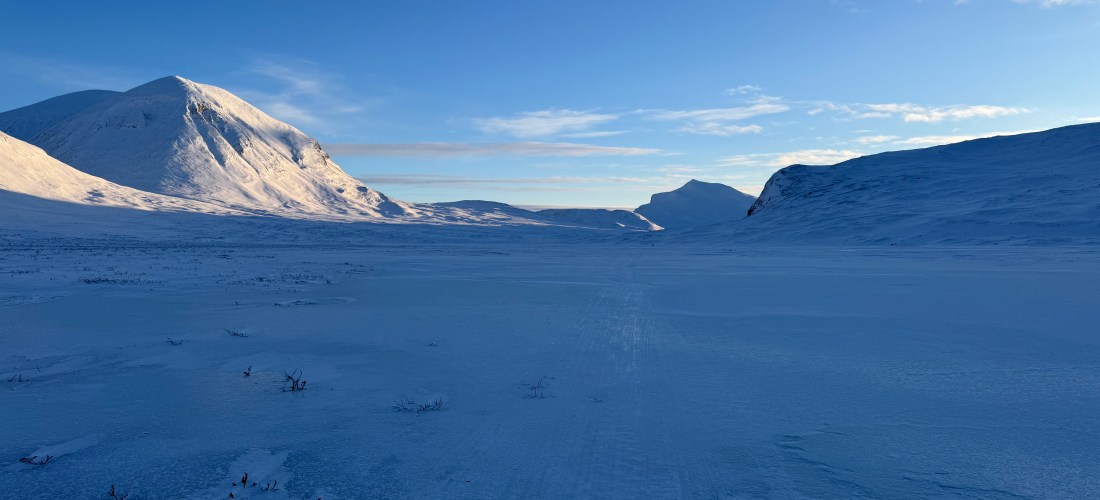
The cold has fingers.
They creep up my chest, slip around my ribs and slide up my spine, searching for a way in. I can feel them through three layers, thin and gentle at first, then harder, testing seams, pressing zips, hunting for skin.
I stop, exhaling billowing clouds of vapour into the -30 °C air. Kirstie’s headtorch bobs around somewhere behind me. Ahead, the valley is just an empty black hole in the mountains and a faint line of snowmobile tracks. No shelter. No lights. No room for mistakes.
I pull off a glove, then the liner, and push my bare hand under my jacket. My base layer is wet.
You sweat, you die.
Phil’s voice, from a warm classroom three days and a lifetime ago. Back then it sounded like scaremongering. Right now it feels final.
The sensible thing is obvious: stop, pitch the tent, light the stove, strip off the wet layer, wait until I’m warm and dry.
The racing part of my brain has other ideas: it’s only a couple of hours to the hut, just push harder, keep moving, you’ll be fine.
I stand there, heart hammering, the cold licking at the sweat on my skin, and realise this is the first real decision of the race.
A month earlier I’d joined a guide for a day’s ski touring in St Anton. I needed to test my skis and new boots, and it seemed like a good chance to check my mountain legs too. It was -15 °C when we started. With a growing sense of trepidation I wondered if my hands would ever warm up. Walking slowly up a valley deep in shadow, I took my gloves off and tucked my hands into my armpits. This jumped straight to the top of my list of fears, up with camping and wind.
As soon as I got home I started researching mittens for arctic conditions. Normally I love hunting for kit, but this time I needed something to stop me feeling sick with worry. Eventually I chose a pair and decided price would not be a factor. It was too important to skimp.
A few weeks later I spotted some windproof ski touring gloves with leather palms and fingers. They went into the kit bag too. Hopefully they’d be perfect working gloves; the idea of putting a tent up in mittens so big I looked like a lobster was not appealing.
To enter the race you needed relevant cold weather experience, which for me amounted to bivvying in a blizzard on Cross Fell during the Winter Spine race , a worryingly long time ago. Phil, the race director, said that because I’d got through that and carried on I’d “be fine” – but only for the 100 km, and only if I joined a three day training course beforehand. The 200 km sounded a long way and I had no desire to take on the full 400 km, so that all seemed reasonable.
As the date of my journey to the Arctic approached, the unease intensified.
“Why do you do this to yourself?” Zoe asked after I’d snapped at her for the thousandth trivial thing. “…and to us,” she added.
I didn’t really know. Maybe I still needed to prove I was as tough as I pretended to be. I’d realised that what had sounded like an exciting adventure was a foolhardy distance from my comfort zone.
I’d started to wonder if I could do the whole thing in one go, avoid the stress of camping and just push straight through. Last year’s winner must have done that, finishing in about 32 hours. Physically I was capable and I could handle one sleepless night. It was the unknown that unsettled me. A hundred kilometers in 32 hours is just a gentle walk. So what was I missing?
I managed to get on the wrong carriage of the train from Stockholm. The conductor cheerfully told me I was five cars away from my cabin.
“And you really don’t want to be here because the train splits during the night.”
Fucks sake.
Laboriously and sweatily I shuttled my massive kit bag up the train, then went back for my skis, over and over. This was not the restful journey I’d hoped for. As I paused for breath another conductor appeared.
“Where are you going?” she asked, brusque but smiling – the Swedish way, I think.
“Er… car 12, Abisko.”
“You’re there. This is your cabin.”
I’d been leaning on the wall opposite it.
Shaking my head at the lack of concentration that had nearly sent me marching past my own bunk, I gratefully piled everything in and collapsed, giving my nerves a chance to stop jangling.
“We have a bistro,” she popped her head back through the door, adding with another smile, “and we have cold beer.”
Perfect. I was okay now. The cabin was tiny – three bunks and just enough standing room – and I’d booked it early enough to have it to myself. The train was old, creaking and clanking, with puffs of ice cold air sneaking through cracked seals. It was going to be an adventure in its own right, but first I wanted a beer, some food, a book, and hopefully some sleep.
A couple of hours before my stop I spotted someone in the corridor with as much kit as me, staring out at snow laden fir trees reflecting the low pink sun. He looked grim and apprehensive. I recognised the look.
“Morning,” I nodded. “Heading to Abisko?”
“I am, yeah. Just been thinking how cold it looks out there. You on the training course too?”
My shoulders loosened a little.
“Yep. And fucking hell, it does look cold. I’ve gone from thinking I had too much kit to not enough.”
We swapped stories and dug out gloves ready for the short walk to the hostel, even though it was a relatively mild -10 °C.
The first day of the course was an intense blur of talks and practical sessions. By the end I was exhausted and heading upstairs for a lie down when Alex, the assistant race director, intercepted me. He has a huge amount of arctic experience, and a way of looking at you that makes you feel like he’s reading your mind.
“Go okay out there today?” he asked, one eyebrow raised.
I nodded, not entirely convincingly.
“I noticed you had your hands in your armpits. Not a good sign for the first day here – and it’s not even that cold.”
“Yeah. I’m not sure my gloves are up to the job. I’m going to try putting my outer mitts over them tomorrow.”
He frowned.
“We had a guy here last year with a similar issue. We pointed it out early. He did nothing about it. He was out of the race before the first hut.”
There were seven of us on the course and I was sharing a dorm with four (Stuart had sensibly bagged his own room; I’d left it too late. Kirstie was sharing with the other girl). We bonded quickly – partly from the growing sense of what we’d signed up for, partly because everyone was genuinely lovely and we all looked out for each other.
Slowly, an idea I’d been trying to suppress started to bubble up: maybe I could win this. Two years of therapy had loosened my grip on big, outrageous goals, but this one had slipped through. It sat in a dark corner of my head, feeding that tense, twisted feeling in my stomach: not just surviving, but proving I was tougher and faster than everyone else.
Most people here say they’re going to take their time, use the generous time limit, a voice in my head argued. You could just go. It still counts.
But what about Carlos? I countered.
Carlos? He’s the wild card. How cold does it get in Barcelona? Is he a cold weather guy?
He’s done the Winter Spine. He must have something.
On it went, until I dragged my attention back to the more immediate problem: not dying of all the things they were warning us about.
The more we learned, the more we realised how little we knew. With hindsight that was deliberate, to sharpen our focus. At the time it felt overwhelming; I could feel important survival information leaking out of my head. I just hoped it left a trace I could reach for when I needed it. One thing I did not forget was to do my zips up after a pee. The photo of a frostbitten todger was burnt into my brain forever.
Our second day ended with a mini “exped” (expedition to you and I), pulks fully loaded, to a forest nearby. The goal was to time how long it took to pitch tents and melt snow for a brew. I opted for hot chocolate instead of tea and was pleased how smoothly it all went. Guy lines tied to trees, neat little camp, snow melting away. Sitting in my tent, I wondered if this was the moment to try bringing the stove inside.
Phil had prefaced that lesson with, “Now, forget everything you’ve ever been told about stoves and tents. There is a way, but you have to be very careful.” It sounded insane. Looking at my stove out on the snow and the cramped nylon bubble around me, it seemed even more insane.
Earlier in the day I’d used some of John Bamber’s wire and my Leatherman to lash my stove to a chopping board wrapped in tin foil. It felt much more stable now. This wasn’t the kind of thing you can practice often – get it wrong and you’re left with no tent – but I figured it was better to try for the first time when I was relatively relaxed and warm, rather than exhausted and desperate.
To my surprise it was fine. Better than fine – brilliant. Within a minute I was toasty and had to take my hat off.
Taking the tent down later I ran into the problem I’d been dreading. I couldn’t do anything fiddly in the huge mitts, so I changed into liner and leather gloves. By the time my pulk was packed my hands were freezing. Jumping up and down, shaking them, doing the penguin dance, nothing worked. It felt like I had icicles instead of fingers, and the low level apprehension escalated to real concern.
I took a leather glove off and clenched and unclenched my fist. Instantly it warmed up. What the fuck? More layers are supposed to mean more warmth, aren’t they?
Then I remembered something Phil had said: air needs to circulate, and tight gloves can choke the blood supply. No blood, no warmth. You can’t wrap an ice block in a down jacket and expect it to heat up; the warmth has to come from somewhere. It’s easier to stay warm than to get warm once you’re cold.
That night Paul offered me some chemical hand warmers, saving me a three‑mile round trip to the supermarket (which turned out to be essentially a giant sweet shop). I tucked them into the “important things” pocket of my rucksack, half hoping I’d never need them, and half knowing I was bound to.
The night before the race I hid in a quiet corner of the library, trying to untangle the knot in my stomach. Admitting I was scared helped a bit, but the dread stayed. I kept picturing a grim trudge through Europe’s last wilderness: frostbite, the demons that turn up at the edge of exhaustion, the sheer effort of not stopping.
Underneath that was another image I couldn’t ignore: standing at the top of a podium, faster than everyone else. I’d never won a race before and the idea felt intoxicating. It would feel amazing. But every time I allowed myself to picture it, a small voice whispered: at what cost?
I felt drained and was grateful when Kirstie arrived with drinks and sat opposite me. She looked even more scared than I felt. Somehow we managed to calm each other down.
Amazingly we all slept pretty well. At last the waiting was over. We’d packed and repacked our pulks a couple of days before, so all we had to do was eat a big breakfast, make packed lunches, fill flasks, remember to pick up our stoves (two were forgotten last year), and kit up for the 9 a.m. start.
Somehow I ended up near the front as we set off into gently falling snow and the first section through the forest. It was slippery and crowded so most people walked, apart from the Scandinavians who shot off on skis, never to be seen again.
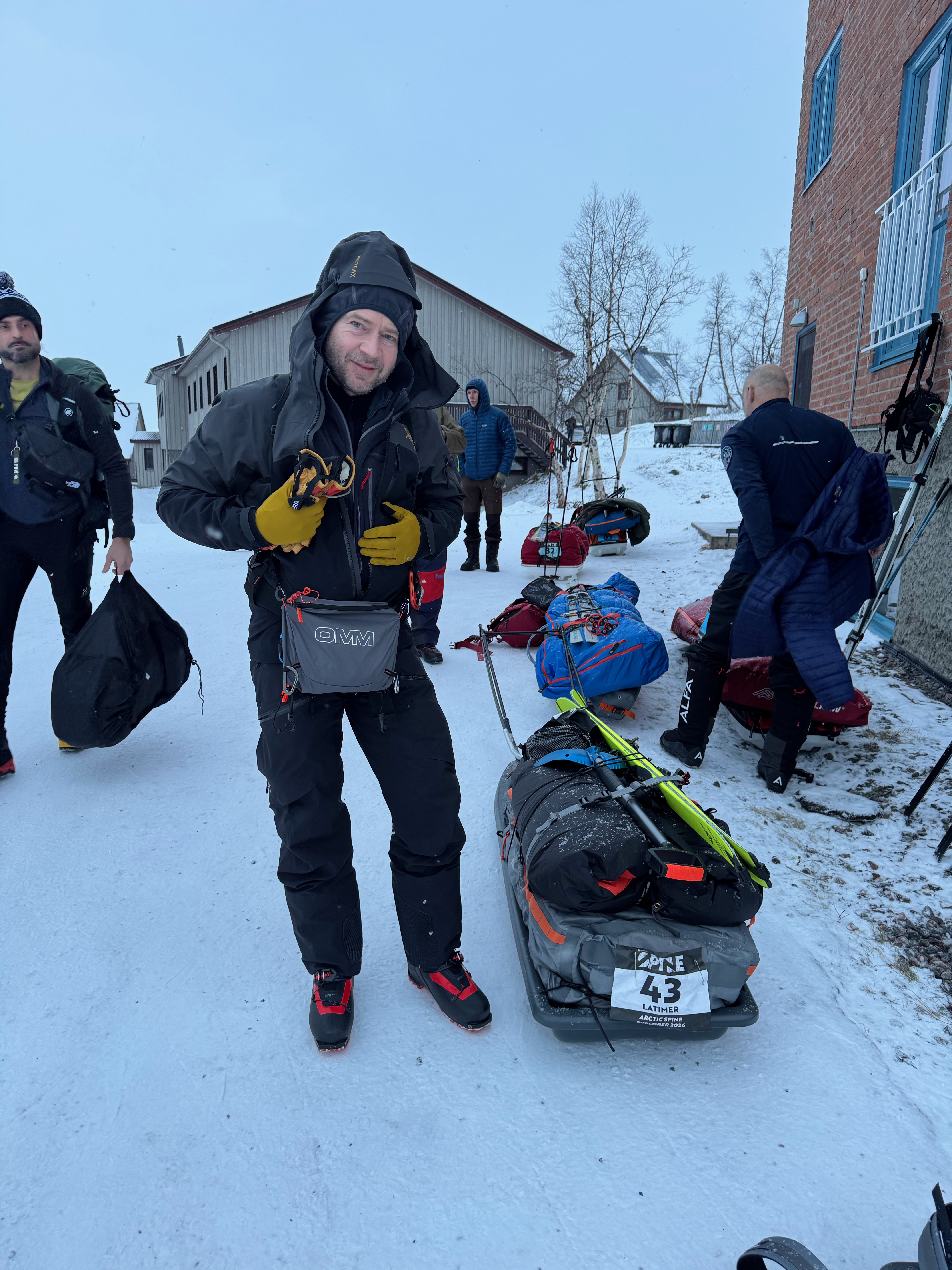
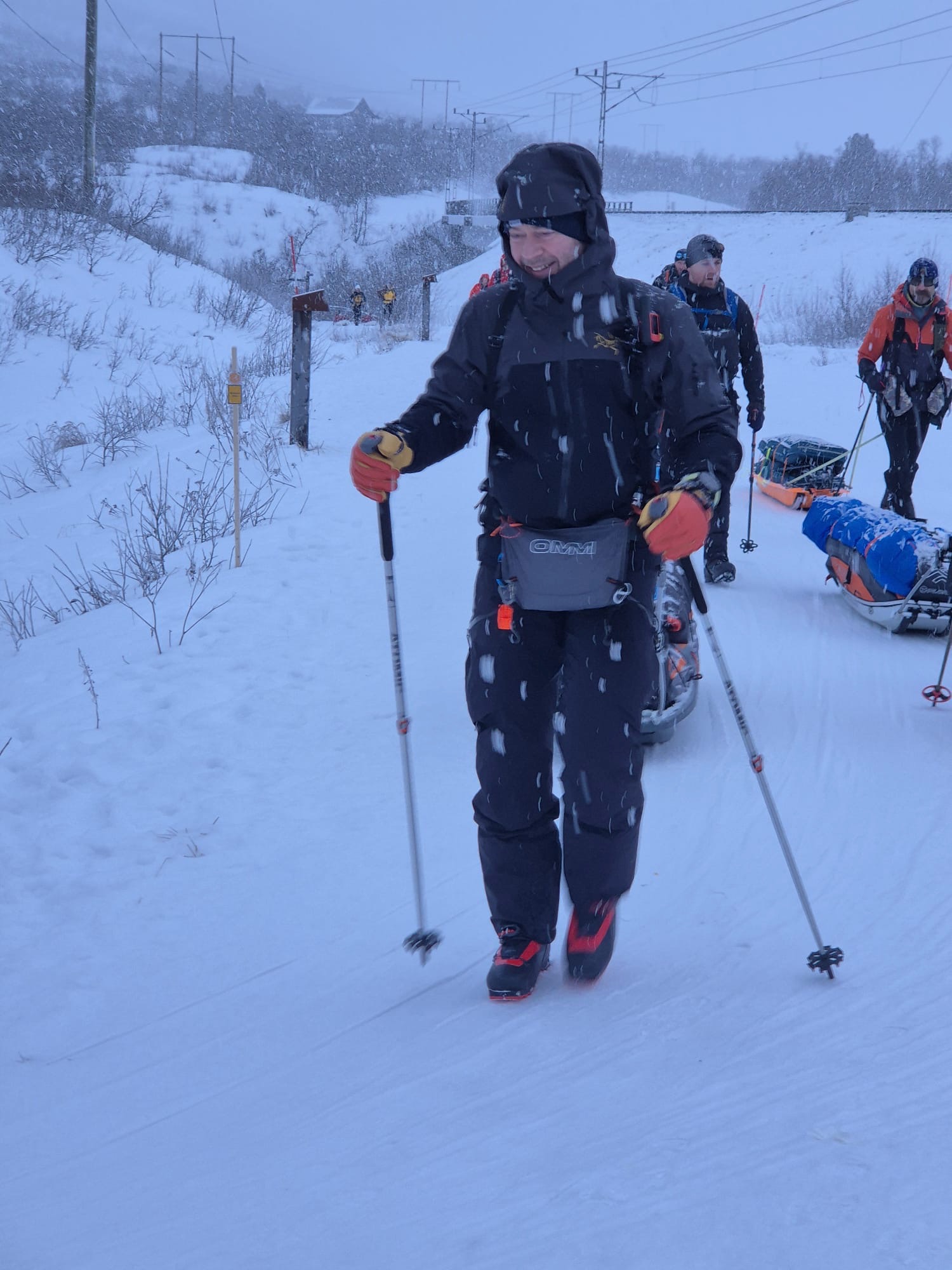
After a while I stopped to clip into my skis and strip off a layer. There’d been hanging around at the start and I hadn’t been brave enough to “start cold”, so now I was sweating – not ideal. People streamed past, which was fine by me. I settled into a gentle “all day” rhythm and decided to see what happened.
After two hours I stopped for a hot drink and some food. The plan was to do that regularly, to keep calories and hydration ticking over; it’s very easy not to bother, and there was a long way to go. Navigation and cold took up most of my headspace, but I did manage a few photos and a moment to admire the empty valley between snowy mountains.
It was such a relief to be moving. A few times I found myself grinning like an idiot. I’m actually doing this. It’s happening. After nearly a year of preparation and worry I was on skis on the Kungsleden trail, heading into the unknown. It was really, genuinely exciting.
I started to overtake people. By the time I reached the first pass I’d moved far enough up the field to catch Kirstie, who had marched off in trainers hours earlier. She’d stopped to put her skis on; the snow was deep. We chatted for a bit and then moved off together, but I’d stopped longer than planned and got cold, so I had to up the pace to warm up. Thankfully I’d paused just before a climb, so I had a nice incline to work some heat back into my legs.
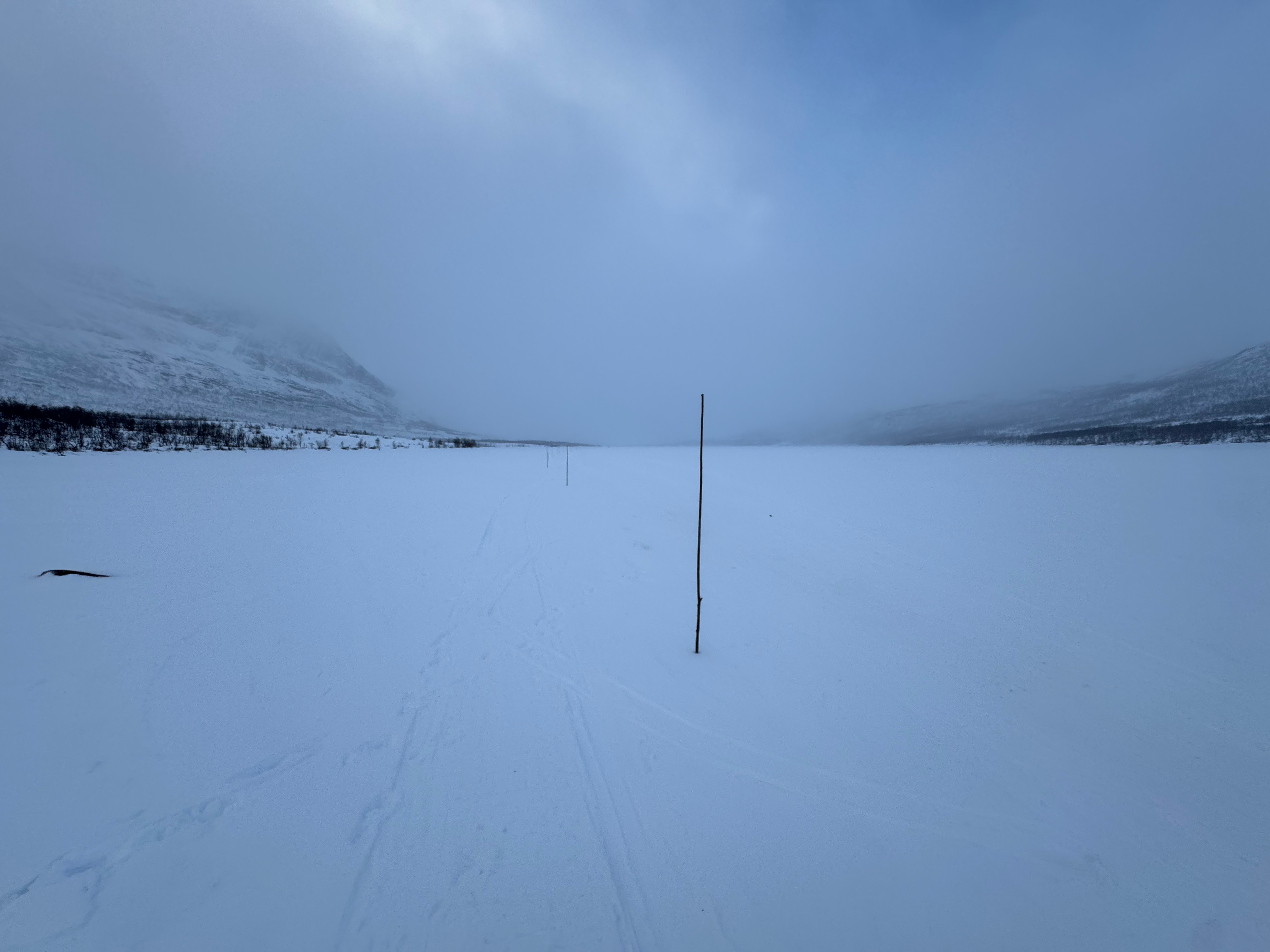
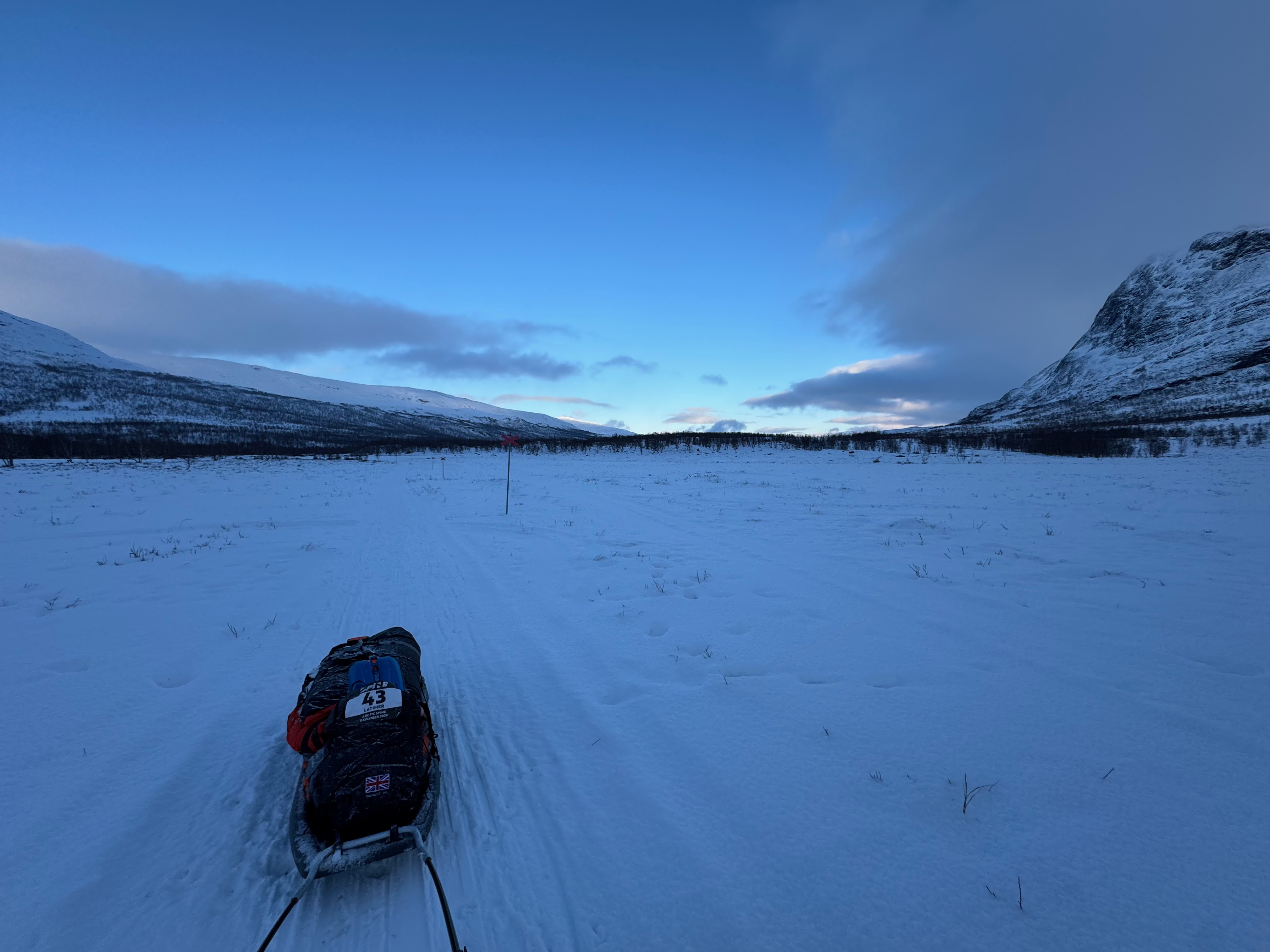
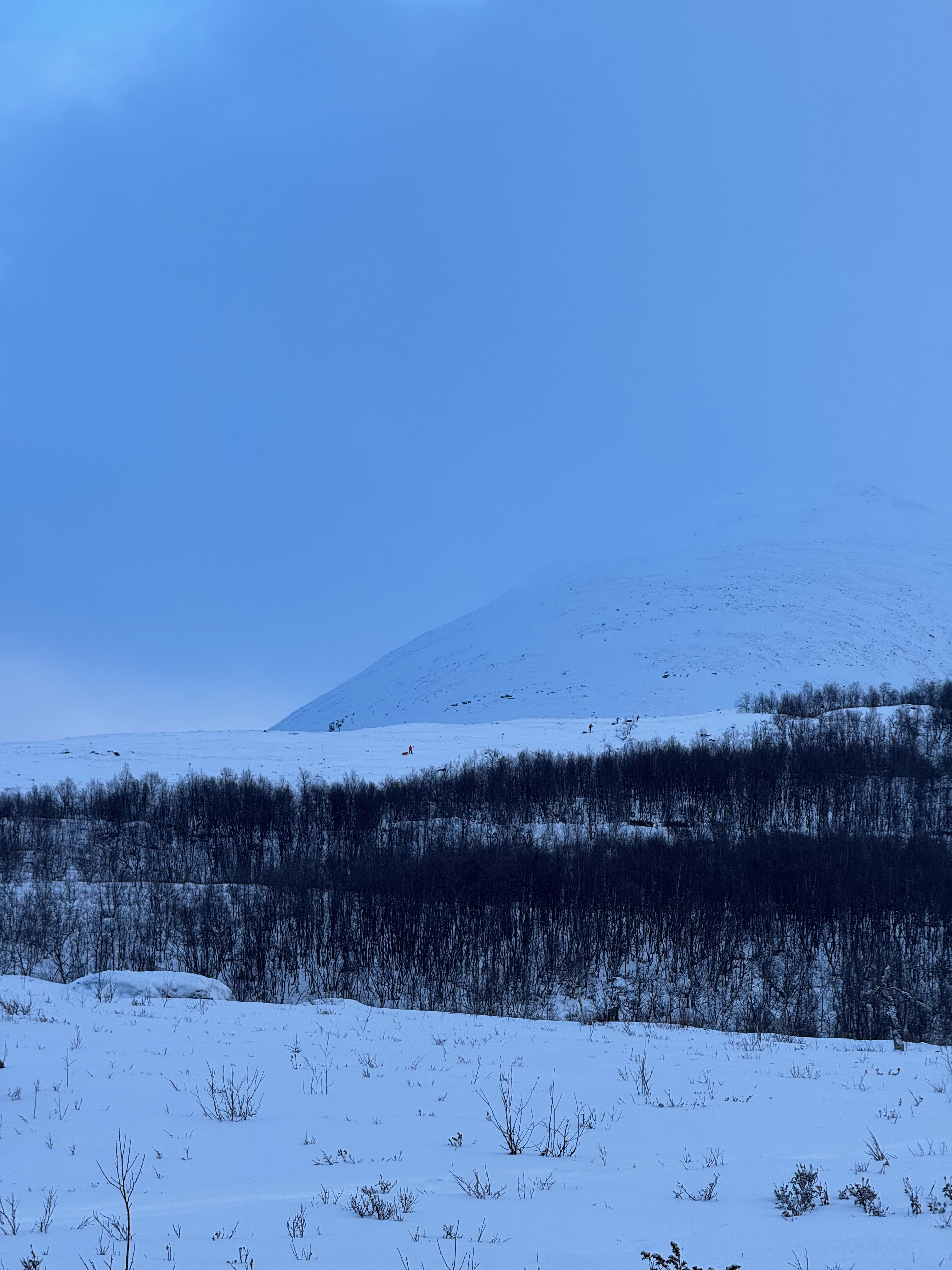
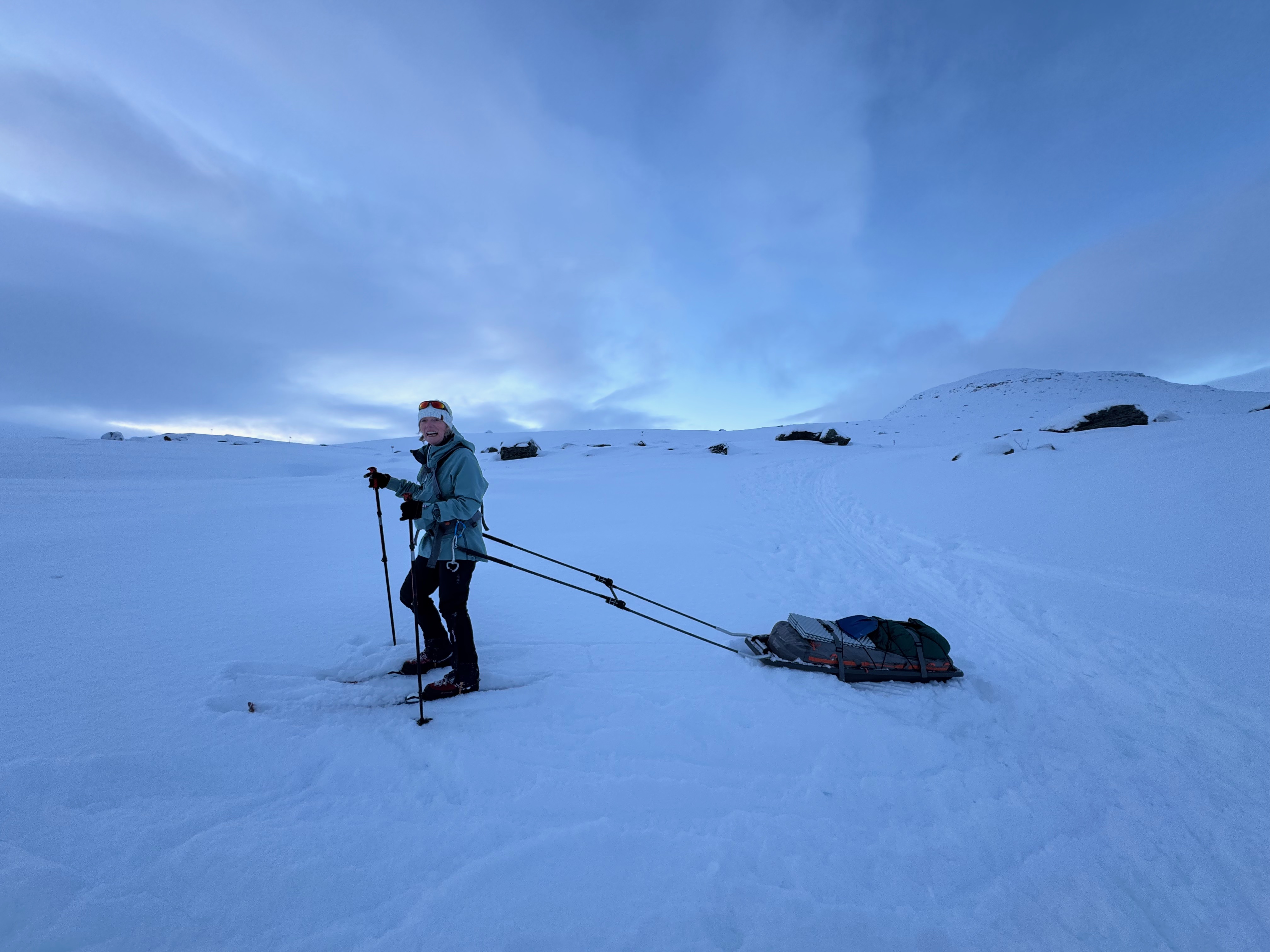
Part of me relaxed into my stride, happy just to be moving through this wide, white valley. Another part quietly counted every person I passed, nudging that thought back to the surface: what if I could actually win this?
The sun was going down as I headed towards a big lake, overtaking a few more people and feeling warm and positive. We had twenty-four hours to reach the first hut; I was hoping to do it in about fifteen. The real challenge, though, was avoiding sweat. I run hot and it was proving troublesome.
Gloves on, gloves off. Hat on, hat above my ears, hat off. Hood up, hood down, vents open, closed, half open. Constant little adjustments to stay somewhere between “sweaty” and “cold and scary”. I was down to a base layer and shell, even though it was -15 °C or lower. My pace was comfortable, running my own race. Not chasing, not waiting, just moving forward and hoping it was fast enough.
By the time I reached the lake it was fully dark. Red crosses marked the summer trail looping high around the shoreline; my GPX track followed them. On the map that route looked lumpy and hard work. I was hoping instead to cross directly over the lake, and sure enough most of the tracks of those ahead headed straight onto the ice.
The problem was, that line wasn’t marked with sticks. We’d been told that sticks indicated safe water crossings.
I followed the ski tracks anyway, my sense of impending disaster growing with each glide. Occasional cracking sounds didn’t help. A couple of headtorches swung somewhere high above – people who’d clearly taken the cautious line up towards the hut. Behind me, a few distant lights, at least a mile back. For the first time all day I felt completely alone.
I could hear Phil’s voice in my head, scolding me for blindly trusting a line I didn’t know was safe. Eventually I stopped and pulled my map out. Most of it was already lodged in my brain, but you can’t hold all the details. I was pretty sure I was now on the winter route; last year had been mild, which might explain why my GPX track gave the lake a wide berth. I wasn’t totally convinced, but I knew roughly where I was and which way I needed to go. I decided to keep moving, get off the lake, and stop for a snack at the hut at the base of the climb.
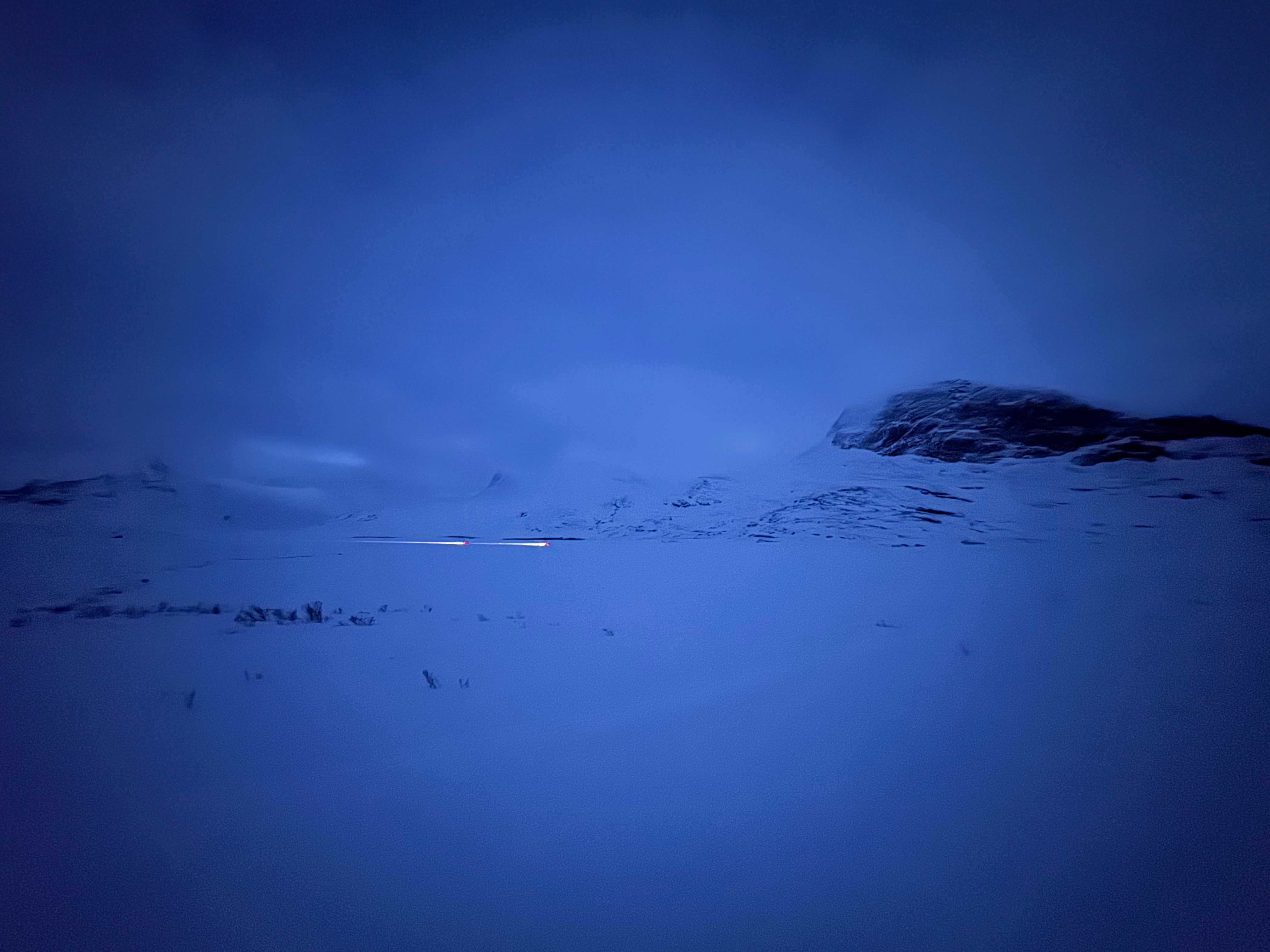
When my headtorch finally picked out the hut above me I felt an enormous wash of relief. It had been bitter on the lake and I’d added a mid‑layer fleece. I reckoned I could manage my heat with vents and hat for now, and if the wind picked up higher on the ridge I’d be grateful for the extra insulation.
There was a little downhill kink after the hut complex. Four or five people were milling around there and I had to do some clumsy turns to avoid either crashing into them or tipping myself and Killian – I’d named my pulk Killian, hoping that invoking someone more competent than me might make me a little more forgiving of its behaviour.
I overtook the three-man military team and the satisfaction of that small victory kept me moving briskly. They were doing the longer route, but I was faster than them right now, and that made me quietly happy.
As I climbed towards the high point the trail became faint. At one stage I thought I’d gone wrong, but the GPX on my watch insisted I was fine, so I kept grinding upwards. Way above, a flashing red light blinked in and out of view. I assumed it was the hut but it was impossible to judge the distance in the dark, with no stars to outline the mountains. Sometimes it vanished behind a ridge then reappeared, apparently no closer.
I was running low on water after more than twelve hours of near constant movement, breathing lungfuls of vapour into the dry air. I’d drained almost all the four litres I’d started with. My watch reckoned it was just a couple of kilometres to go, so I rationed the last few sips, keeping some back in case I needed to melt snow.
As I neared the hut I checked the time: about 10:30 p.m. I’d been moving for eleven and a half hours, well ahead of schedule, feeling good. Nothing hurt, I wasn’t particularly tired, and I’d reached halfway. It’s hard not to extrapolate in moments like that. With a short break, I could be out and over the highest point and well on my way to the finish within an hour or so.
Inside, John Bamber stood over a huge cauldron of hot water.
“Oh bloody hell, I wasn’t expecting you yet!”
“Sorry, can I get some water please?”
“’Course, lad, ’course. Hand me your flasks.”
I could feel myself overheating in what felt like a sauna. Worried about sweating into my down jacket, I stepped back out into the porch to think.
On the wall was a whiteboard with the forecast: -27 °C and dropping. Underneath someone had written:
> Stay safe. Keep warm. Make good decisions.
Make good decisions.
If I carried on, my core temperature would definitely drop. The route from here was mostly downhill, including a section just after the high point where I’d read about people getting tangled in their pulk lines and harness, struggling to free themselves before they got dangerously cold. Back in my warm local pub, pint in hand, I’d decided that doing that part in daylight was the only sensible option.
“How many have come through?” I asked John.
“You’re the fifth.”
Blimey. I really had been moving.
“Did you see Carlos?”
“Aye. He was third.”
I could probably catch him if I left now. I wavered.
The calm, wise voice that had been visiting more often lately spoke up.
Get some rest. Sort your kit out so you’ve enough food in your pack for tomorrow. Dry your sweaty things – they’ll be a problem if you push on. This is an adventure, remember? If you want to come back next year, wouldn’t it be better to have first hand experience of camping in -27? You’ve spent days training for this. Why rush it, be miserable, and increase the chances of dying? It’s going to be even harder to make decisions if you don’t sleep.
Stuffing my refilled flasks into my pack, I clipped my harness on and walked away from the hut into the night.
As I passed a cluster of tents I spotted a flat patch. That’ll do nicely.
I’m going to have a hot meal and a decent sleep, I thought. Good luck to Carlos. I hope he stays safe.
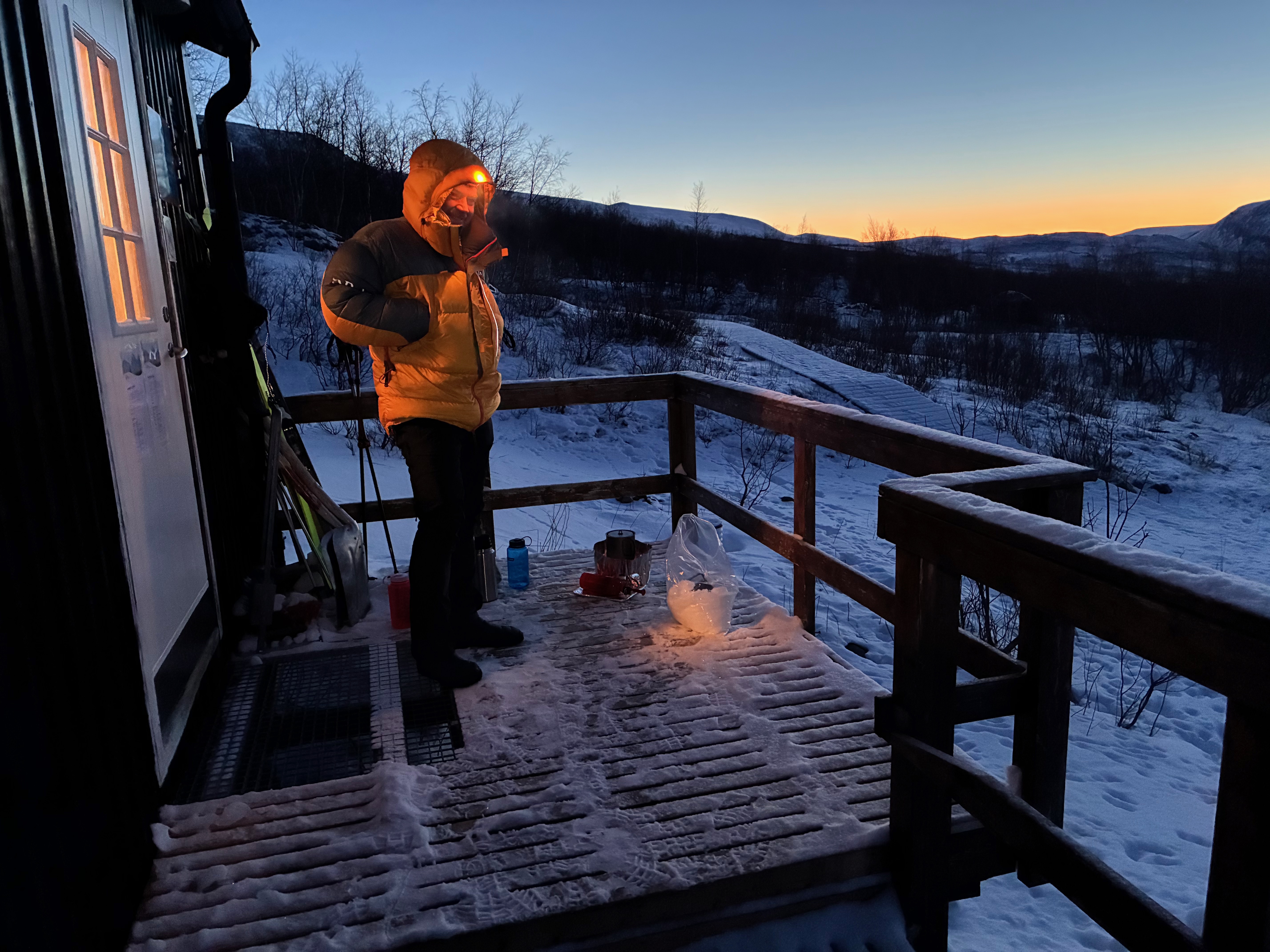
Within twenty minutes my tent was up, a little trench dug in the porch so I could sit properly, and the stove was roaring away, melting snow. I delayered, wrestled off frozen boots, then brought the stove inside to dry my hat and gloves. It was cosy, and the temptation to lie back and drift off was strong, but I forced myself to sit up, sort my bags out, and get hot food going.
I must have been more tired than I realised; everything took forever. It was nearly 1 a.m. by the time I wriggled into my sleeping bag. My feet glowed around a hot water bottle (I’d only just learned you can put boiling water straight into a Nalgene) and I cinched the bag tight around my neck to keep my breath out. As I drifted off I heard Kirstie’s voice outside. She’d made it too. I relaxed a little more. Maybe I’d see her in the morning. I was in no rush now, and set my alarm for 6 a.m., aiming to be back on the trail by eight.
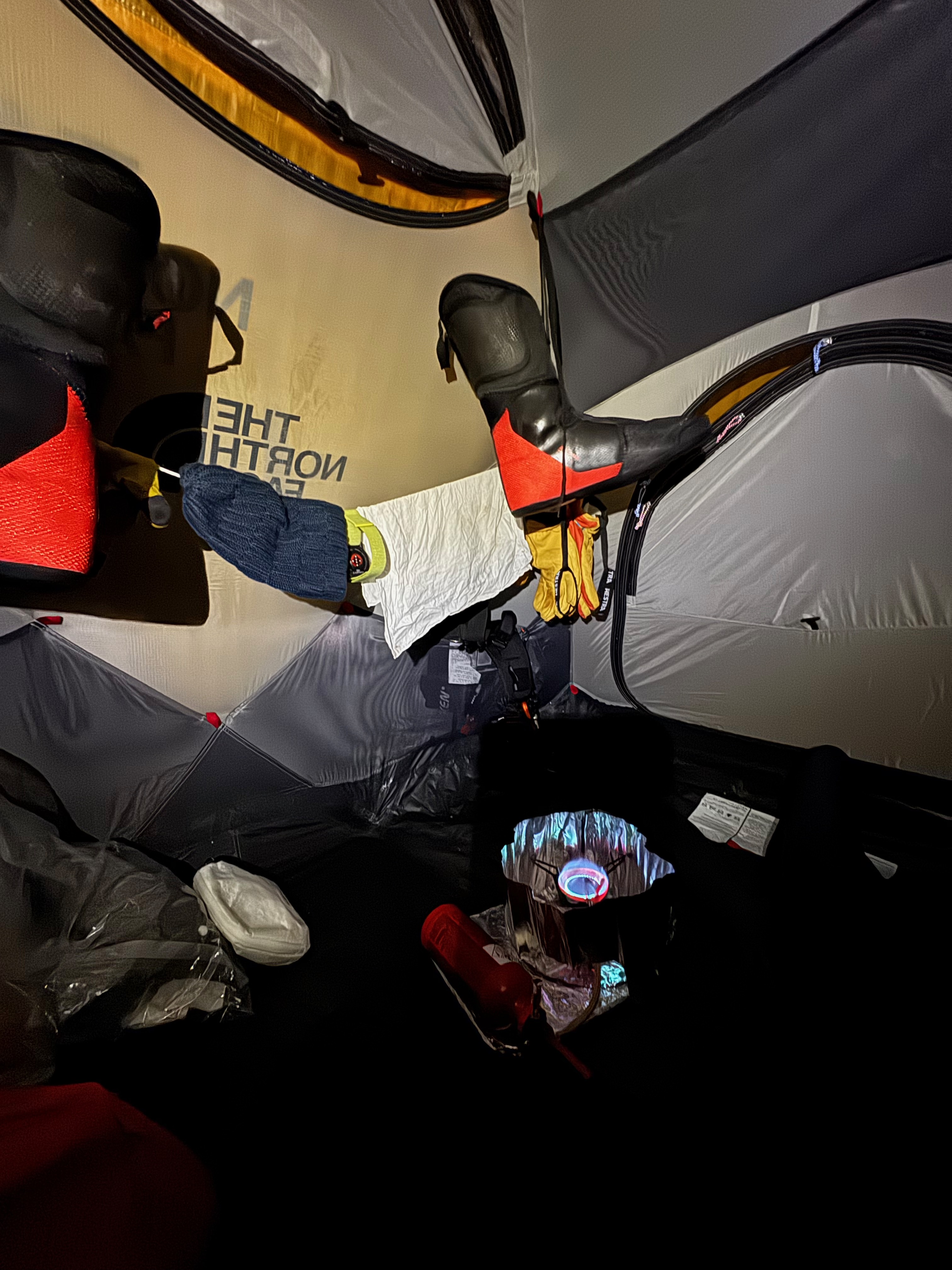
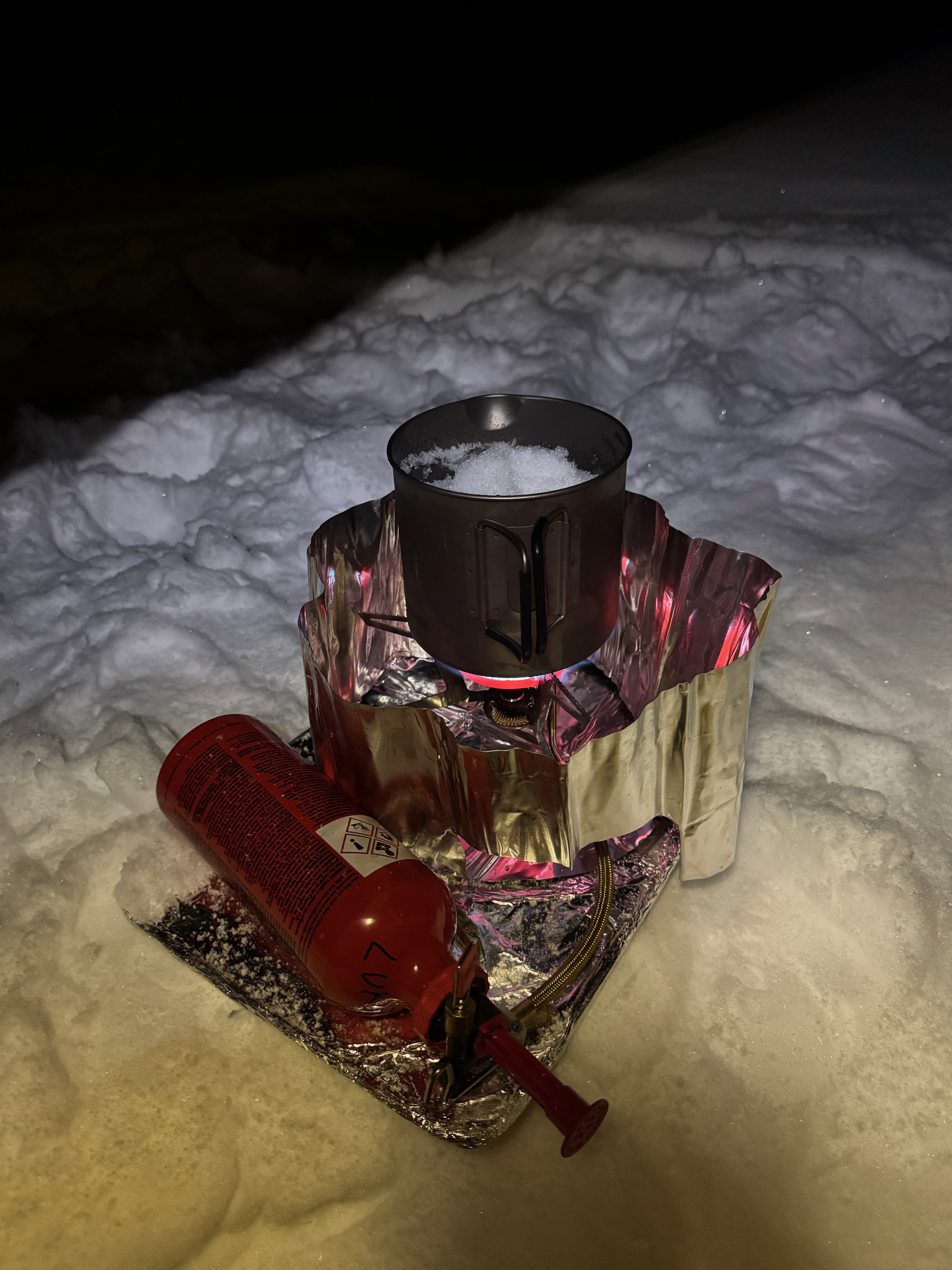
I slept unexpectedly well. I hit snooze a couple of times before accepting it really was time to move. Headtorch on, I surveyed the tent. I needed a plan: once I was up I’d start getting cold, and there would be no time for faff.
My reading glasses were crusted with ice – urgh, mistake. Everything else was frosted too, but that was easy enough to brush off. One of the mantras drummed into us was moisture management. Snow and ice creep into every nook and cranny; if they melt, they ruin your insulation. Down works by trapping warm air; water conducts heat straight from the warm thing (you) to the cold thing (everything else).
My head was foggy from sleep and, as I faffed around making breakfast, the ice on the inner tent warmed just enough to let go and fall as snow. I’d known this could happen but had forgotten. Shit. I scurried around to get everything into the pulk, then brushed the ice into a pile and chucked it outside. Still warm inside my big jacket, I ate quickly, packed up, and got moving – after five minutes of swearing at my frozen boots again. Another mistake: not putting hot water bottles in them when I got up.
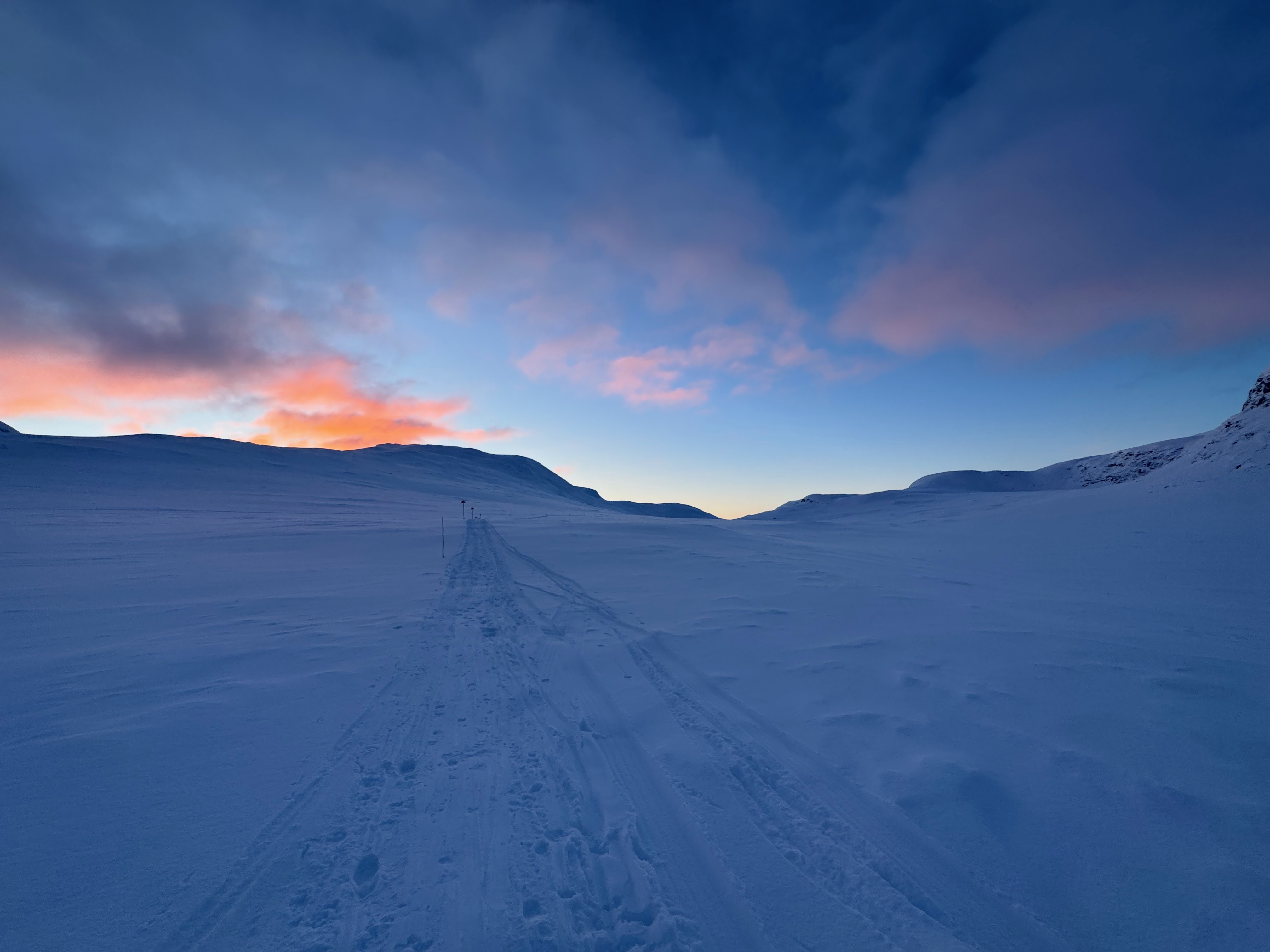
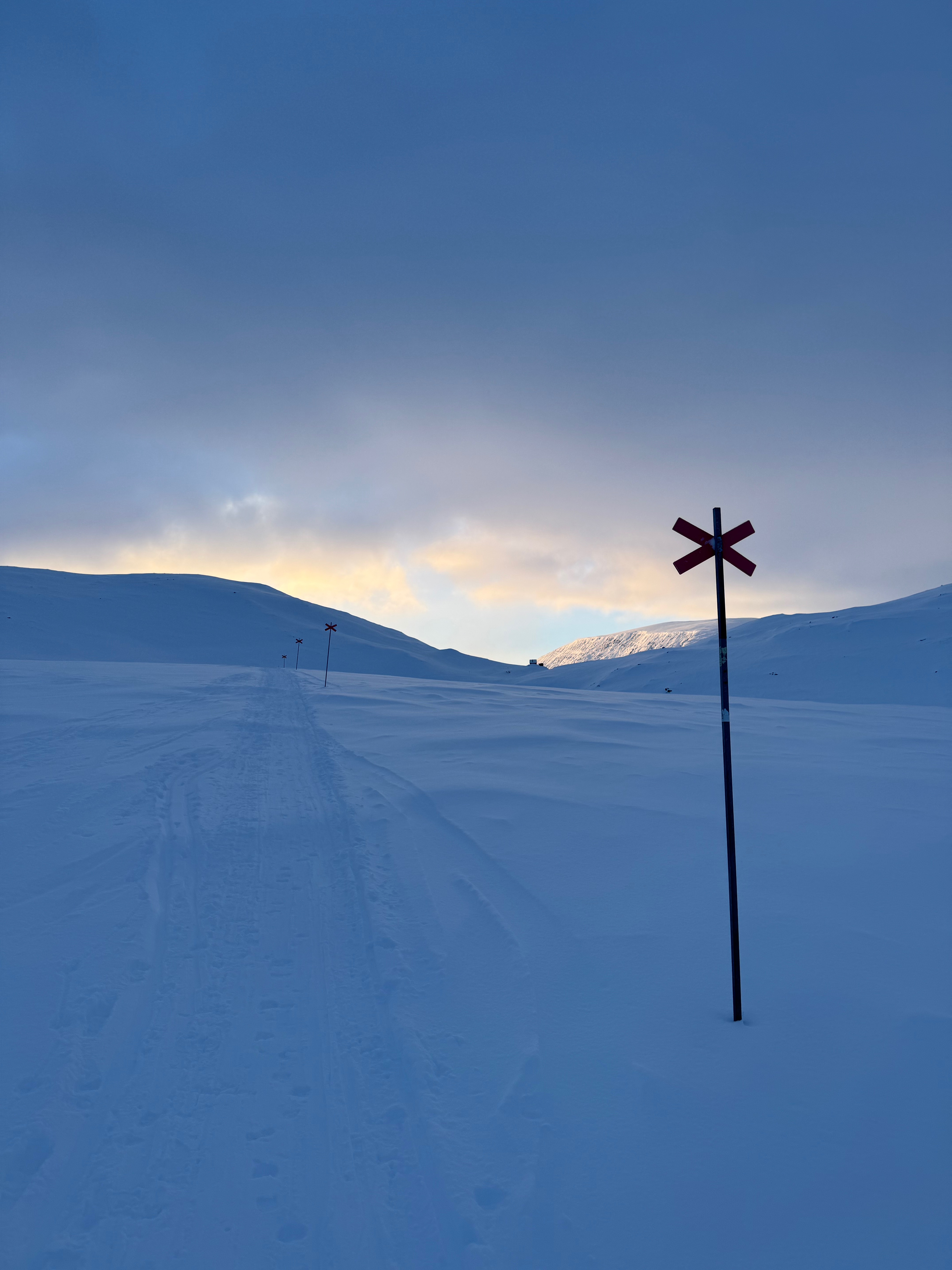
The sun wasn’t fully up yet and the sky was a pale, clear blue. It was the most beautiful morning I’ve ever experienced, made even better by the fifty kilometres I’d already covered to get there. The mountain tops glowed pink behind me. As I slid up the trail I felt rested and happy.
Something in me unclenched. For the first time since London, the knot of dread and ambition in my stomach loosened. I stopped trying to measure everything in hours and places and let myself just move – a tiny dot sliding through a huge, pristine, pink tinged silent valley.
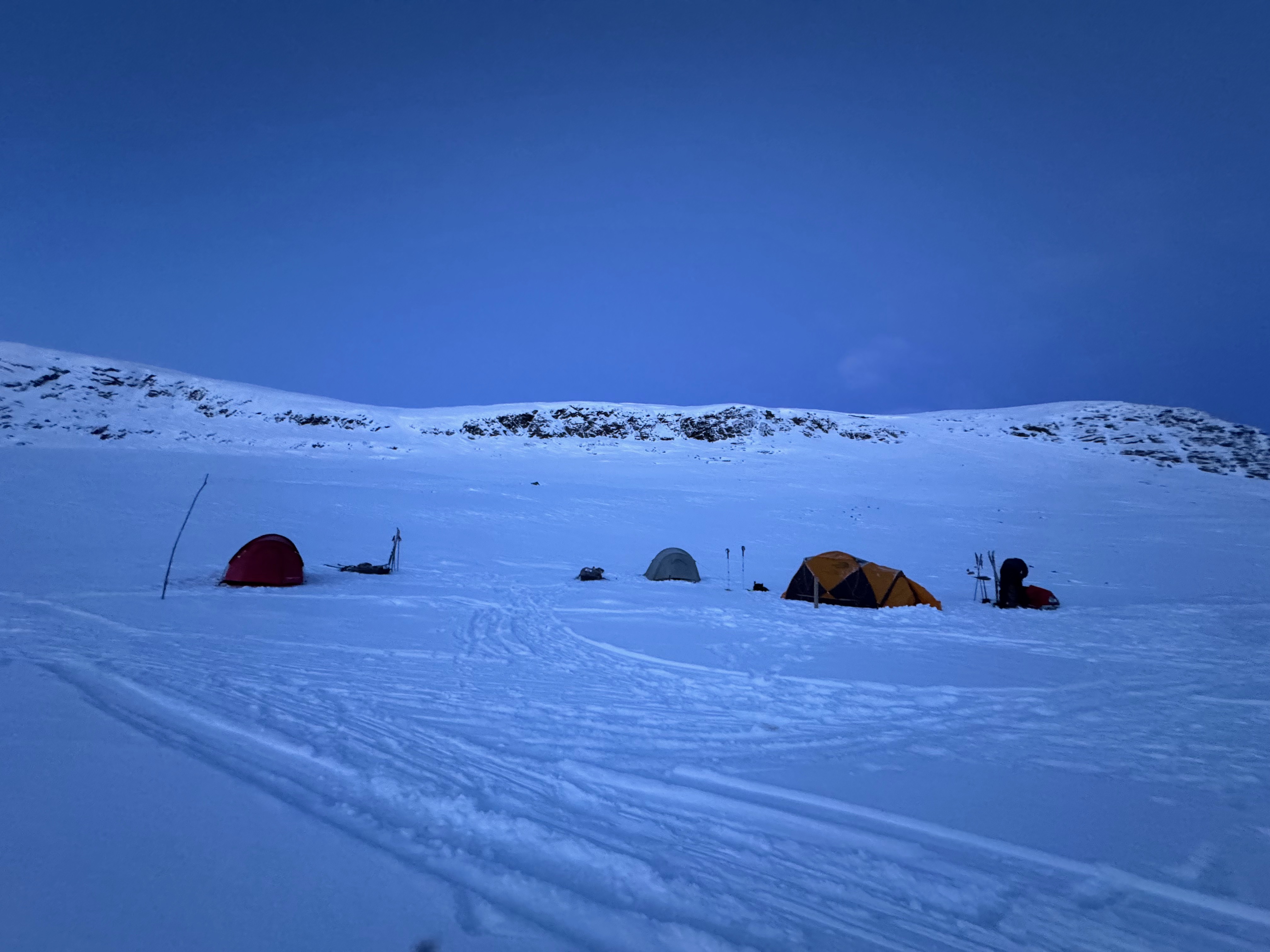
Then I got really, really warm, pulled a layer off, and wondered how many places I’d lost overnight. There had been no sign of Kirstie or her tent; maybe I’d see her later.
I reached the pass quicker than expected and paused. Ahead lay a wide, unmarked snowfield, barely any tracks, just crying out to be skied. This might be my only chance. I whipped my skins off, tucked them inside my jacket to keep them warm, clipped my heels down, and pointed my skis downhill.
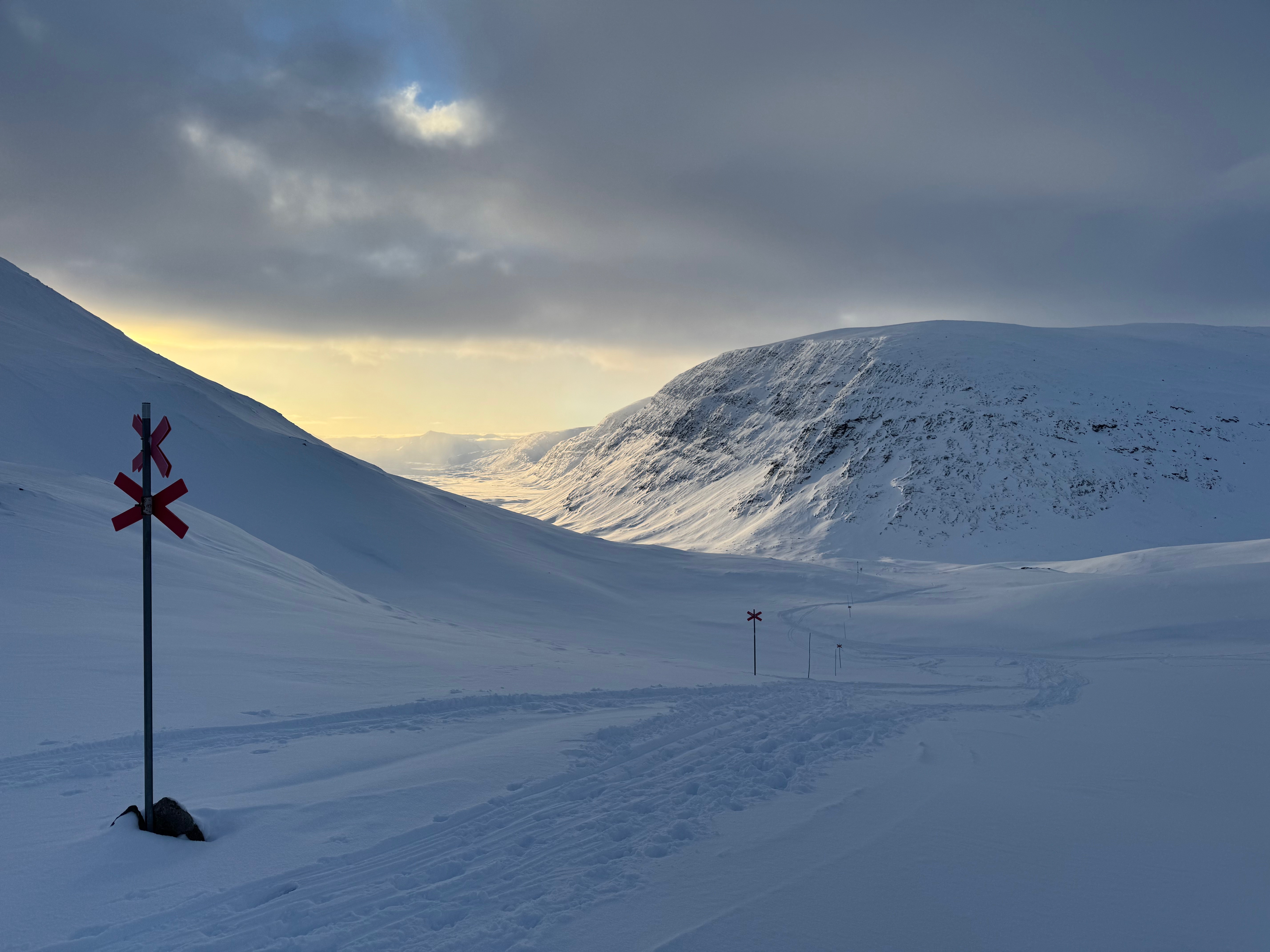
It was glorious: soft fresh snow in early sun, blue sky, just a couple of people far ahead. With wide, swooping turns I cruised down, momentarily forgetting I was tethered to a sledge full of kit.
That’s the problem with being too happy – you stop paying attention, yet another thing to monitor. The pulk flipped, threw everything out, the harness twisted, and I ended up face down in the snow. Feeling slightly sheepish, I put it all back together, grateful nothing had broken, and watched Max shoot past whooping with joy. I caught him later and discovered he was a local on a two week holiday, doing the Kungsleden on his own. That was sobering.
The next couple of hours passed uneventfully, apart from meeting another solo winter Kungsleden traveller, Yan from Switzerland. We chatted for a bit; I’d see him again at hut 2, where he’d be very disappointed to find it heaving when he’d been hoping for two weeks of quiet solitude. Oops.
Squinting into the sun, I tried to decide if the figure ahead was Kirstie. The hat looked right, and I recognised the way she moved. By the time I caught up she’d stopped for a break, so I parked up beside her.
“Alright, you badass mum?” I said.
She laughed – always smiling, unlike some of the people I’d passed the night before. “You look happy. How’s it going?”
“I’m having a great day. Time for some spaghetti bolognese, I think. Hot food in the sun – what a spot.” I messed around with flasks and pouches, then settled in to admire the view. “What are you eating?”
Her face fell. She held up a plastic bag.
“Slop. And it’s all frozen into one horrible lump.”
“That sounds a bit shit. How was yesterday? Sorry I left you – I got cold. Long old day, that.”
“It was long, and I kept fainting, which didn’t really help.”
“What the fuck, woman, that’s not good.”
“I know it sounds bad, but I can manage it. I’d just lie down for a bit, get some food in, then move on until it happened again.”
I shook my head, but didn’t tell her she needed to eat more – she knew. Still, there was a long way to go and I was more than a little concerned.
“Um,” I said, rummaging in my pack, “want a biscuit?”
Kirstie’s head snapped up, eyes suddenly bright.
“Biscuit? What sort of biscuit?”
“I dunno… these.” I handed her a blue plastic tube.
“These are Jammy Dodgers! Bloody hell, Jammy Dodgers – Swedish ones. Are you sure I can have one? I can’t believe it: middle of bloody nowhere and you’ve got biscuits. Are you sure you don’t mind? Jammy bloody Dodgers.”
“Of course. I’ve got way too much food” I smiled.
I packed up and headed off, leaving Kirstie smiling and munching. Hopefully she managed to get some calories in and stay warm. You can’t brute force something like this, and I knew she knew that.
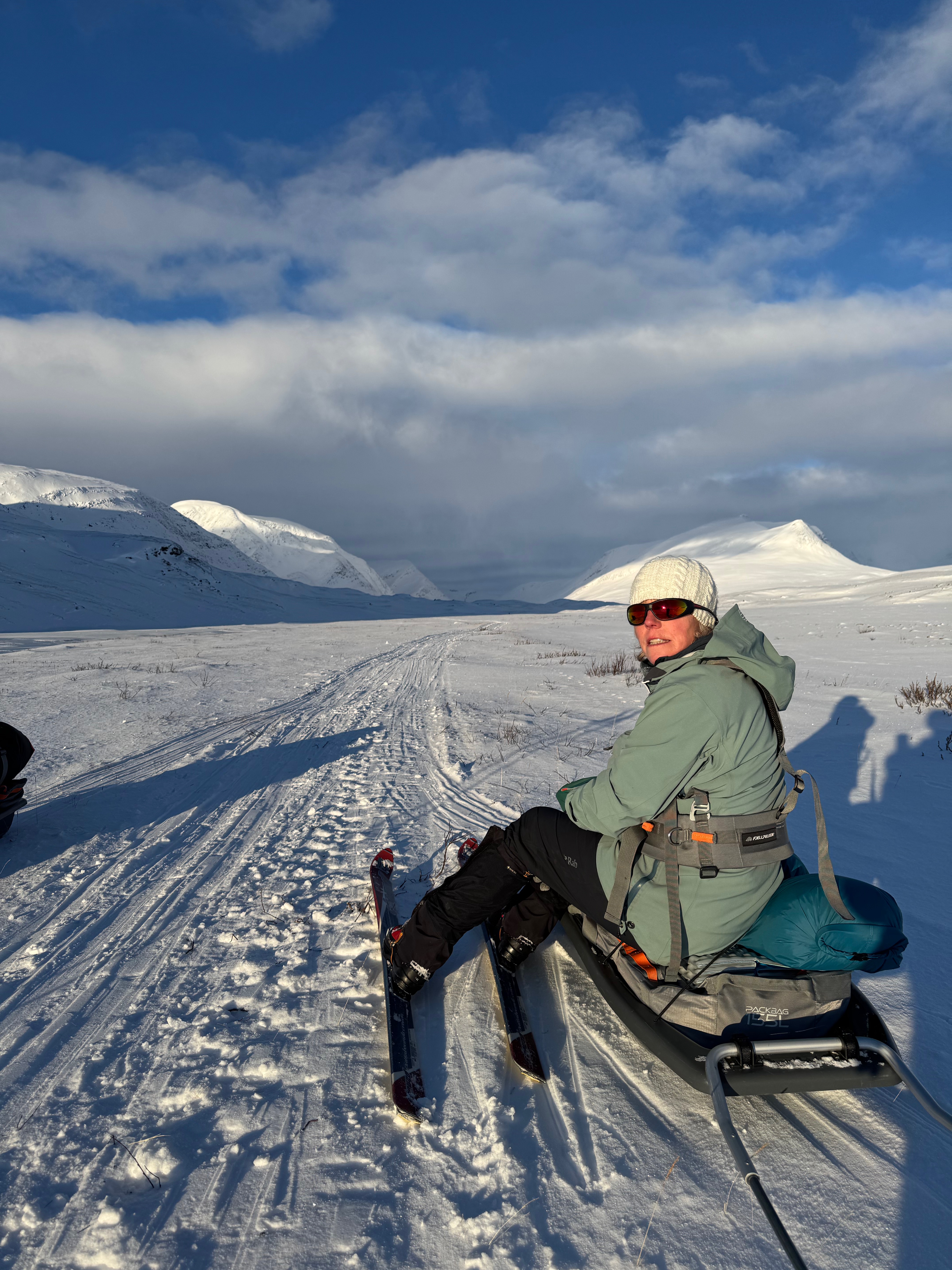
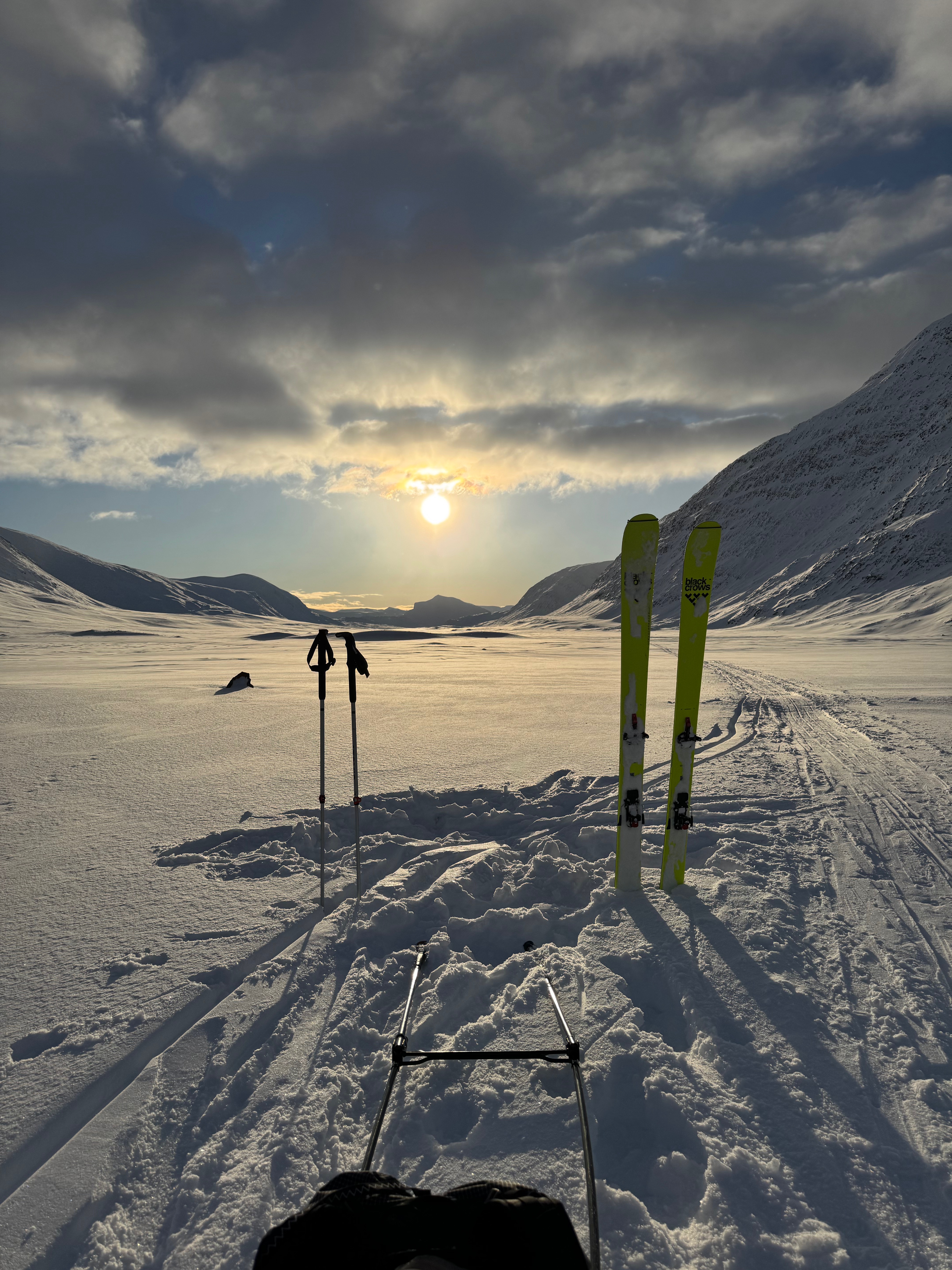
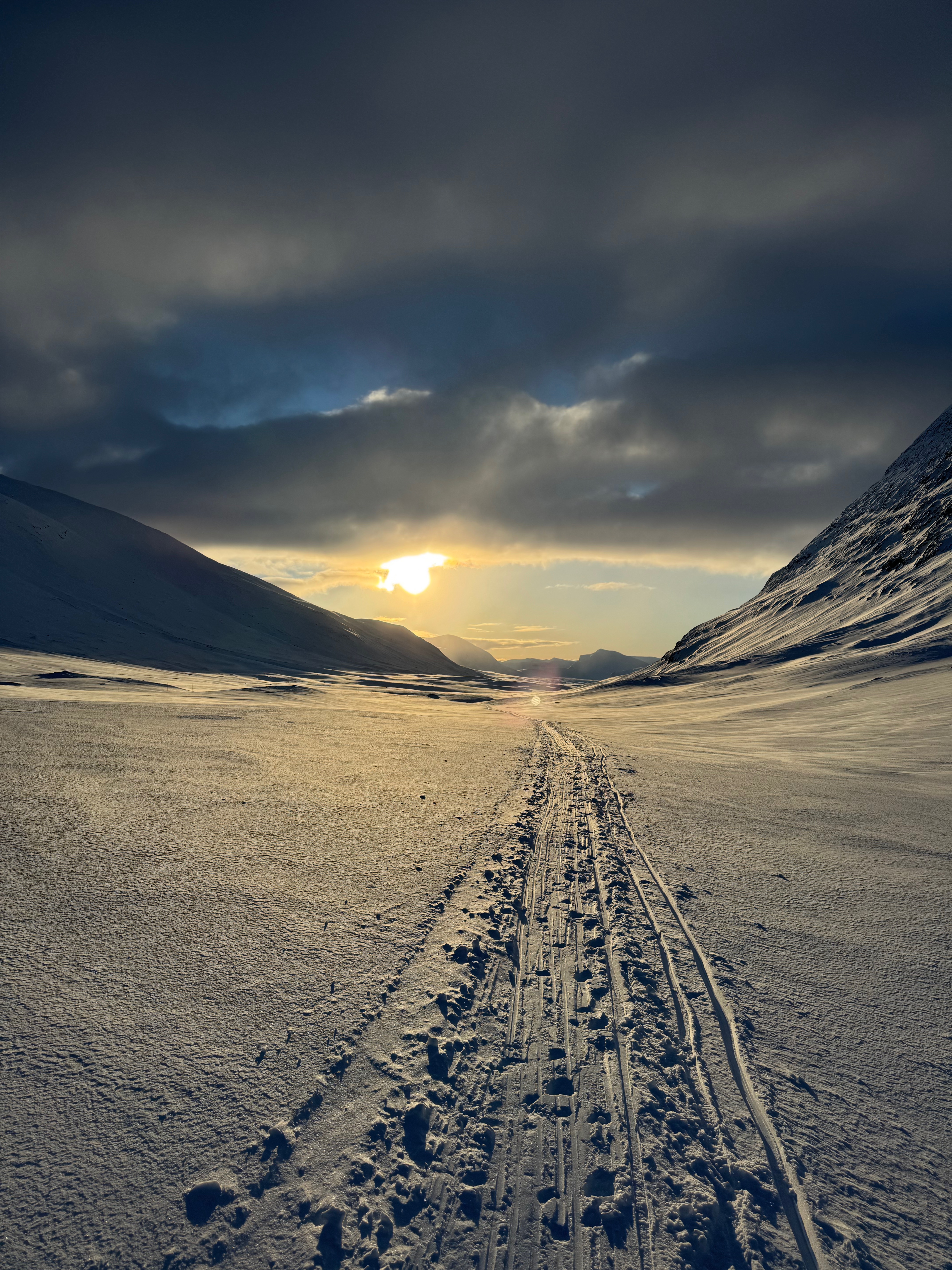
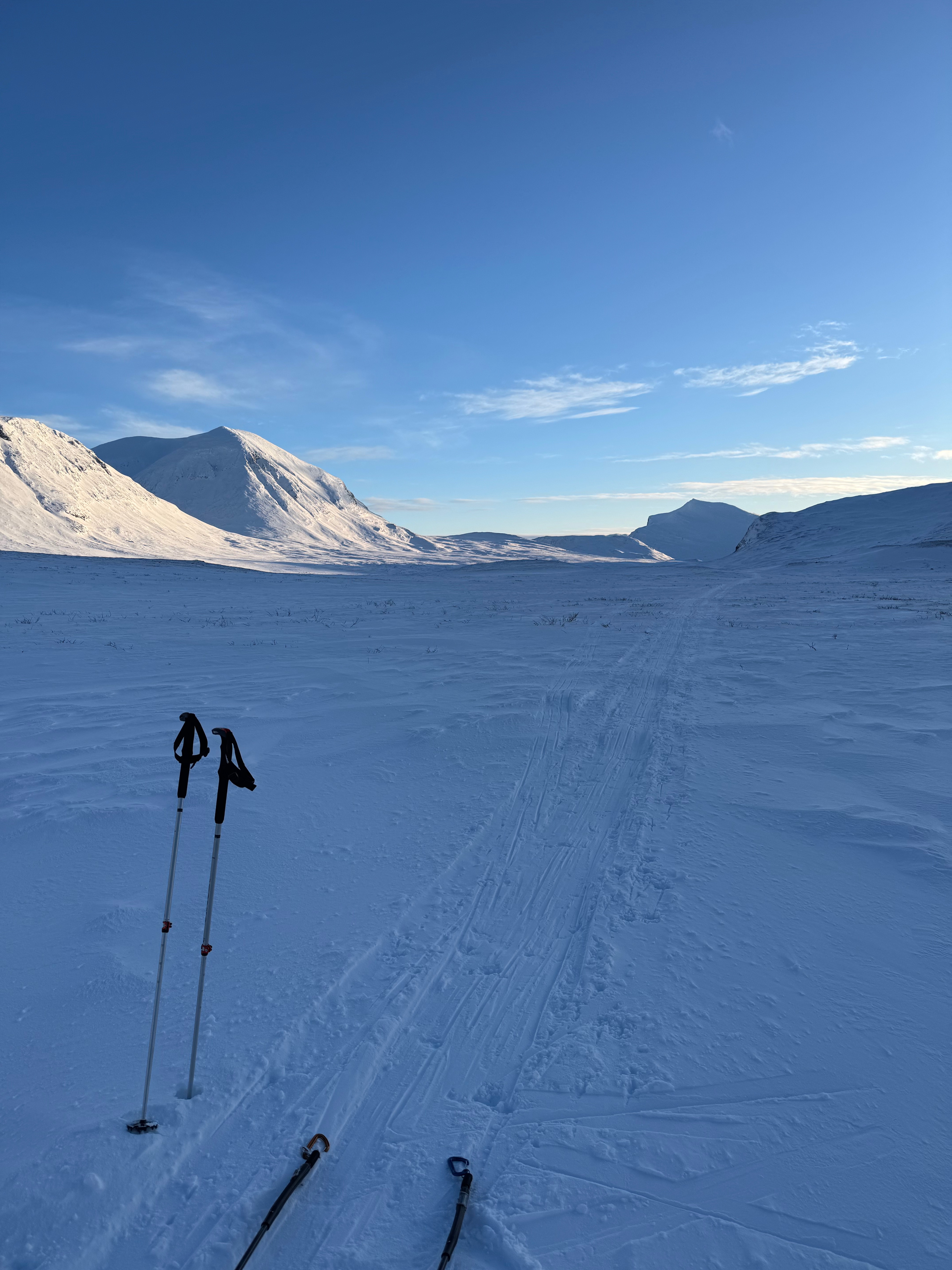
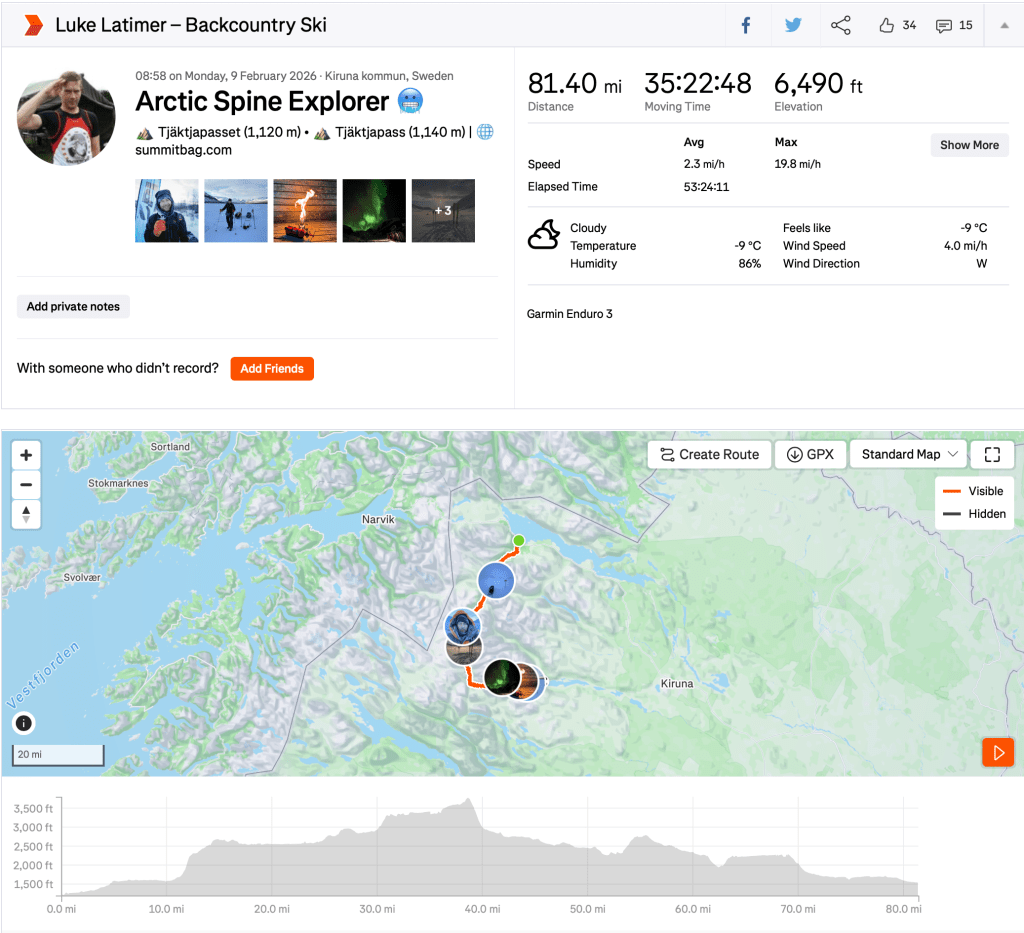
The rest of the day passed uneventfully, in that nothing dramatic happened. It was still around -27 °C and I was fighting to keep even one bottle of water from freezing so I could stay vaguely hydrated. The plan was simple: reach hut 2, refill flasks, eat, and then push on to the finish. I’d left hut 1 just before 8:30 that morning and, if I held this pace, I should be done before midnight.
As I wound around the last few hills, skirting a Sámi village, it started to get dark and I felt more tired than I expected. The constant low level vigilance – monitoring cold, sweat, navigation – was draining. I began to question whether a long, dark valley on my own was such a great idea. Maybe I could sleep in the hut instead. There should be an emergency shelter; the safety team would be using the main one, but at least I wouldn’t have to pitch the tent.
I parked my pulk alongside a cluster of others and a couple of snowmobiles, wrapped myself in my duvet coat, grabbed my flasks and stepped out of the wind into the porch of what looked like the centre of activity.
Alex appeared with a smile.
“All okay? I’ll get those filled for you.”
I smiled back. “It’s a bit cold out there. What’s the shelter situation here?”
Behind him I could see wooden tables and chairs around a roaring log burner. Waves of delicious heat rolled towards me, melting the icicles hanging from my eyebrows.
“Sorry, mate. It would be chaos if we let you guys in there,” he said. He was right – and I didn’t really want to melt all the ice on my kit anyway. “The emergency shelter’s closed, but you can use this room here.” He pointed to a wooden door behind him.
“Okay, great, thanks.” I pushed it open, hoping for a little haven.
Nope. It was the size of a small single bedroom, with one bed and a window that seemed to have ice on both sides of the glass. A man sat on one of two stools, spooning some sort of slurry into his mouth, staring at nothing. I recognised that dead eyed, zombie stare from the Pennine Way, though it felt a bit early for that look here.
I perched on the edge of the bed, trying to ease the ache in my lower back, and sorted some food while I figured out what to do next. The smoke alarm needed new batteries and beeped every few minutes. The room was freezing; I kept my coat on.
Paul arrived, then Kirstie, and we had a little reunion and catch‑up. Paul was doing the Challenger and would be turning off onto a different route after this.
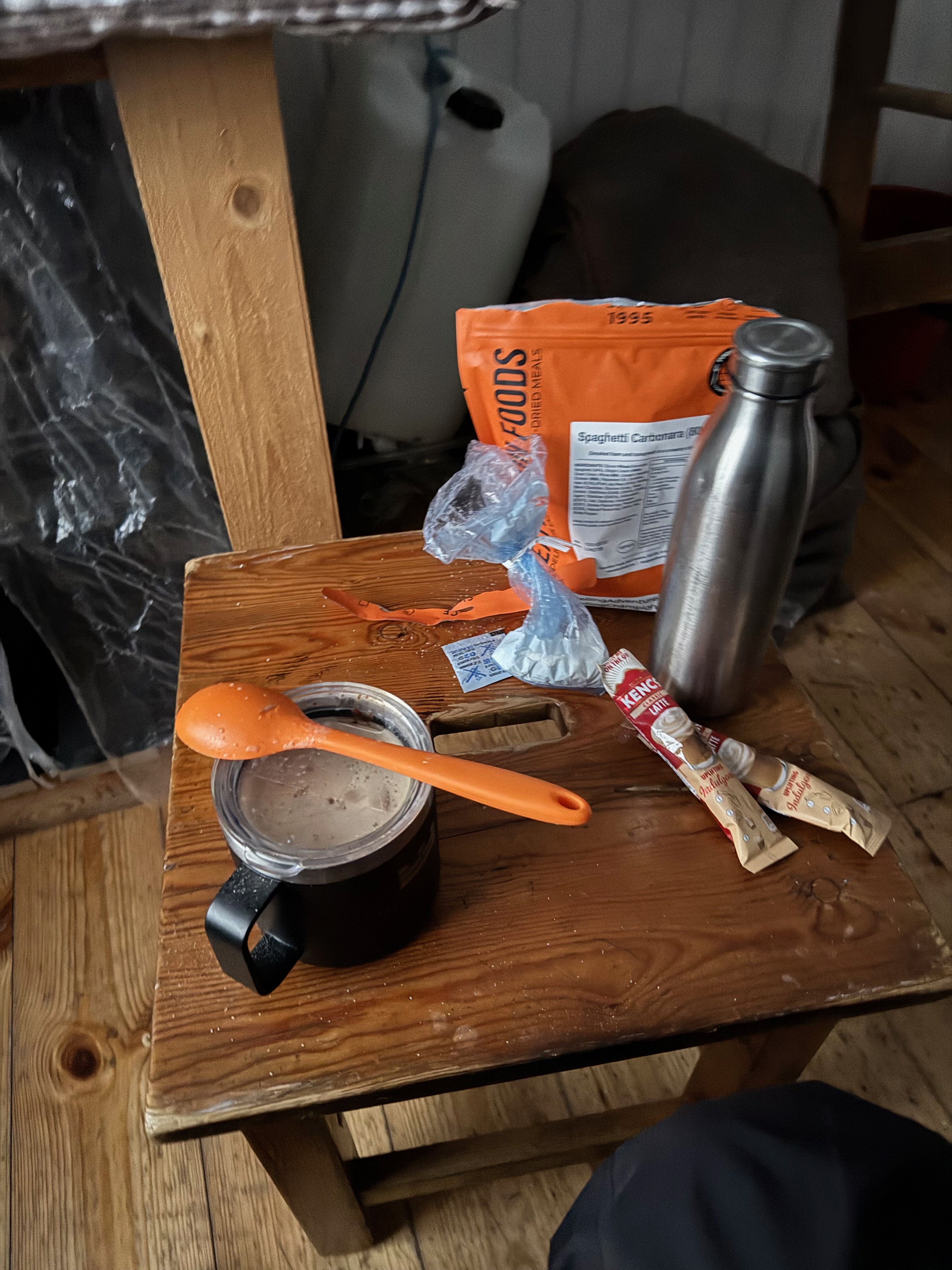
“What’s your plan, Kirstie?” I asked once she’d eaten.
“Not camping,” she said, with conviction.
“Same. I don’t really want another eight hours in the dark down that valley either.”
Jack from the media team poked his head in.
“We’ve just come up from Nikkaluokta. There’s a lot of sheet ice down there, and overflow on some of the lakes. Be careful – our snowmobile was skittering all over the place.”
Kirstie and I exchanged glances.
“I’m going to head to the hut about halfway down, Kebnekaise,” she said. That sounded ideal. I pulled my map out, saw I’d circled the hut weeks ago. It wasn’t much of a detour.
“Mind if I join you?”
“That would be great. I’m going to get moving soon though.”
“Okay. I need to brave the outdoor toilet and fix a broken bit on my pulk. I’ll catch you up.”
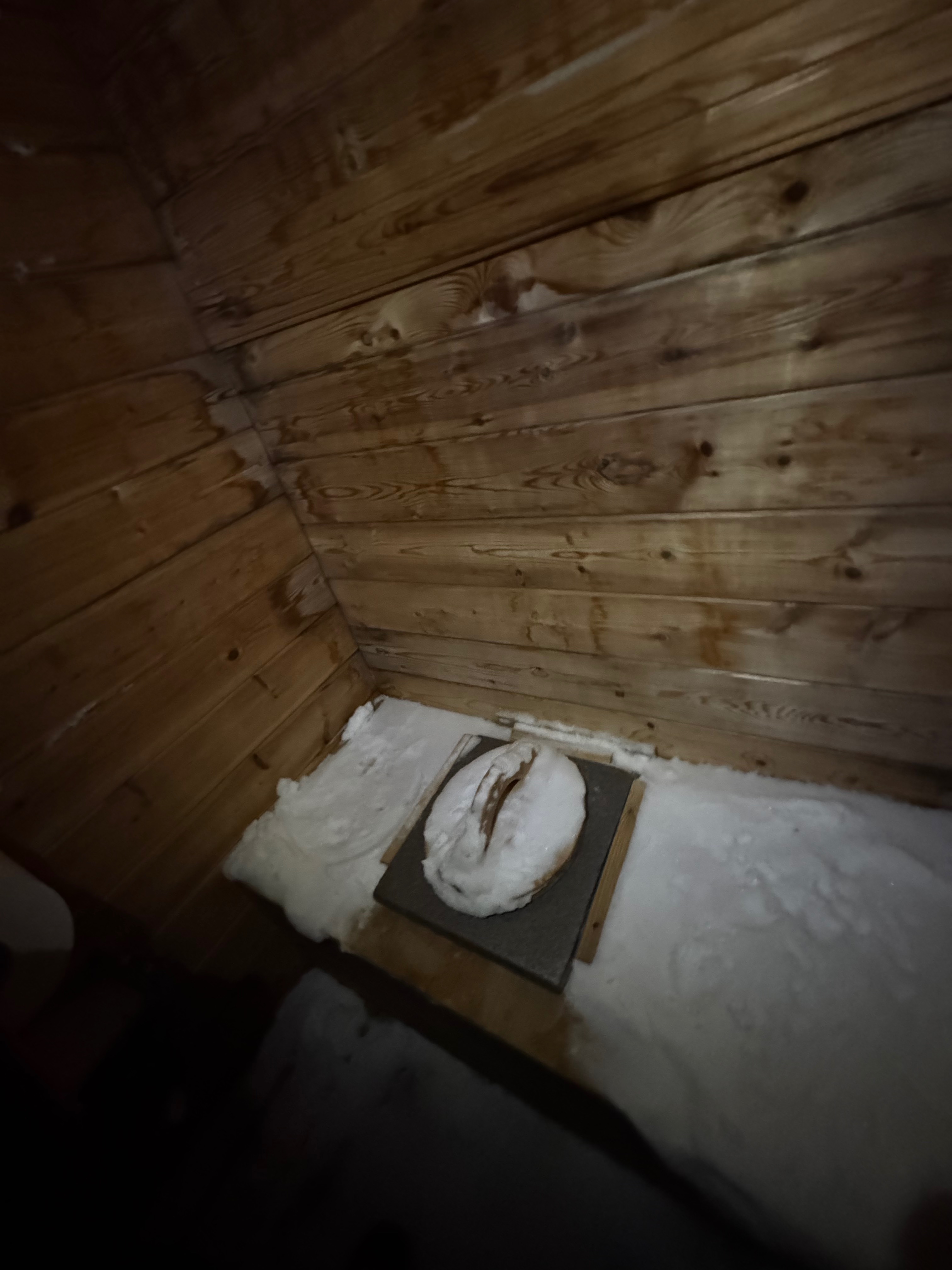
Thankfully I’d packed a random length of sailing rope. I used it to lash the pulk harness where an O‑ring had vanished somewhere in the snow, then tried not to rush the rest of the packing in case I forgot something important. It was fully dark now and the temperature had dropped further, so I added a thick fleece to the three layers I was already wearing, pulled on a heavy buff, and tucked a hot water bottle against my belly under it all.
Kirstie’s headtorch had already vanished over a lump in the trail. I set off quickly, not wanting to be left too far behind. My hands had cooled and I was grateful for the extra effort needed to get some warm blood moving. The new gloves I’d bought the day before the start were performing brilliantly so far; my enormous “happy mitts” still hadn’t left the pulk.
We arrived at the pass together.
“Bloody hell, I thought you were tired!” I said, as we paused side by side. “Didn’t you say you only had an hour and a half’s sleep last night?”
Kirstie shrugged through a mouthful of nuts.
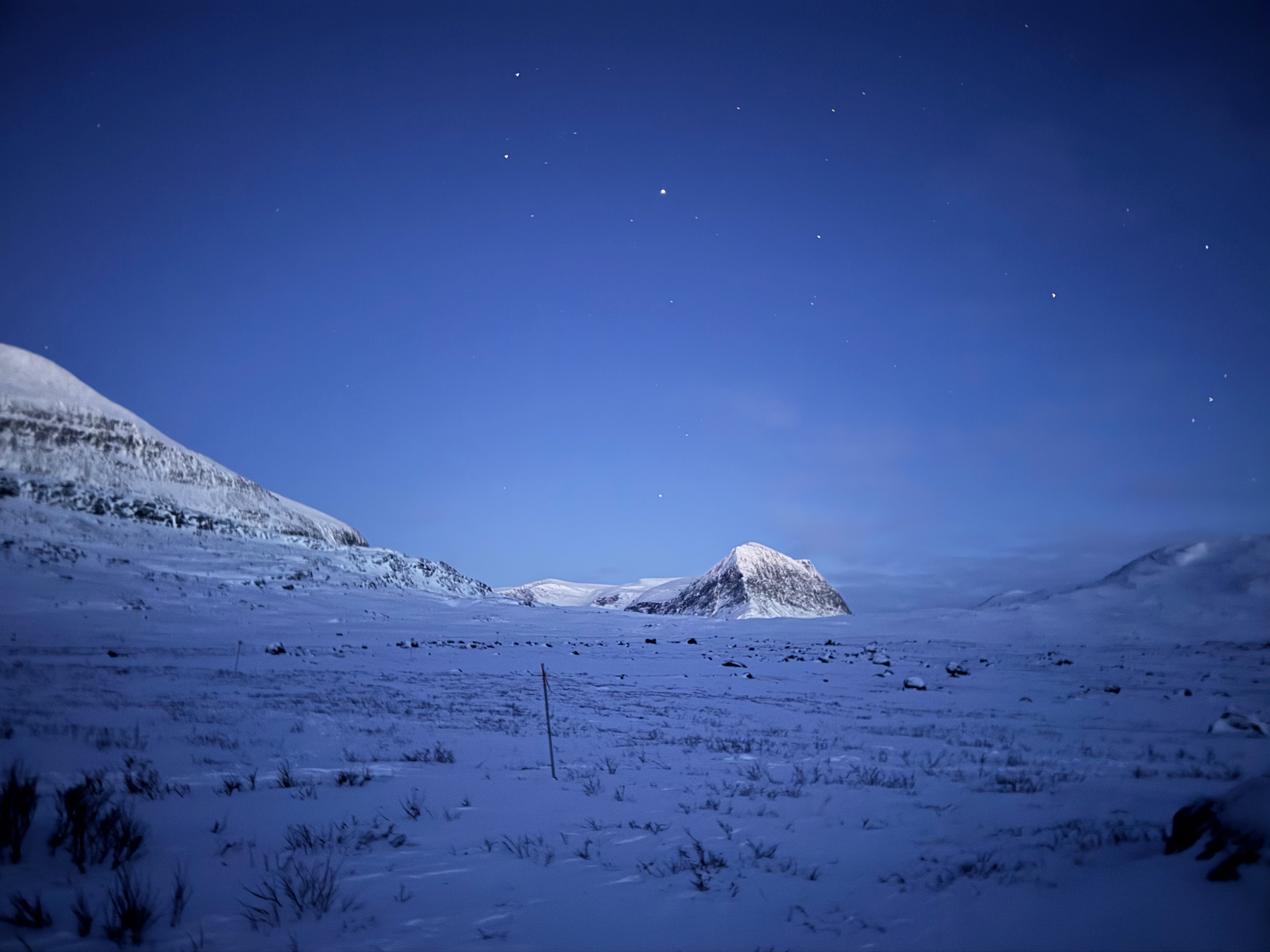
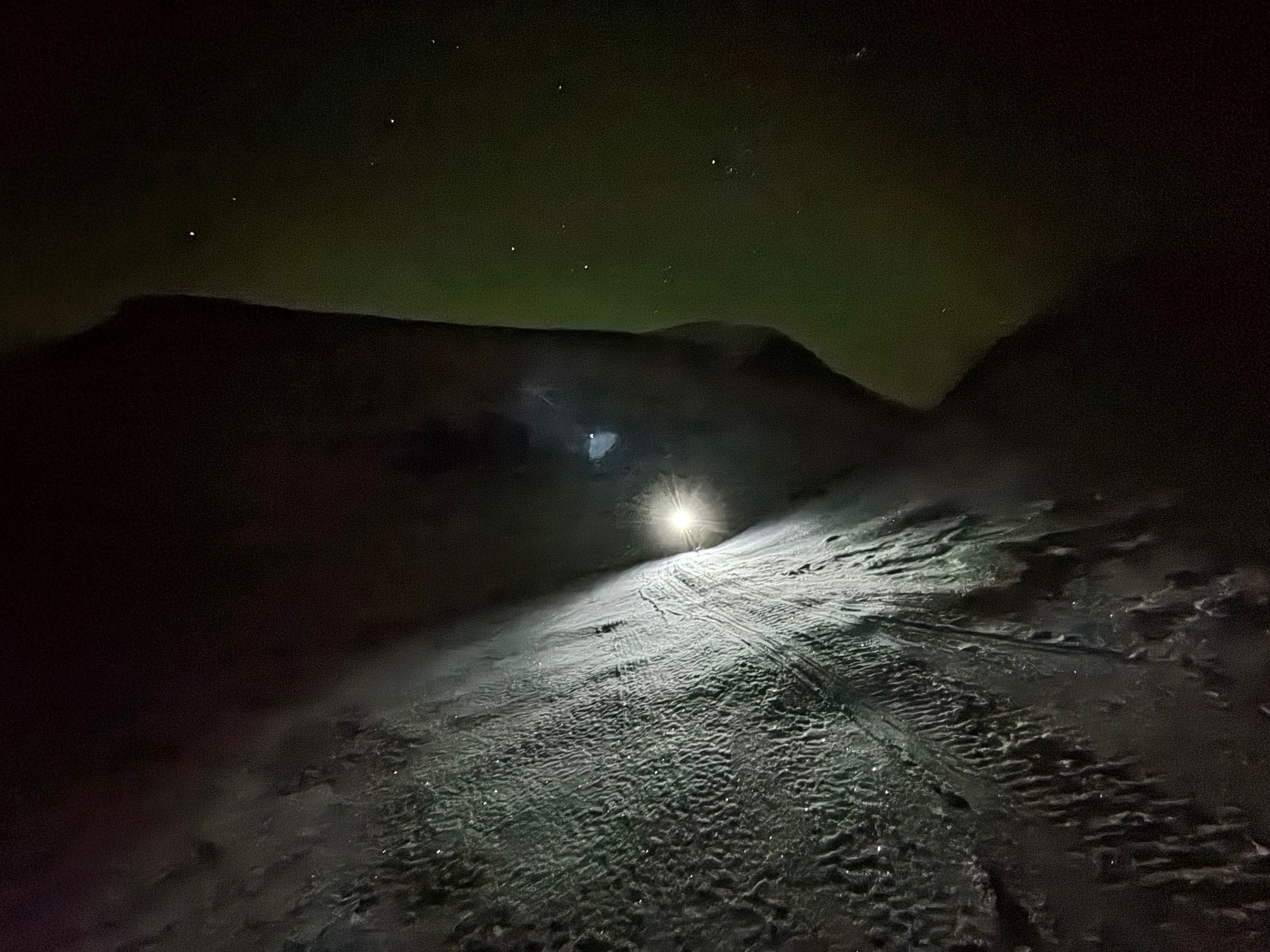
There was no moon and the sky was clear, thousands of bright stars overhead and walls of darkness to both sides. Our headtorches picked out the snowmobile track easily enough, and the slope down the valley was pleasantly gentle. Ten kilometres or so to go.
We later learned this valley collects cold air like a basin. Out of the sun, it just sits there, pooling and thickening. Tonight it would be the coldest it had been so far. Even at -16 °C the inside of your nose goes crispy, it was forecast to be -30 °C.
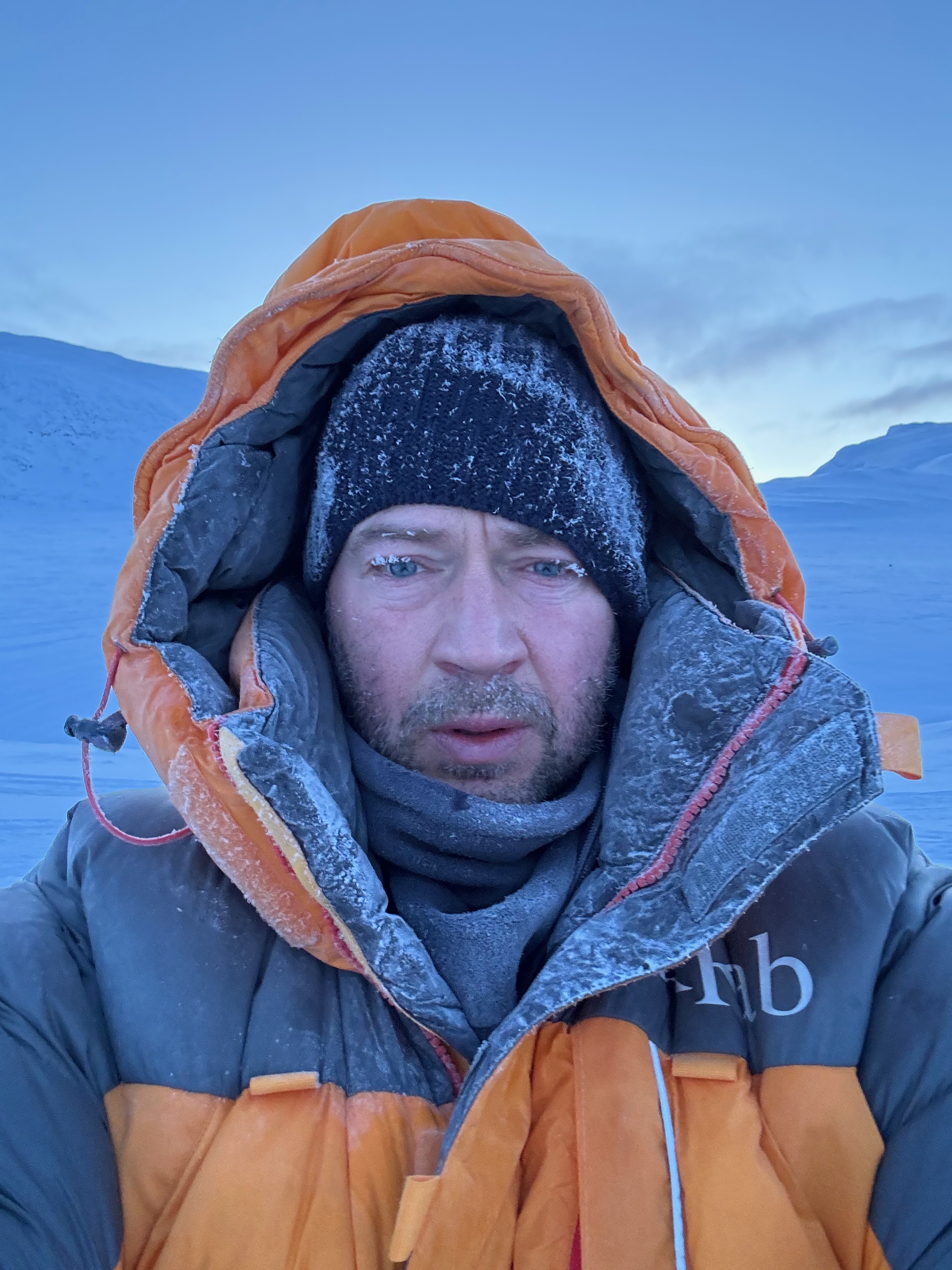
The cold felt like a malevolent presence, lurking everywhere, waiting to snatch whatever warmth it could. Any exposed skin was drained in seconds. When it got frustrated, the wind picked up, probing for cracks in your armour, stripping away any tendril of heat that escaped your layers. It weaponised moisture too. The vapour from my breath froze in my eyelashes and beard. The inside of my jacket had patches of ice where heat and sweat had been sucked through, stolen, and discarded into the dry, empty air.
So when I felt ice cold fingers sneaking up my chest, sliding around my ribs and up my back, my heart jumped. How long before they pushed into my flesh, sending needle sharp claws around my organs, searching for the glowing centre – my heart, the final refuge of my life force?
I peeled off a glove, then the liner, and reached under my layers to my base layer. It was wet.
“You sweat, you die.”
Phil had warned us that slogan tended to scare people. It certainly scared the shit out of me.
At -30 °C water freezes almost instantly. Exposed skin can develop frostbite in ten minutes. Plastic and nails go brittle and snap. The snow stays dry and powdery – too cold to melt and bond – so my snow anchors for the tent had been useless and I’d had to use skis as deadman stakes. It’s not a temperature to mess around in. You do not want to lose your insulation.
Normally, when things start to go wrong, you stop, assess, and decide on a plan. Not here. Not with the temperature and wind gathering strength, ready to strike harder and maybe fatally. You keep moving. Think on your feet.
The voices started.
It’s only a couple of hours to the hut. If we pick up the pace and push hard we’ll stay warm. Then it’ll be fine.
Yes, but we’ll be soaked in sweat, even wetter than now. Then none of the insulation will work.
It’s fine, there’ll be shelter. It’ll be warm.
What if we can’t find it? What if something else happens? It’ll get very cold, very quickly.
The quiet voice cut through.
Is this a good decision?
Silence.
No. It’s an all‑or‑nothing mad dash for safety. If you don’t warm up soon you need to change your base layer. That means putting the tent up, getting the stove going inside, and waiting until you’re warm and dry.
Yeah, but I can’t be arsed with all that faffing…
Can’t be bothered?
I could see Alex’s face, stern and serious.
“Be bothered,” he’d said.
I paused and looked back. Kirstie, head down, walked straight into the back of my pulk.
I thought of the Winter Spine, my leggings drying under a Gore Tex shell as my legs quietly evaporated the water. If it had been sunny I might have gambled on sublimation, where moisture is turned into vapour in the dry air. First, I needed to make sure everything else was ok.
“I’m going to have a quick snack and check the nav,” I said. I wondered if sleep deprivation was finally catching up with her.
“Good plan,” Kirstie replied brightly, pulling out her phone and checking her offline maps. Ninety kilometres in her legs, barely any sleep, not much food, and she was still smiling and making sensible decisions. The perfect companion.
“Trap the heat” Phil had told us. I pulled my buff over my nose and mouth and closed my hood tightly. If I wasn’t warm in half an hour I’d let Kirstie know the new plan.
Eventually we reached the cluster of huts we’d been aiming for. From a distance they looked like a small village: maybe ten buildings of different shapes and sizes, half buried in snow. We parked our pulks and pulled on down jackets.
“How do we find the emergency one?” Kirstie asked.
“No idea. Try all the doors? Maybe avoid the one with the lights on.”
“Yeah. I don’t want to explain why we’re not using our tents. And I absolutely do not want to camp.”
“It’s closed!” she yelled from around a corner.
“It can’t be!” I stumbled through deep snow to her.
“Oh wait, it says use this other one instead. Where the hell is it?”
We started working our way around the huts. Each had a name. Through frosted windows we could see glimpses of cosy rooms.
“They’ve got beds! Do you think there’ll be wood for a fire?” Just the idea of that kind of luxury felt decadent.
“Here, this one!” I called. “Door’s open.”
Kirstie appeared beside me on a wooden veranda running along the front of a single storey hut. We rushed into the tiny porch and swept it with our headtorches.
“Awesome. Let’s check out the facilities.”
Both inner doors were locked, but we found a light switch. There was a bench, some shelves, a satellite phone, a few sachets of instant soup and dried snacks, and a roll of toilet paper.
We looked at each other as our hearts sank.
“Oh. It really is an emergency shelter, isn’t it?” Kirstie said quietly.
“Yeah. It really is,” I agreed.
We inspected more closely.
“It’s warm though. Look, this little radiator is on. I think we could just about sleep here, one either side of the doorway,” Kirstie said. “I can sleep anywhere. I’m hobbit‑sized.”
I laughed and sat beside her on the bench.
“This is actually pretty nice, you know. Shall we get our stuff and have some food?”
It had somehow taken us two hours to get up from the valley and it was nearly midnight. I messaged HQ on my tracker: “Me and Kirstie (#44) sleeping at Kebnekaise shelter for the night.” The reply was almost instant: “Thanks for the update, sleep well.” I left the tracker outside where it might catch a signal, but worried about the battery in the cold.
“What time shall we leave tomorrow?” I asked between mouthfuls of lukewarm pasta.
“Six?” Kirstie said, uncertainty in her voice.
We were both shattered, and for the first time since we left I could feel real fatigue in my legs from that final climb. I remembered something Elaine had asked me in a therapy session.
“It’s about seventeen kilometres to the finish. At a reasonable pace, that’s five hours. I’ve got nothing to prove here, and I’d quite like a nice time in the daylight. It doesn’t get light till after eight. Why don’t we leave around then?”
Kirstie smiled; her shoulders dropped.
“That sounds perfect. We’ll be there in time for lunch. I’ve got nothing to prove either – this is my holiday.”
We decided to skip hot water bottles and stepped outside to brush our teeth. The sky was clear. Black mountains ringed us on all sides, bright stars scattered above. Then a green cloud drifted into view, slowly twisting and unfurling across two thirds of the sky. The best northern lights we’d seen yet, and because our eyes were fully dark adapted it looked just like it does on camera. A genuine treat.
As I settled into my cosy sleeping bag and turned off my headtorch, I could hear Kirstie making small happy noises on her side of the porch. I drifted off smiling.
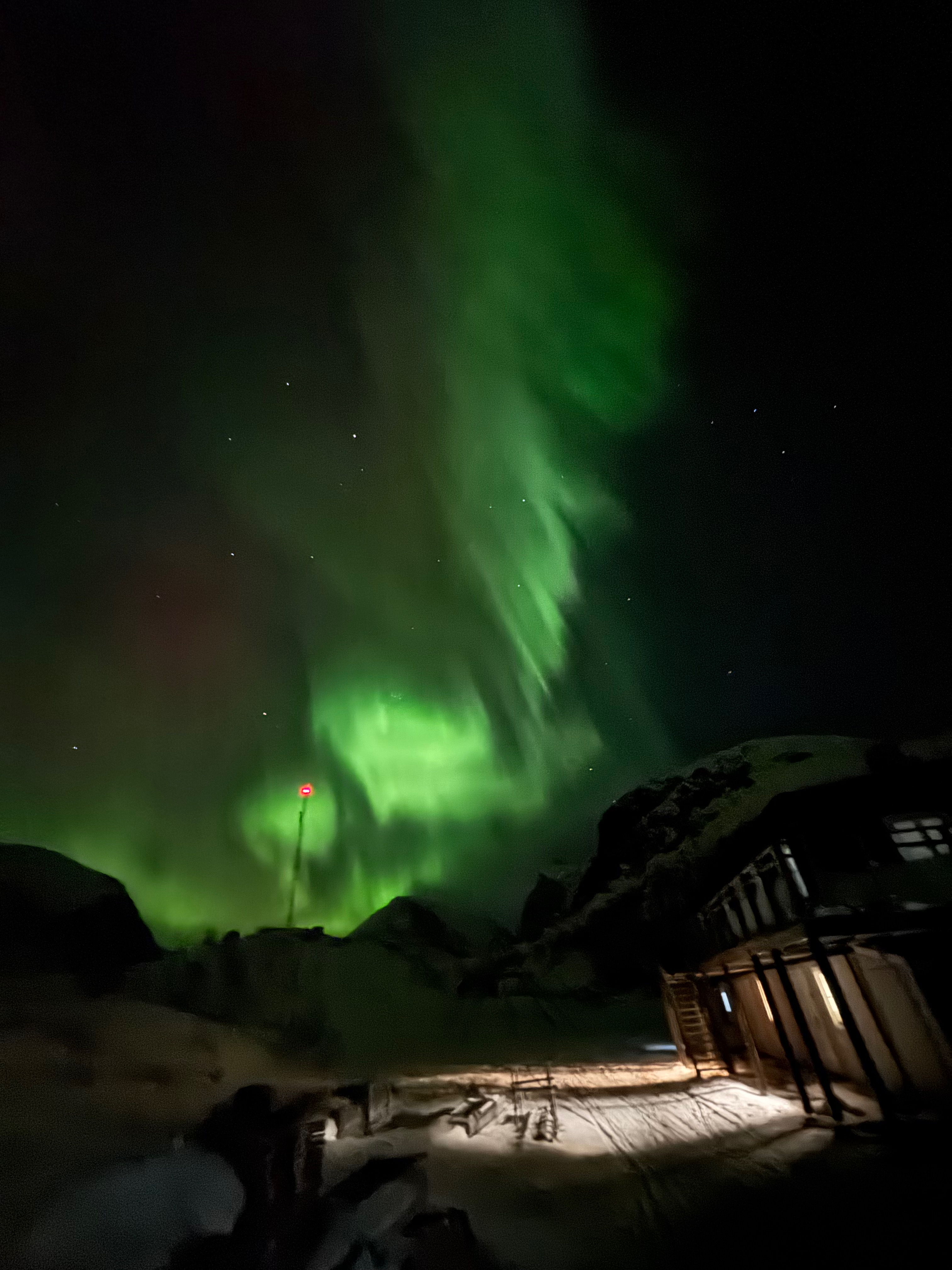
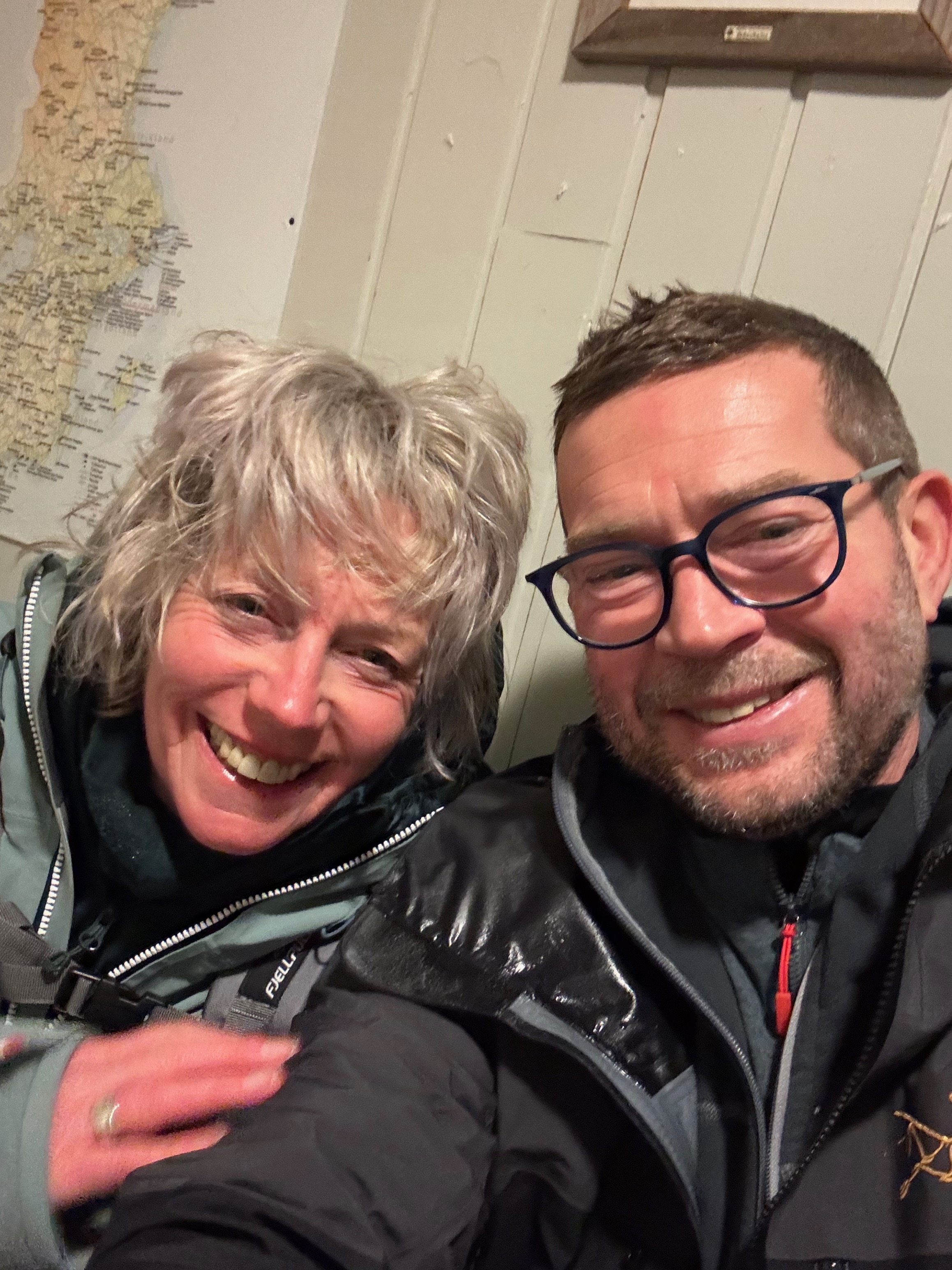
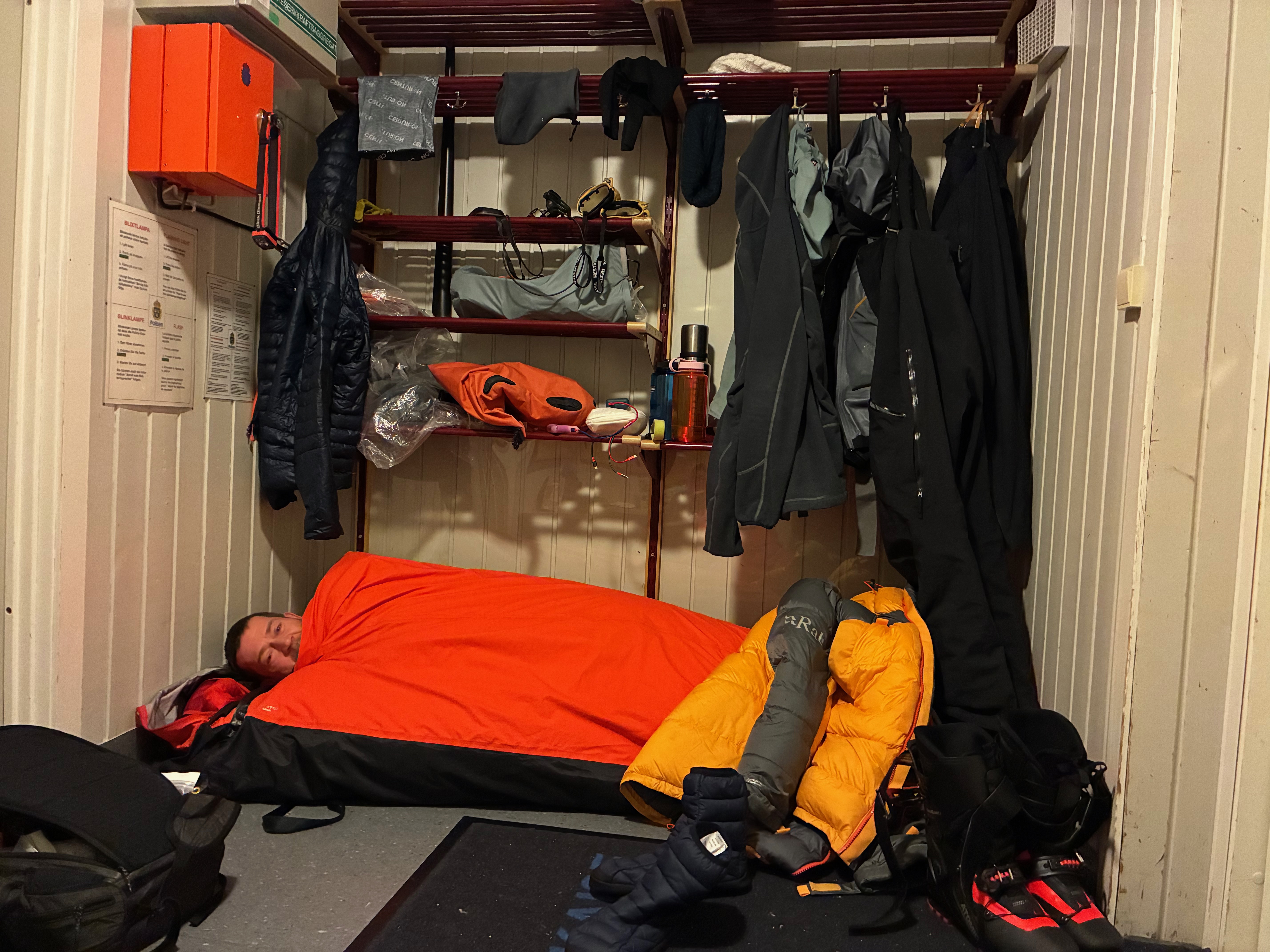
It took longer than planned to melt enough snow to fill all our flasks. We finally set off about 9 a.m., happy and rested, swapping stories as we headed down the valley towards the finish.
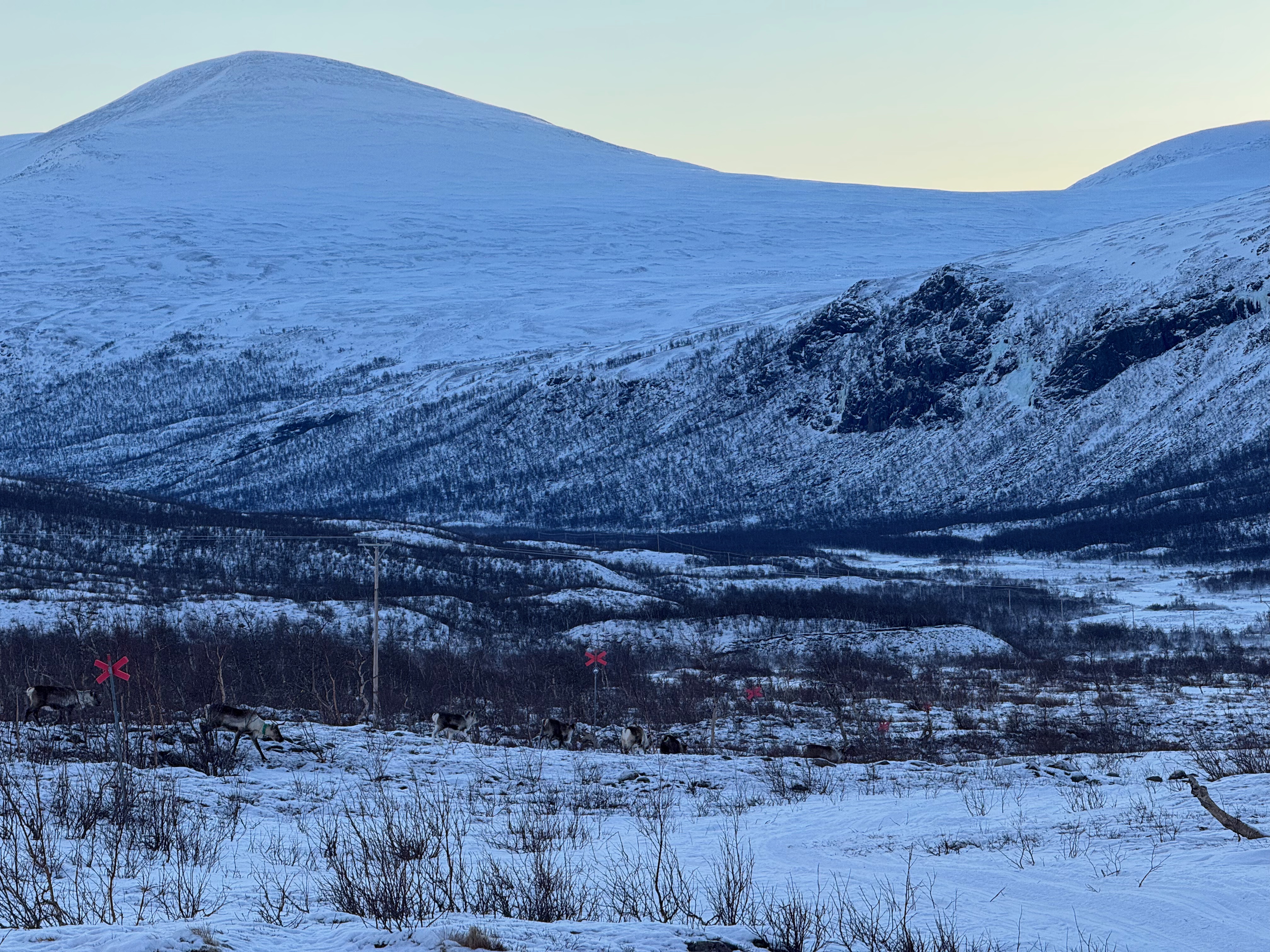
A herd of reindeer crossed just in front of us. Birds chattered loudly in the trees. We spotted wolf tracks in the snow. It was the first wildlife we’d seen since leaving Abisko more than two days earlier and, for a while, it almost made us forget it was still -30 °C and we had many hours to go.
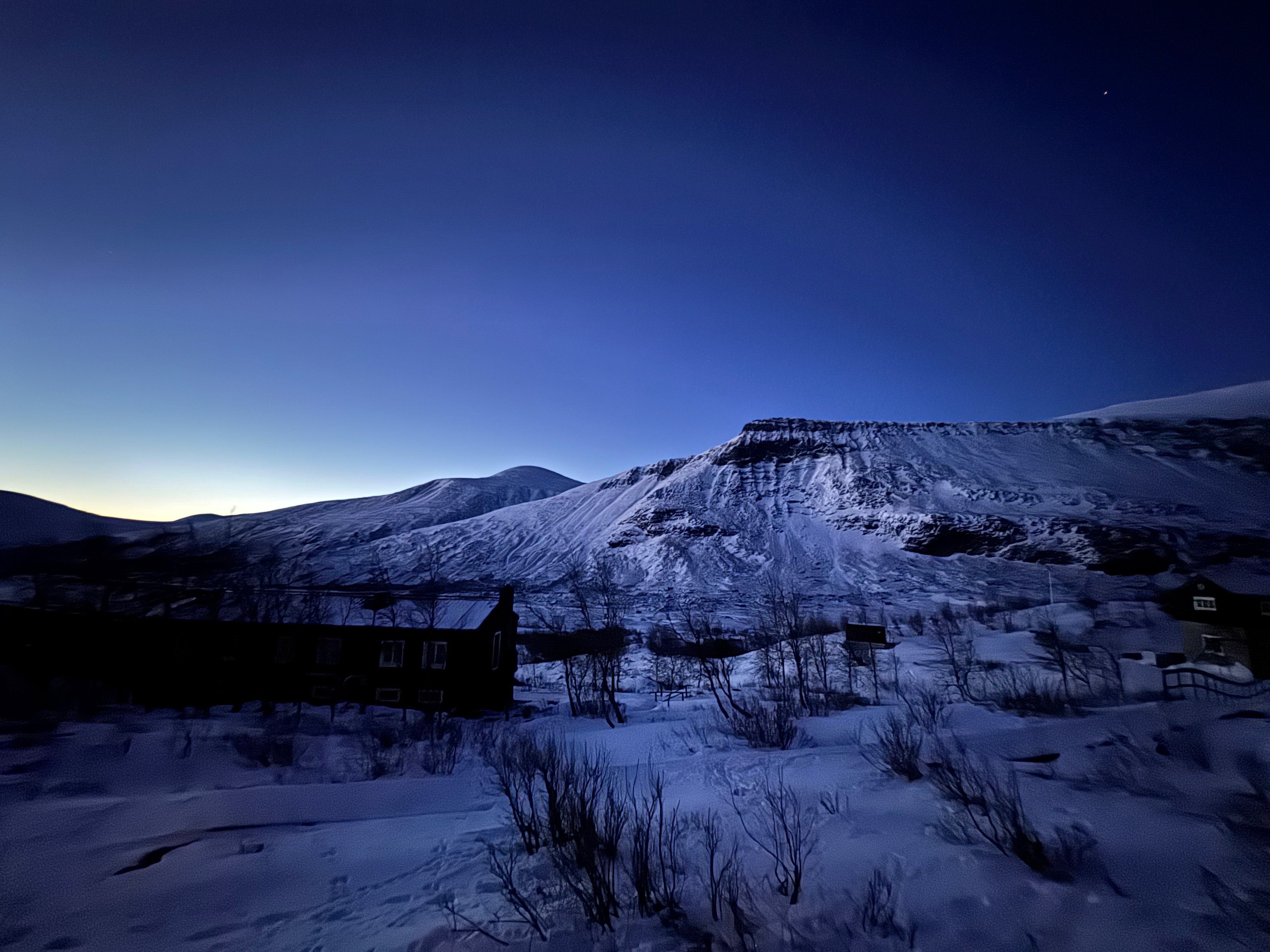
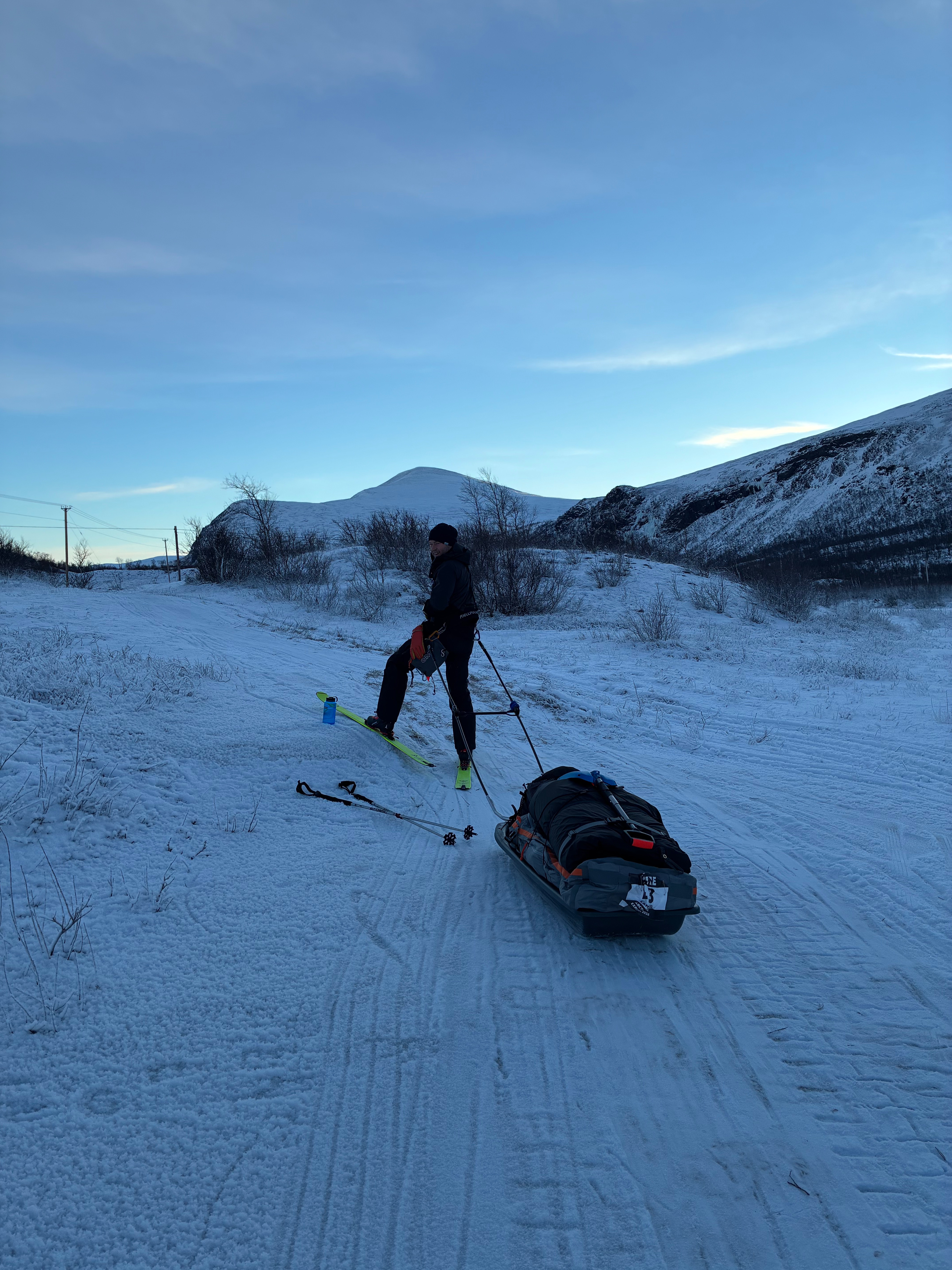
The sun popped over a ridge as we crossed a long frozen lake, and we soaked up the brief warmth.
“Only six kilometres to go!” I whooped. “And it’s practically sunbathing weather!”
Minutes later the sun slipped below the high horizon and the lake hungrily sucked the heat from our bodies.
“We should stop for some food,” Kirstie said. “But not on this lake. I’m frozen already.”
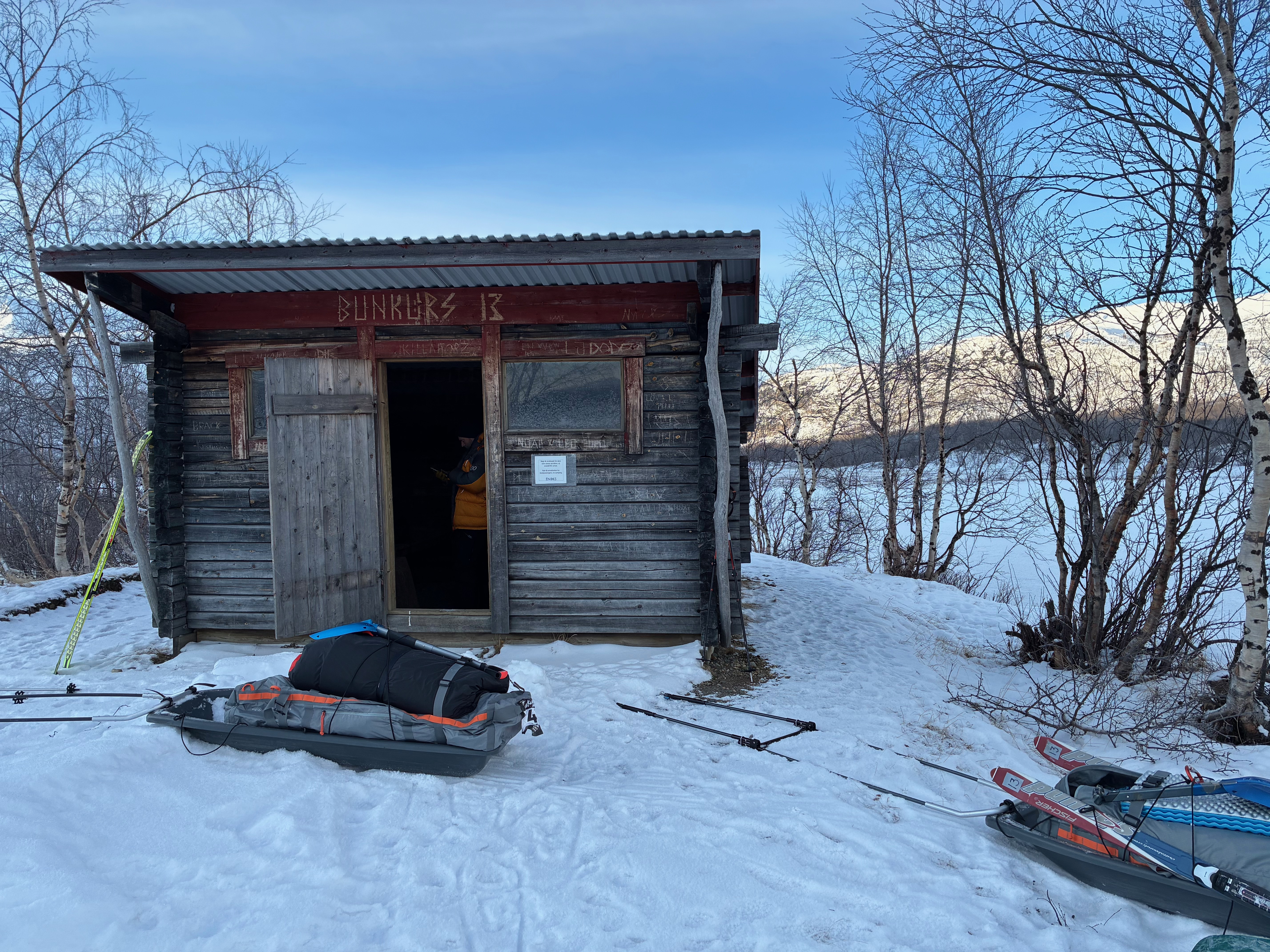
We spotted a small wooden hut on the far shore and agreed to huddle there for a bit and try and warm up.
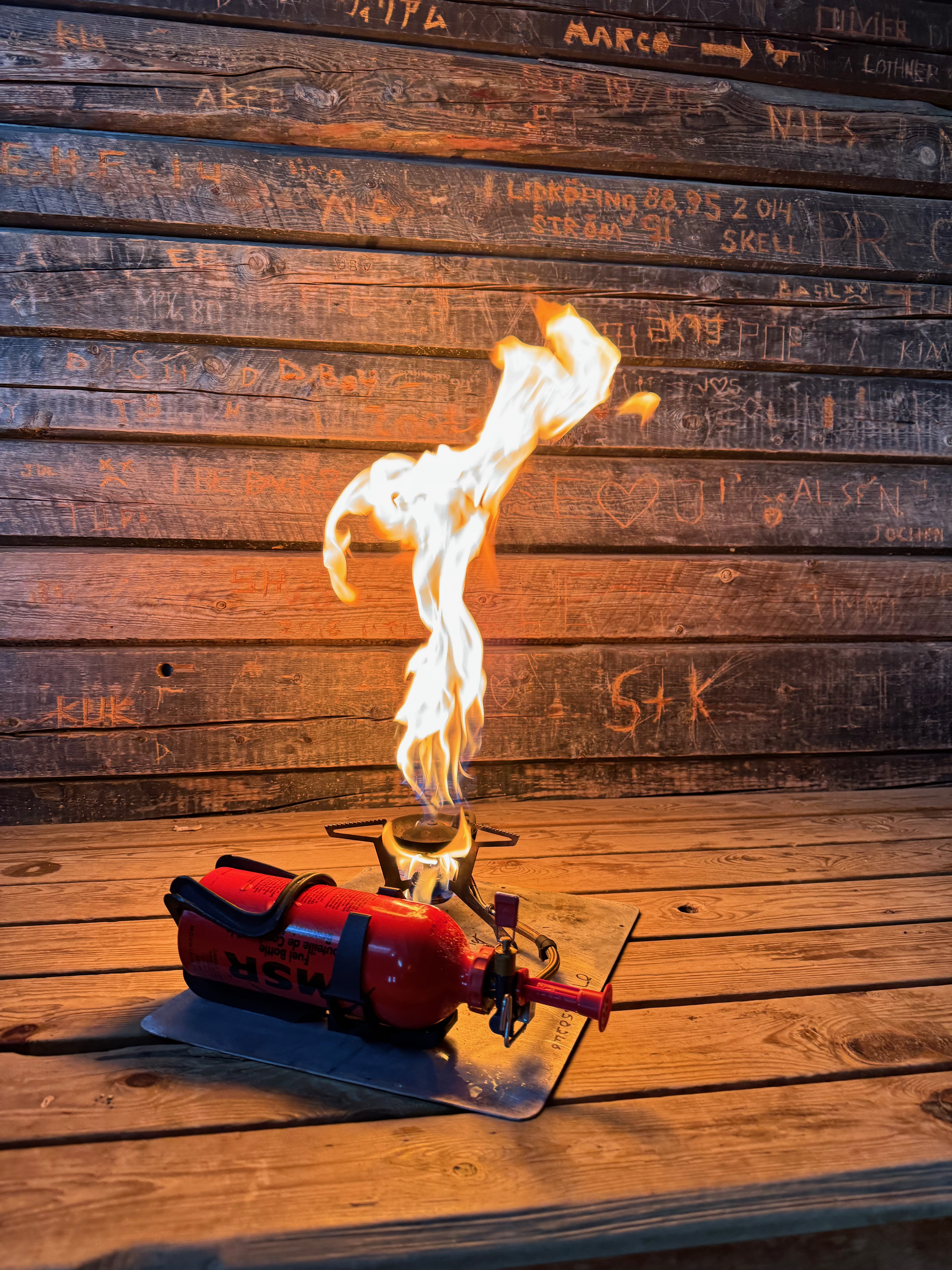
Inside it was draughty. Graffiti scribbled across the walls suggested it was a teenage hangout in the summer. A dead bird lay inexplicably on the floor. The door didn’t shut properly. We wrapped ourselves deep into our big down jackets and fired up the petrol stove. I managed to accidentally open the valve too far, sending a huge yellow flame leaping up. The stove wasn’t actually helping much; it just made us nervous. My flask produced enough warm water for a tepid dehydrated chicken curry – eight hundred calories that barely dented the deficit.
We didn’t stop for long, but long enough.
Something shifted. Kirstie had gone quiet. I dragged my attention away from the flame. She was standing beside me, pale, staring at her mitten encased hands.
“My hands are really cold,” she said, voice flat.
Minutes earlier we’d been in high spirits, joking about frostbite and sunbathing. Now the reality of -30 °C hit. At these temperatures, the second you stop generating heat, the air and wind strip away what little you have. Even a minute without big gloves can push fingers into the danger zone. We’d had ours off for too long, lulled into a sense of safety by four flimsy wooden walls.
“Keep moving, I’ve got some hand warmers somewhere,” I said. Miraculously, they were right at the top of my rucksack, not buried under random kit in the pulk. I tore the packets open and dropped them into the bottom of her mitts.
“They don’t feel very warm. Are they working?” she asked, sounding more like herself but still worried.
I really hoped they were. Without my glasses I couldn’t read the instructions.
“They usually take a few minutes to get going,” I said, trying to sound more confident than I felt. “I’m going to pack up.”
“I don’t think I can secure my pulk with my hands like this,” she said, “but I can load it and then go outside and jump around to warm up. That okay?”
“Of course. I’ll deal with the straps. We just need to get moving again.”
Out here, self rescue is everything. On skis, dragging pulks, four kilometres an hour is good progress. You can’t rely on help arriving quickly, even if you hit the SOS button on your tracker. Lose your hands and you lose your tent and your stove, and then the cold finishes you off. The constant vigilance – watching for small mistakes snowballing into something irreversible – was exhausting, and even that mental fatigue was something I knew I had to monitor.
We clipped back into our harnesses and marched down the silent, frozen valley, towards warmth and other humans, both of us wrapped in crunchy, frost covered clothes and our own thoughts. We were relying on the years of training that got us to the start line and hoping our muscles would churn out enough heat to carry us all the way to the end.
If you’d offered me the win there and then, but taken Kirstie’s fingers or our safety in exchange, I’d have laughed. Whatever I’d wanted at the start, the only thing that mattered now was that we both walked over that finish line together, under our own steam.
Once we were moving properly we set a brisk pace, willing hot blood back into her fingers.
“Any better?” I asked eventually.
“Yes, thank god. I can feel my hands again.”
What a relief.
The distance to the finish dropped steadily, and then, suddenly, there it was: the Spine Race sign. Cameron and the others appeared as we shuffled in side by side, wrapped in frost and silence.
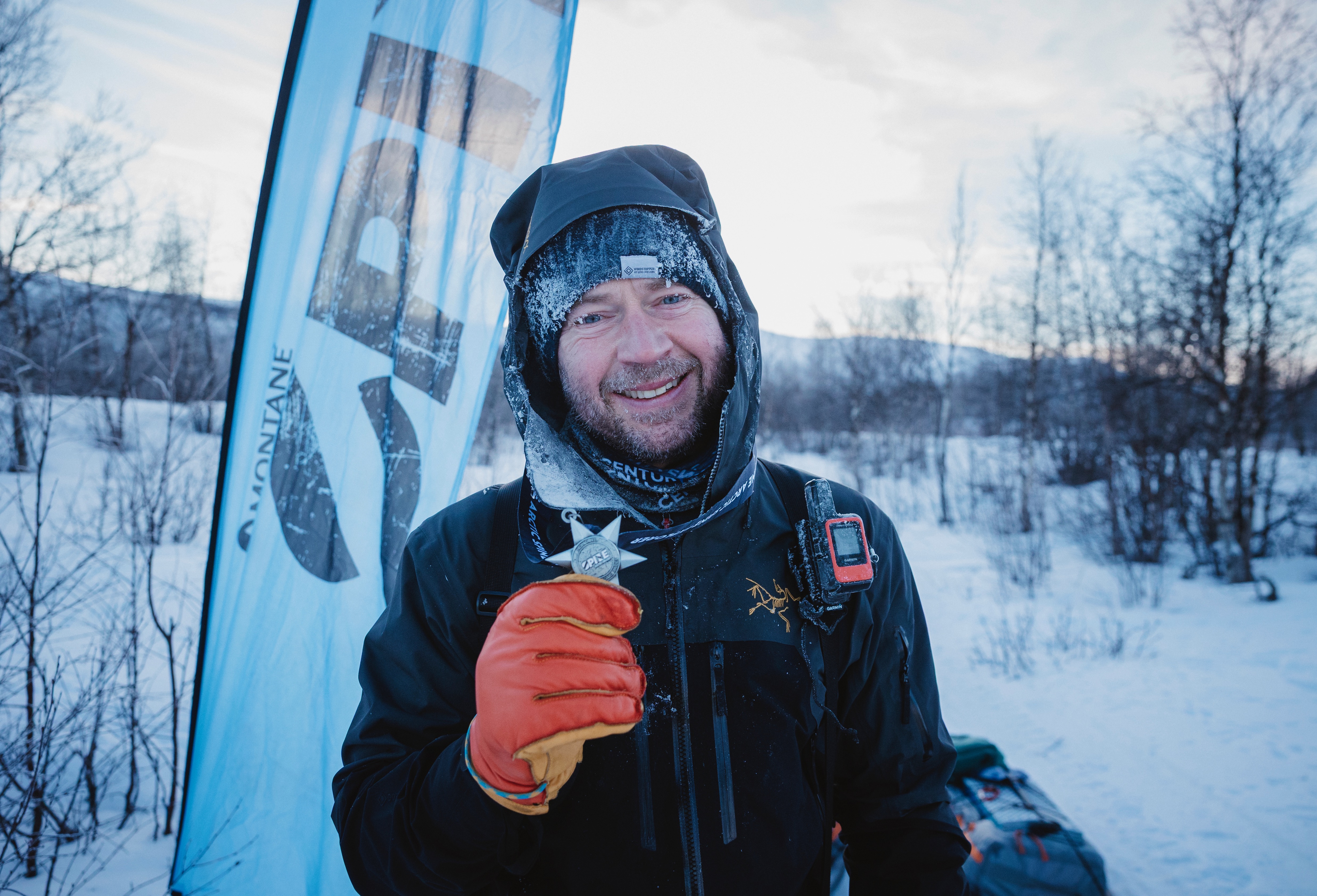
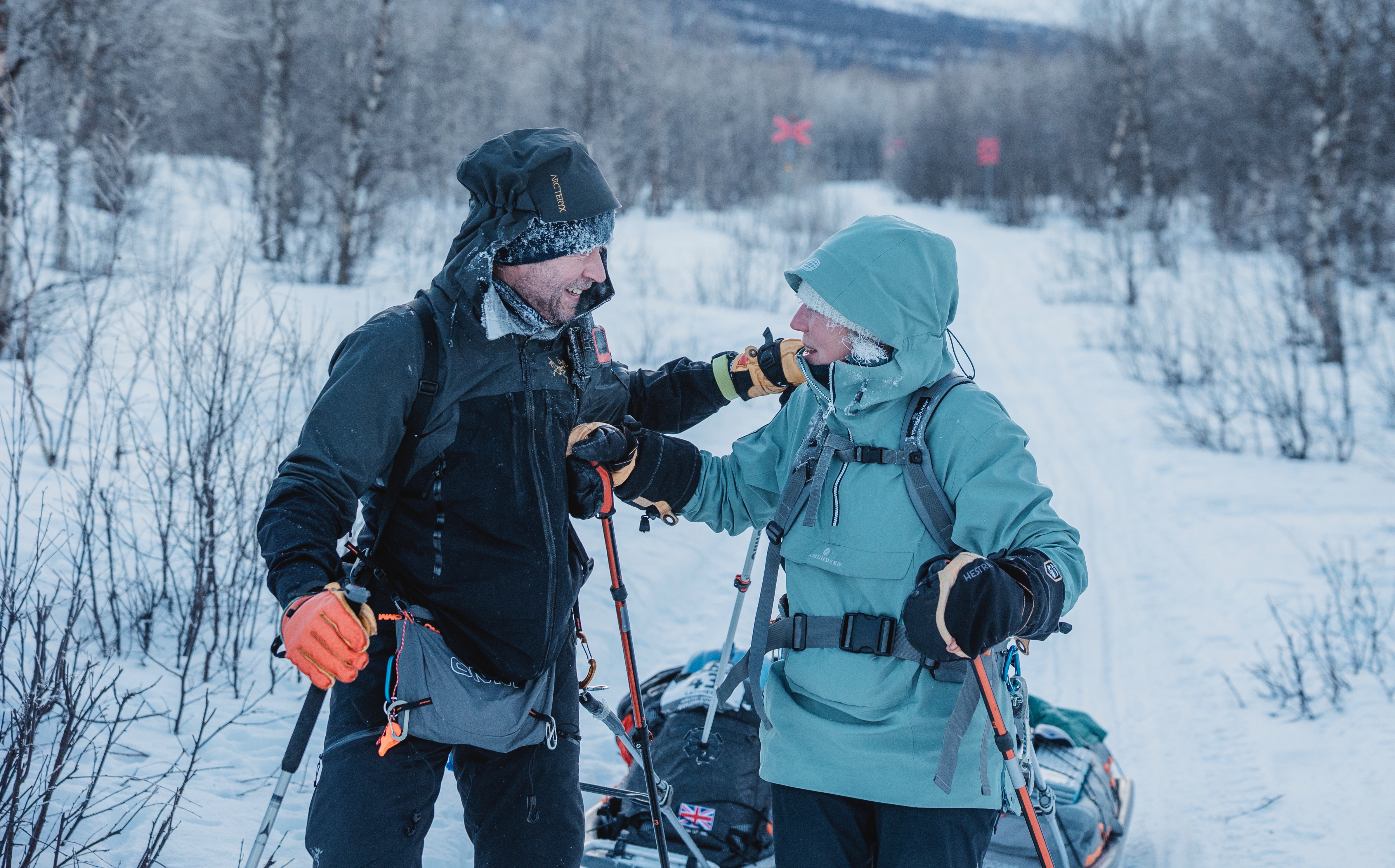
“We bloody did it, mate!” I laughed – and then started crying as we hugged. Joint second overall, first lady for Kirstie – but what I felt most was a warm, quiet satisfaction. We’d taken our time when it mattered, looked after each other, and come through this harsh, hostile place together, safely.
Within minutes we were sitting in a warm hut drinking tea.
“Want some mac and cheese?” someone asked.
“Not if it’s dehydrated,” we laughed.
“No, we made it earlier. I’ll pop it in the microwave.”
Actual hot food. A chair. Even a shower. Proper luxury, after three days of learning what ‘you sweat, you die’ really means – and discovering how valuable it it is to slow down, be bothered, and walk out of the Arctic with all your fingers, toes, your sense of humour, and a friend beside you.






































 jura runner