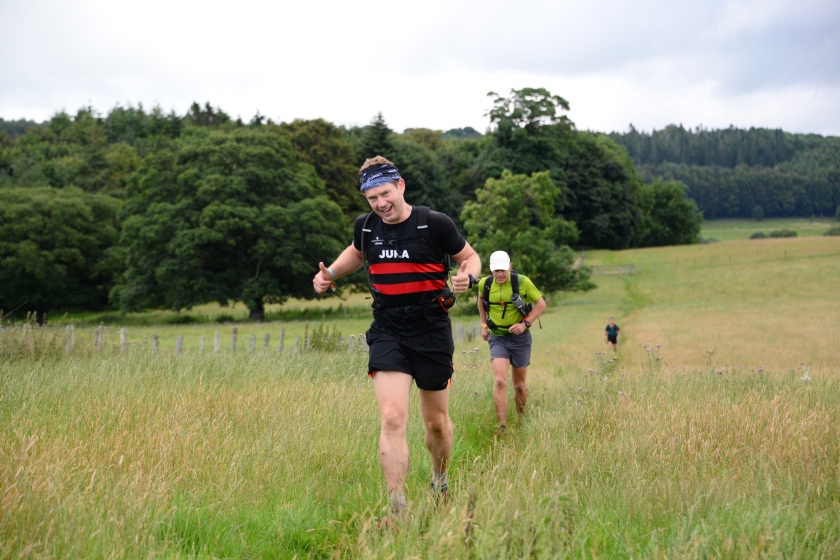
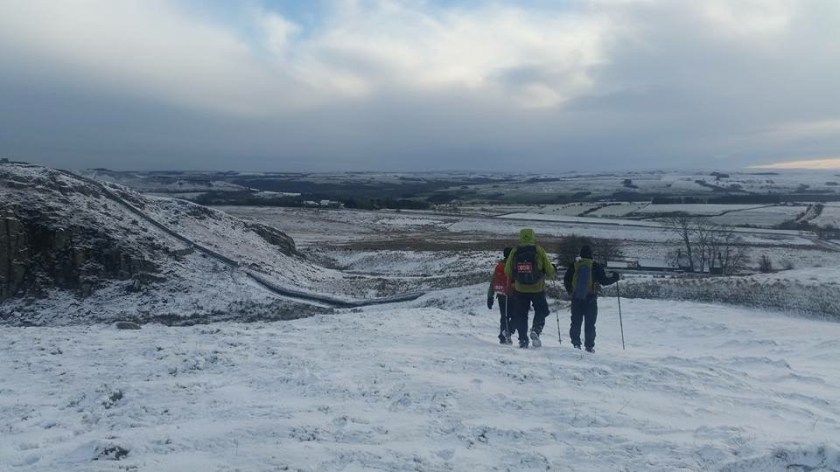
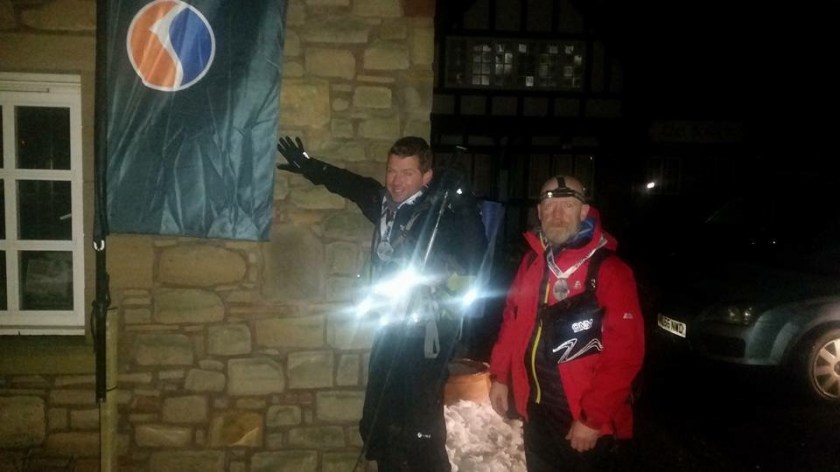
The Spine Race 2016 – Kit Notes

kit

Another list for the kit geeks, you know who you are.

Head

I’m a top down sort of person, so let’s start with my head torch.

For reasons I’ve forgotten, most excellent reasons I’m sure, I bought a Petzl Nao with a spare battery.

I’d read that batteries don’t like the cold much, so I also bought the extension cable so I could keep them nice and warm (assuming I wasn’t also frozen).

I also threw in an old Petzl Tikkina for backup, and a Petzl Elite for emergencies (at 35g it seemed silly not to).

I don’t really know why I didn’t use my trusty Led Lenser, which has very useful dim (to save power) and narrow focus (to spot those elusive national trail signs) features. Probably because the battery compartment is a bit fiddly and the little Petzl was more self contained.

The Nao lit up the surrounding area really well, it was like a floodlight and I needn’t have worried about the lack of beam focus.

Battery life was, ok ish. I was pretty disappointed when the first one lasted only 5 hours, I’m sure lesser torches go 12 hours on 3 AAAs. The second one lasted 6, and after that I just planned accordingly, making sure I always had a backup in place.

Next time I’ll take 3 batteries, and after seeing various multi USB chargers in CPs, I’ll be taking one of those too (in a busy CP you’ll be lucky to get one plug, and I also lost one of my adapters, not helpful).

This setup worked pretty well, though due to my close fitting pack the only potential home for the batteries and spare torch was a small area at the top of my chest. Uncomfortable at first, but with enough time you can get used to anything (probably anything).

For more excellent reasons I had at least 4 hats packed (I was expecting rain), but only wore one.

This was made from super soft possum wool, transported by my lovely mother from New Zealand a few years ago.

It was really warm, even when wet (but dried out quickly), long enough to pull down over my ears when I needed it to, and was my almost permanent comfortable head wrapping companion.

Until David Lee commented:

It looks like a really itchy hat that, is it itchy? It looks it.

It wasn’t. Then it was.  Really itchy (I’d had other things to think about). At that late stage in the race I wasn’t going to ditch my new best mate, so itch on we did.

When I was buying a new dry bag at Snow and Rock, I noticed some buffs by the till and grabbed one. Total spontaneous purchase that turned out to be spot on.

The (weirdly named) Turtlefur was really warm, and tight enough to pull up your face when needed, but not so tight that you get panicky moments of feeling that you’re being strangled (I’m looking at you, Nike Thermal Neck Warmer).

I like the idea of merino wool buffs, so much so that I’ve got 3, but after about 10 minutes they seem to droop down and provide no neck comfort whatsoever. I kept an inov8 one handy though, for the two occasions when it was too hot for my wonder-hat, but too cold to expose ones bonce completely.

IMG_6002

Shoulders

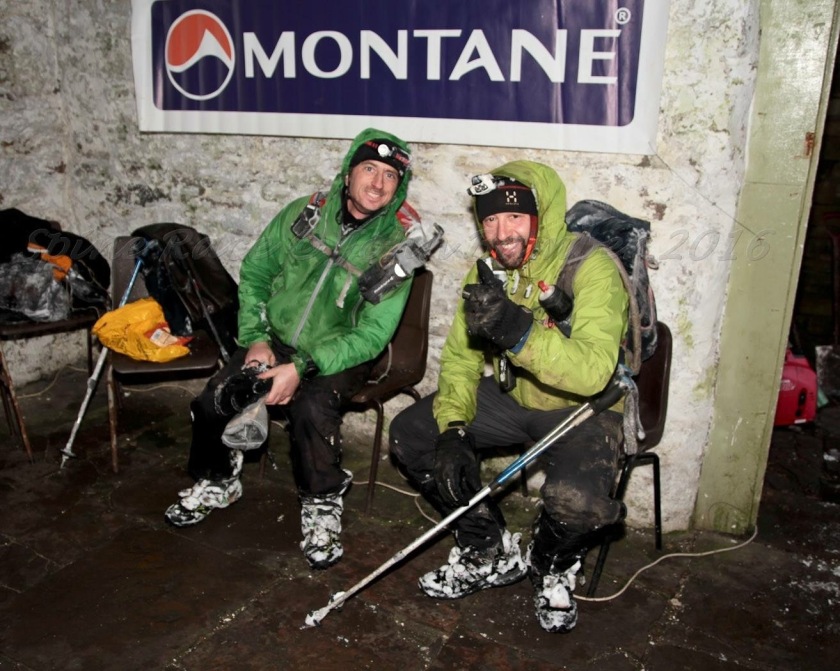
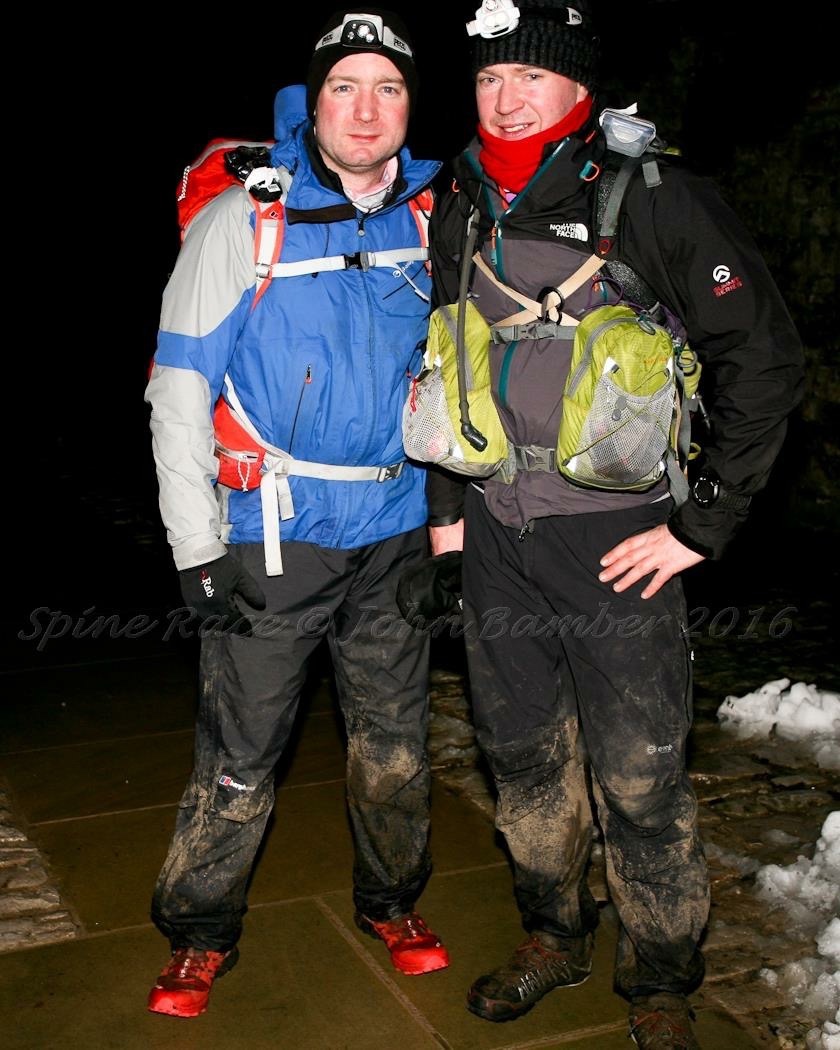
Two Helly Hansen “warm” baselayers that I rotated, an OMM Rotor smock to keep in my pack and don for the chillier sections, and a bullet proof North Face Summit Series goretex jacket with the bestest tent like hood ever.

Oh, I wore Bontrager arm warmers (snaffled from my bike kit) because forearms don’t do much when you’re walking and mine always get cold.

Nearly forgot my Patagonia primaloft gilet, which I wore nearly all the time.

Why I didn’t feel the need to add another layer to my upper arms I don’t know, I only just realised they’d been left out actually, but they didn’t complain so don’t see any need to change this setup.

I love all this kit, and with the exception of the OMM smock I’ve had it all for years and it’s all been thoroughly battle tested in ultras, endurance sailing and skiing.

The HH warm tops are close fitting and made from merino wool. I was warm and dry at all times. Apart from once when I thought I had hypothermia.

Honestly.

It was on the way to Bryness and I could actually feel icy tendrils of doom snaking their way round my sides and clutching my chest. Pretty scary to be honest, and precipitated my only (short) run of the race in a desperate attempt to warm up.

Like a fool I’d left the underarm vents on my jacket open after getting a bit hot earlier and had completely forgotten.

That’s what 12 hours sleep in 6 days will do to you. It took me a while to warm up, even with my heart still hammering away.

Still, this is a good demonstration of making sure you’ve got decent kit and are confident in its abilities. All it took was a couple of drafts and I was being slowly frozen, even whilst marching hard through the snow.

Having managed to borrow a lightweight PHD sleeping bag for the race, I splashed out on a new pack. After enduring considerable agony on the challenger with my cheapo, not fit for purpose, overstuffed rucksack, I was hoping to do better this time.

Aarn packs first came onto my radar a couple of years ago when chatting to Papa Ferret before he started his Spine attempt. I was very intrigued by the size of the front pouches, and the number of straps and fiddly bits.

From the reviews I could find, people were generally very happy, “once you got it adjusted correctly”, which was enough for me – surely I could get it right with a week of constant use. There were a few useful videos on their website too.

I went for the Mountain Magic 22L, deciding against the larger one as I figured I’d just end up taking more stuff.

The pack itself is a bit heavy, around 1KG, so the challenge was to add as little extra weight as possible, whilst making sure I had everything I needed in an emergency.

Setting aside all non essentials I got it down to about 8KG including food and water, much better than the 14KG I lugged round on the challenger.

The two 1L pouches on the front of the pack, coupled with an insulated bladder and hose, meant that aside from adding/removing layers, I didn’t need to take it off at all.

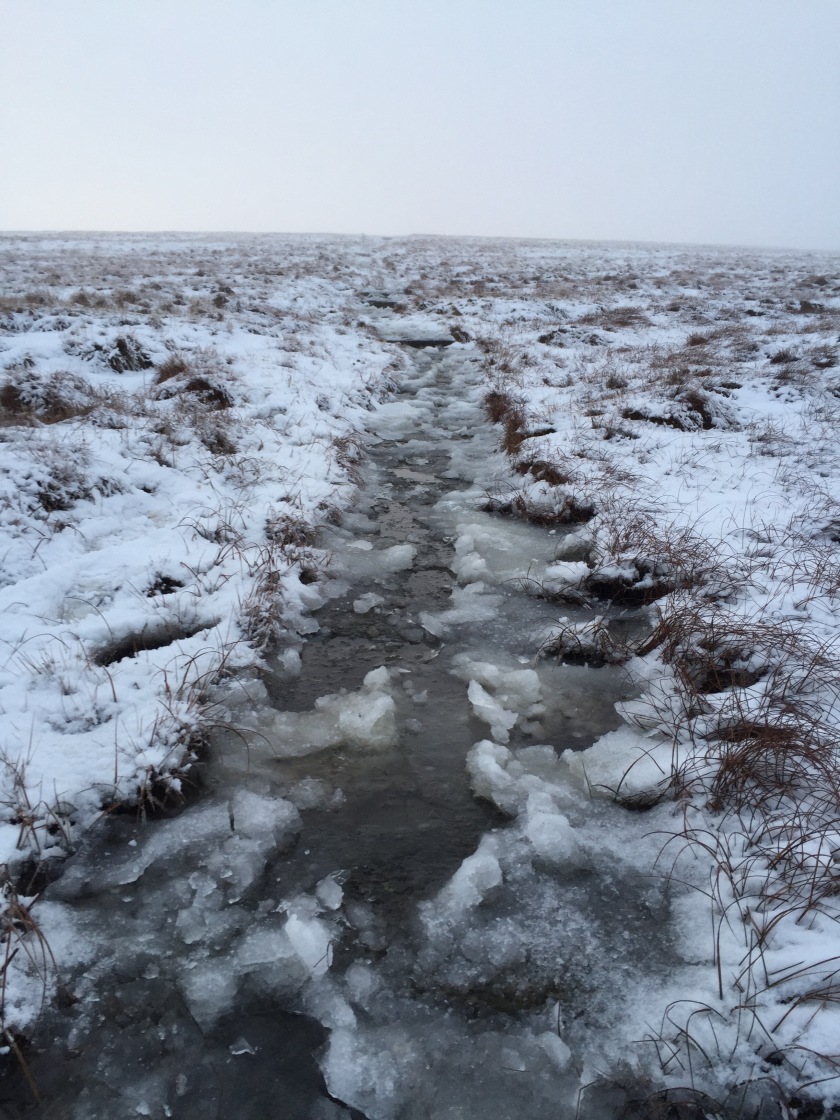
My hose still froze (oo-er missus), -15C takes some serious insulating against, but I had a couple of 250ml soft flasks that mostly survived the cold, presumably the movement helped.

After much deliberation I went with a super basic sleeping mat, a bog-standard foam roll-up job. Not particularly compact, but at around 200g and providing cushioning and warmth for a small handful of £s, it was a no brainer.

My bivvy bag was a non breathable basic something or other, but very light and waterproof.  Condensation was a problem but the only time I used it I also had my waterproofs on, so that didn’t matter.

I know that breathing outside of the bag prevents that, but it was condensation or frostbite. Another easy choice.

I threw in a silk liner just for that extra bit of warmth, and it definitely helped. The main downside is that it’s not stretchy, so couldn’t really be “snuggled” down into. Anyway it’s main use this time was to keep mud out of my sleeping bag, and as Shippo pointed out, a bin liner would do that job just as well.

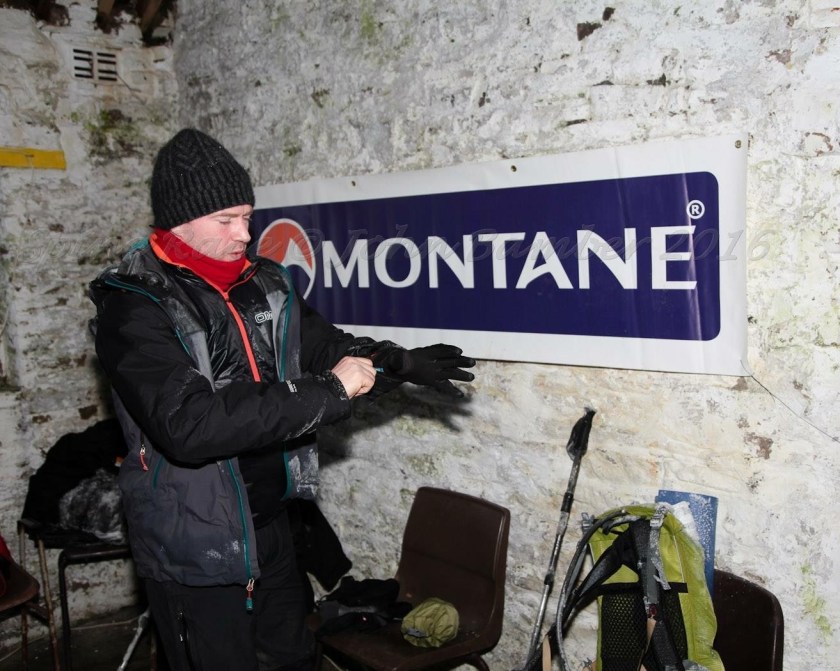
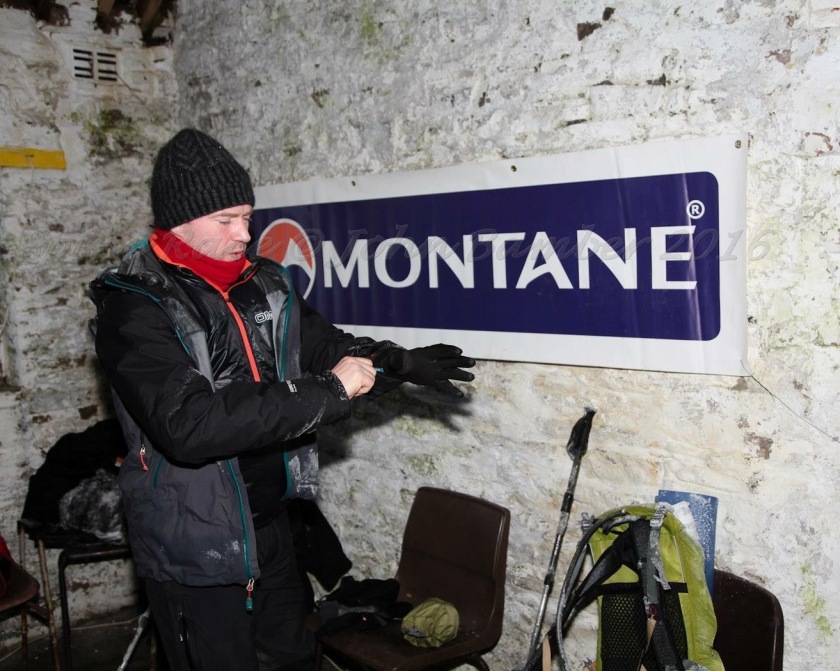
I bought some SealSkinz waterproof mittens for the challenger, but they weren’t going to be enough on their own, even though I don’t tend to suffer from cold hands. After some research I bought a pair of Montane Via Trail gloves, which turned out to be ideal.

The description said they come up a bit small, which in reality meant that they were close fitting enough to maintain dexterity – tying shoelaces for example. They also have sections of conductive thread, so you can operate your favourite touch screen device.

Having two pairs of gloves was great, it gave me an easy way to regulate temperature (sometimes just removing one mitten was enough to cool me down) and meant that when I needed to fiddle and faff, my hands didn’t freeze completely solid.

Next time I’d take something to clip my mittens to though, I dropped one a couple of times and it was sheer luck that there happened to be someone behind me who picked it up.

Before I forget about touch screens, a note on phones and battery life.

Switching my iPhone 6 to 2G mode and enabling low power mode meant that I only needed to charge it a couple of times, and managed to take a few photos and send the occasional text.

The real cellular workhouse was a very basic Samsung (£10 from Tesco) which kept me in touch with the outside world and still had battery left at the end of the week. It took me bloody ages to get used to predictive text again though.

IMG_6001

Knees

Again, I’d packed a pair of leggings for each leg (of the race!), but ended up wearing pretty much the same combo for the whole week.

I did have a few pairs of decathlon wicking pants though, there are limits to recycling, even when racing. These are amazing, and coupled with some body glide meant the end of chafed nether regions.

Unlike Mr Valentine, who entertained us during the trudge up to Malham Tarn with an innovative use for a buff.

Some un-lubricated, persistent, bollock on thigh action had rendered both areas excruciatingly painful. We’ve all been there, and the thought of stopping is very high on the list of outcomes.

Not when you have a handy buff! Just wrap it round your thigh and scamper on happily.

Buff! Top to tail protection, from cold, wind and friction!

Don’t forget to put that buff in the special do-not-recycle bag.

In fact we bumped into an unhappy lad at one point who was suffering from the same affliction, I wonder if he took the advice.

I wore some new 3/4 length inov8 leggings under the extraordinarily awesome Rab eVent over trousers.

My legs were warm and dry throughout, and if the lower bit ever got wet, they soon dried out due to the excellent breathability of the fabric.

I picked up a few minor rips round the ankles, which given how many sharp things they encountered isn’t too bad (including my own knife, embarrassingly, whilst cutting off lumps of frozen mud).

IMG_5980

Toes

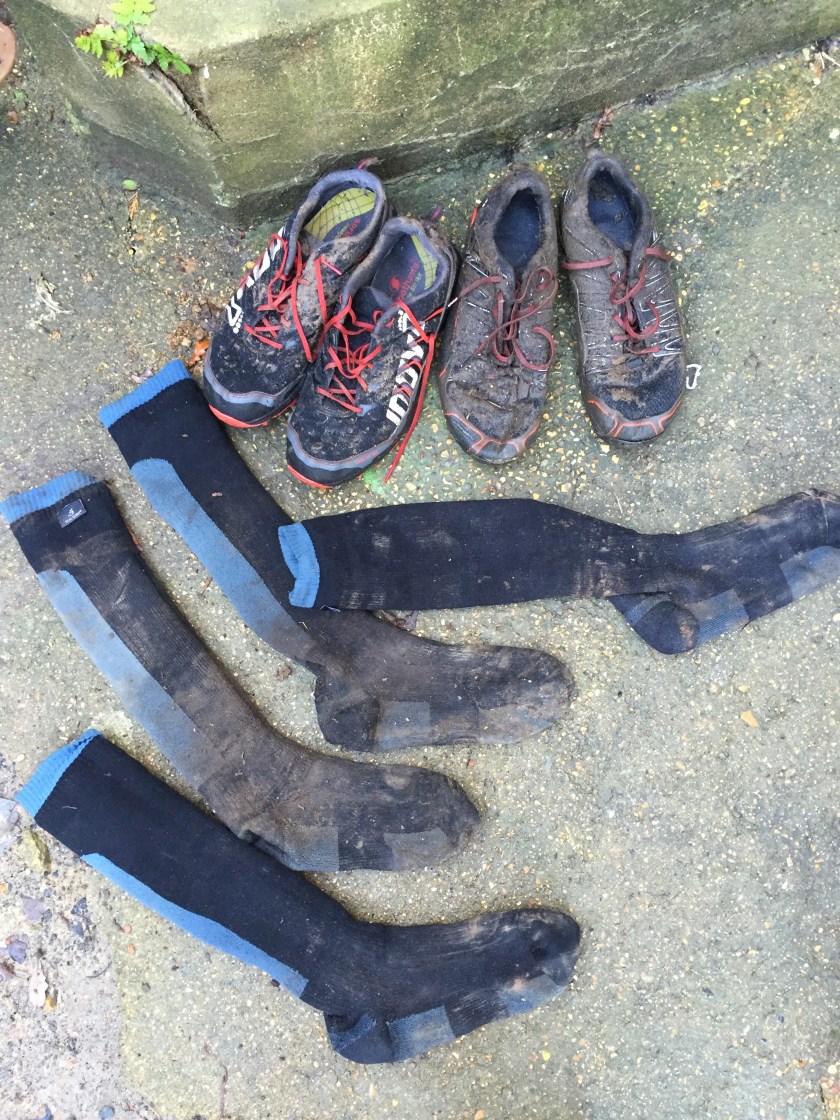
The long seal skinz and injinji liner sock combo worked well on the Challenger, and I saw no reason to risk something different.

Your feet do eventually get wet, and if you’re dunking them in icy muddy water for hours on end, they do get cold as well.

On the whole however, my feet felt warm and comfortable. I changed liner socks at every CP and outer socks half way (along with shoes).

I can’t remember where I picked up the tip, but the first thing I did at a checkpoint was to get shoes and socks off and flip flops on. Pretty sure that this really helped prevent blisters.

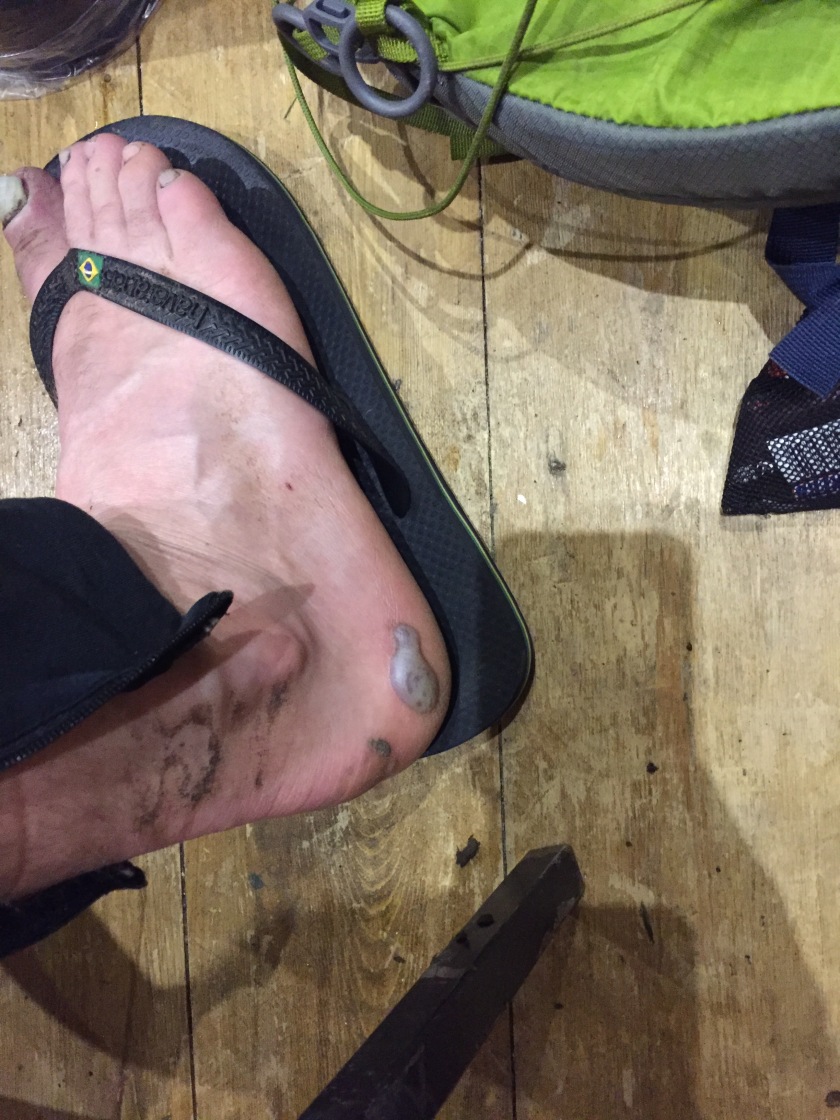
Speaking of which I managed get two, one tiny one on my heel which didn’t cause any bother, and one huge deep one on the outside of my foot. No idea how it happened, and though it was sore if I poked it, or side kicked a rock, didn’t cause a fuss.

Seeing the big puddle of blood when it was lanced was slightly disconcerting, but an interesting new experience to tell the future grandkids.

My trusty (and still slightly too small for the double sock setup) inov8 trailrocks rose to the occasion, and a good friend lent (gave, nobody lends trail shoes) me a slightly bigger pair.

Having lost nearly all my toenails, I might invest in some even bigger ones for next year, though that won’t stop there being an abundance of highly kickable rocks along most of the route.

IMG_5970

And eyes

Goggles were part of the mandatory kit list, and after a load of people dropped out last year from semi frozen eye balls (!?!), they seemed like a valuable item to have.

Obviously I just chucked my trusty 7 year old ski goggles in the bag, safe in the knowledge that they worked fine a year ago on some bright sunny French Alps.

Eh, no. I could barely see a thing, especially with the dearth of sunshine. Luckily I was able to twist my hood round and deflect the artic gale away from my face.

Recently I bought some new swimming goggles (Aqua Sphere Vista), they’re almost like something you’d wear scuba diving, I might take them next year, or something small enough to fit in a front pouch – I saw one person with little round goggles with leather sides, maybe not, they looked a bit creepy.

I’m generally pretty hopeless at sleeping so bought a fancy eye mask to use in checkpoints. The Bedtime Bliss from Natural Revolution was top of the list on Amazon which I think just means that you pay over the odds, but I’d had enough of price checking by then and just went for it.

Turned out to be bloody brilliant! Not a peep of light gets in and it’s super comfortable.

And ears

Whilst on the subject of sleeping, I did a bit more research and ordered a bag of Howard Leight Laser Lite ear plugs, another awesome purchase and now that spring is finally here they’re doing a great job of letting me sleep though the dawn chorus.

My hat was long enough to cover my ears and kept them toasty. On the rare occasion that I got slightly too warm, I could roll it up and let the breeze in.

This had the unfortunate side effect of making me look a bit like a binman however, which is something to be avoided when the Racing Snakes photographer was constantly popping out from behind walls and bushes.

IMG_5954

And mouth

Somehow I managed to forget lip salve! Luckily my mother in law came to the rescue with that and a load of food for the race, I just wish I’d taken more of the fruit cake, it was a perfect blend of just-right sweetness and not too hard or too soft.

These things are important towards the end of a long slog!

I listed a load of food on my main report, but here it is again:

In my pack (replenished at CPs):

  • Pepperami – went off these very quickly, going to take proper French sausage next time
  • Snickers – obviously
  • Wine gums – first time on a race, good addition
  • Cooked pizza – didn’t seem to mind being in my bag for the best part of a week, went down very well
  • Beef jerky – fresh, from the savanna at London Bridge in London, separated into a freezer bag per leg
  • 9bars – threw them away, too sweet
  • Shotblox – given to me by a friend of Tonys (I think), awesome, need lots for next time, had forgotten how easy they are to get down
  • Decathlon cereal bars – basic but ok
  • Lucozade gels – not much to say: they work
  • Fruitcake – top of list next year
  • UCAN super starch (plain) – it works and saves having to eat too much actual food. Anything other than plain makes me retch though. Had 5 little bags, one per CP
  • Salted peanuts – another first, lovely

I read somewhere that Ian Bowles took whole blocks of feta cheese with him, cracking idea.

In my drop bag:

  • Extra portions of all of the above
  • Expedition foods, spag Bol, macaroni cheese,…
  • Small pots of ambrosia rice pudding – my stomach has never been in a bad enough place to refuse one of these, life savers
  • Bought/foraged in the wild (not including checkpoints, the noodle bar or the Bryness B&B here)
  • Chicken sandwich from the awesome Bill and Janet who tracked and intercepted me in Lothersdale
  • Steak slice from the COOP in Gargrave, so hot it burnt my mouth, could’ve done without that, also topped up on snickers
  • Large bowl of chilli and rice, washed down with a black coffee in the Pen y Ghent cafe outside Horton-in-Ribblesdale. I also picked up a replacement sleeping mat here.
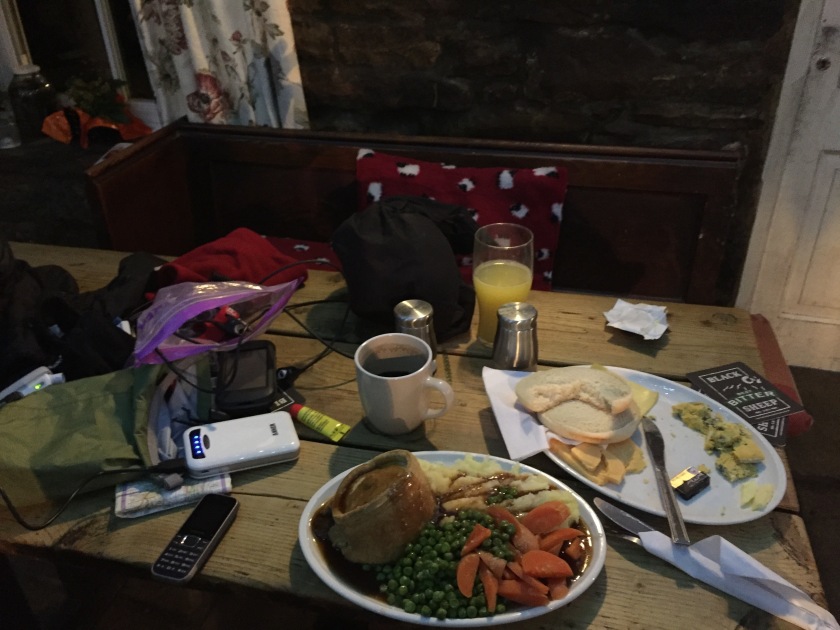
  • Massive plate of food in the Tan Hill Inn
  • Multiple bags of crisps and pints of orange and lemonade in Duftons Stag Inn

Almost stopped at the Twice Brewed off Hadrians Wall, but decided to make the most of daylight and pushed on, Stevies crew gave us some bacon and eggs, which was lovely

I’d definitely make sure to have at least two bags of heatable food before setting off over the Cheviots, one for each hut.

IMG_5968

And nose

Some people seem to spit a lot when they run, I just produce a lot of mucus. I don’t know the reasons for either, but both are pretty disgusting.

The combination of that, with a propensity for nose bleeds (despite an operation when I was 16), meant that I tended to arrive at checkpoints etc with a frozen, bloody, snotty mess on my face.

I thought about taking a balaclava next year, which gives me the option of looking like a ninja (in my mind), a terrorist (everyone else’s mind), or an assault victim.

Not sure which is best really, but no doubt the inhabitants of the Stag Inn in Dufton wouldn’t bat an eyelid. They seem so used to spiners arriving in various states of disarray, and would probably just make you some room by the fire, regardless of what you looked like.

Think that’s it!

(Full report)

IMG_5972

Upping The Ante; Why I Entered The UKs Most Brutal Race

pre race

I needed a hobby, at least I thought I did. It wasn’t that I was bored, a twenty something in London has plenty of distractions, it was just that I needed something to focus my jumble of thoughts. Something to stop them from ricocheting off the inside of my eyes.

Writing software was one option, I had no shortage of ideas for websites. But I already spent all day hunched over a keyboard, tapping out line after line of algorithms and business logic for a ‘certain to be the next big thing’ start-up telecoms firm. Any more of this and I was sure to turn into a full-blown, out-and-out computer nerd.

The pub was an excellent distraction, it calmed my swirling mind, and there was never a shortage of drinking partners.

Ah, the pub. The lovely, lovely pub. A dear friend on the surface, but sadly one that doesn’t really have your best interests at heart.

An expanding waistline and a chance conversation with a recently reconnected Brummy friend, and running was suddenly something I was going to do. Maybe this could be my hobby?

In keeping with how I approach most things in life, I embraced this new pastime with arms wide enthusiasm and went at it with everything I had.

Typical “too much too soon” injuries followed, but after a few years my body settled down, and I started training for The Fell Race (there is only one worth mentioning, like The Marathon).

I’d never been all that interested in the Paps when I lived on Jura, fell running and young teenagers aren’t an obvious pairing. Now that I was a Runner however, the lure of the challenge was drawing me in.

Trundling around my now favourite 20 mile loop which took in the West End of London and many Thames river sights, I noticed that something strange had happened to my body.

It was a bit sore, but seemed to want to keep going. Not fast you understand, but not walking either.

“Just to see if I could”, I rapidly increased my long run distance, and a few weeks later clocked up 26.2 miles in 4 hours.

The subsequent euphoria damped the complaints of my (now very sore) legs, and I dreamily contemplated a future of long distance running.

It turned out that running produces endorphins (endogenous morphine – say no more!) which not only give you a nice post run boost, but imbue you with a calm and gentle feeling of wellbeing. The perfect antidote to working on a busy and aggressive trading floor (which is where all that tapping had taken me).

Some years passed, I accrued running paraphernalia (garmin watches, heart rate monitors), obsessed about nutrition, gained and lost weight, and entered the odd race here and there.

Dimly at first, I became aware of something called “ultras”, or more precisely ultra marathons. These were foot races longer than a marathon, typically at least 30 miles but apparently there was no upper limit.

Someone at work had started doing them, I thought there was something wrong with him, he didn’t even look all that fit.

Running a marathon was hard, ‘AL’ Fell Races were even harder (category A, long. Jura falls into this classification), why on earth would anyone want to do anything even harder than that? The whole idea was preposterous.

The seed wouldn’t go away though, as much as I tried to ignore the idea of these races, the ridiculous concept kept finding it’s way into my thoughts.

Inevitably I gave in (home alone with a bottle of wine and the internet, I’m not the first and won’t be the last to do something silly in that situation). The dusk till dawn ultra marathon sounded perfect.

I was keen to minimise time away from my (now) wife and small child, so the idea of an overnight race was ideal. Sleep deprivation was something I’d been practicing, (unintentionally, babies force that upon you), so that aspect didn’t bother me much.

Neither did the facts that it was to take place in October, was 50 miles long, entirely on muddy hilly trails in the Peak District, and was the inaugural running of the event.

They should have caused me some pause, as it turned out to be really hard (and cold, and wet).

I finished though, in a respectable position. Other than a few scrapes and aches I didn’t suffer particularly afterwards, and felt, quite frankly, invincible.

Without really seeking them out, I stumbled into various races over the next few years, invariably longer and tougher than the ones before.

They were all hard, and I swore I’d never run an ultra again through gritted teeth a few times, but the memory of pain fades quickly, and more challenges duly presented themselves.

Which brings me finally to The Spine Race.

I don’t know where or how I first heard of it, but the mere suggestion of taking part made me feel physically sick. No other race had done that before!

The details don’t sound all that bad:

  • 268 miles of trails, in the UK, in winter
  • 31,000 foot of ascent and descent (Mount Everest is only 29,000 by the way)
  • A generous sounding 7 days (and nights) to complete the route

The description from the website adds a bit more colour however:

The MONTANE® Spine® Race is a 268 mile, non-stop, uncompromising winter challenge encompassing the entire Pennine Way. Widely recognised as one of the most demanding National Trails in Britain. The Pennine Way crosses some of the most beautiful and, at times difficult terrain found in England, including; the Peak District, Cheviots, Yorkshire Dales and Northumberland National Park – finishing on the Scottish Borders.

The MONTANE® Spine® Race is open to anyone with appropriate experience* who wishes to test themselves and compete in a truly demanding race. Expect to race through extreme weather, deep snow, ice, mud, bogs, strong winds and rain in a gruelling non-stop, 7 day race from Edale to Kirk Yetholm.

It’s not just the conditions that are against you – your own body could become your worst enemy with tiredness, fatigue, sleep deprivation, exposure and the general pains of wear and tear playing havoc with your performance. To finish you must be prepared and willing to push yourself harder than ever before.

Ok, that was more like it. Throw in the fact that only 25% of starters typically get to the finish, and you have something that sounds really preposterous.

I turn 40 this year, and what better way to celebrate such a significant milestone than by putting myself through the most gruelling ordeal I could find, and pay cash for it too.

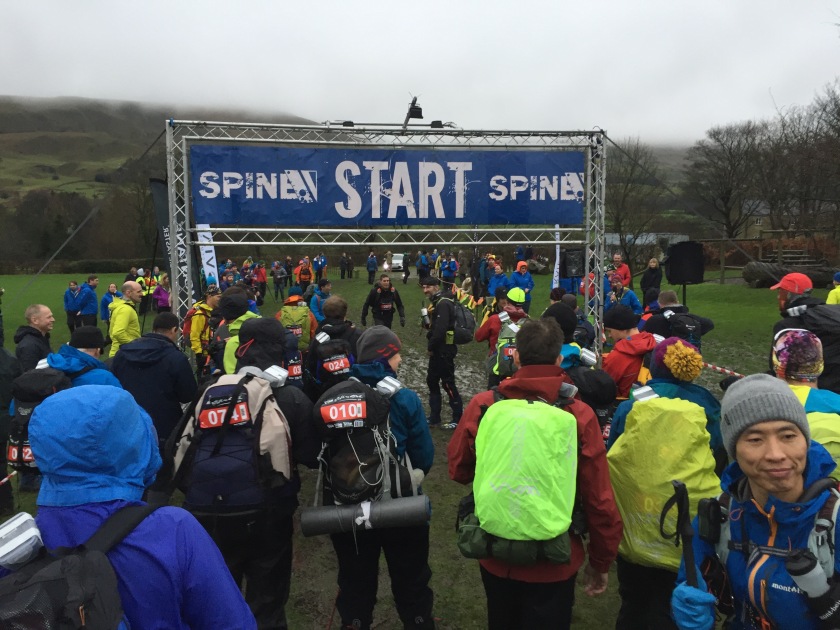
After months of fretting and feverish planning I toed the muddy line in Edale with 67 other athletes (I’m calling myself that now!) on Saturday the 9th of January, and gently trotted off into the unknown.

4 hours shy of 7 days later, I touched the wall of the pub that marks the end of the Pennine Way, in Scotland.

I was physically exhausted, had found places in my mind I didn’t know existed, and was sobbing like a child.

I’d done it.

That was nearly two months ago, and so far at least, I have no desire to up the ante on this one.

Mind you, I met someone who went there and back, so there’s a thought…

[Full report here]

South Downs Way 50 – Race Report

race

Go out fast and hang on as long as possible

When that’s your last minute race plan, it’s pretty much guaranteed that you’re not going to have a “fun” day.


First woke up at 2am when the child got into bed with me. Alarm went off at 4:40, ten minutes later managed to rouse myself wondering what I was thinking drinking a bottle of wine last night and staying up past midnight. Rookie errors all round.
Make brekkie and stumble into a cab, making sure not to forget bag of mini saucisson: race food experimentation.

Nice journey to Worthing with the other horses from the stable.

Everyone spends most of the journey eating and moving kit between race packs and drop bags.

Starts to rain when we arrive, which suits me fine.


The rain looks like it might stay away and the forecast is good, means more kit shuffling – we’re going to be hot very soon as the route goes straight up a hill.


Surprised by how many people there are at registration, feels very different from other UK trail races I’ve done.

All very well organised though and it’s not long before we’re off.

Bump into Mark from the spine, ask him how his feet are then quickly apologise, no doubt he’s had enough of that question (though if you’ve seen the photos you’d ask too, stuff of nightmares).

Concentrate on overtaking as many people as possible, running faster than I have since last August, heart rate over 170 which feels weird after months of SLOW training at 136.

Weather clears up, feeling happy and sprightly and keep up a good pace into CP1 at 11 miles.

Don’t stop and head straight off up the next hill, nibbling sausages.

The glute I tore two weeks ago has set up a persistent complaint, the other one and both hamstrings soon join in.

Decide to ignore them and keep pushing on, despite inevitable telling off from physio and subsequent lingering pain.

Pass the fields of pigs, respectfully wait until I’m out of sight before having another sausage.

Get to next CP at the 17 mile point, top up water, grab 2 biscuits and a jelly baby and head off into the rapidly warming day.

Starting to feel a bit heavy and sluggish, the wine from last night and lack of training adding to the cacophony of “body parts requiring attention”.

Actually realise am feeling decidedly peculiar. Very hot, very heavy and on the verge of being sick. Decide to slow down and force some food down, and drink more. Very aware that it’s far too early in the day to vomit and still make it to the finish.

Soon pass a digger and a massive mound of stinking black stuff, speculate that it must be condensed farmyard excrement. It takes a lot of willpower to keep what little food I have in my stomach, in my stomach.

Spend some time thinking that the sloshing from my water bottle is very annoying and it needs to be upgraded to a soft flask like the other one, even if letting the excess coke fizz out does feel like you’re milking yourself. Disconcerting, but makes me laugh.

Feeling better arrive at CP3, 27 miles. Look at the ham sandwiches, stomach says no, take a bite anyway. Whole body says no, compromise on two biscuits and a jelly baby. Head back out up yet another hill.

Relish the thought that it’s over half way. Concentrate on keeping the pace up and drinking water. Eat the odd sausage and some shot blox.

Remind myself for the hundredth time today that I must buy new trail shoes, 500 miles isn’t so bad, but after 5 years they have zero cushioning left and I can feel every pebble on the amply pebbled trails.

Next couple of CPs come and go, fill up with coke and water, supplement the biscuit diet with a cherry tomato and a couple of satsuma segments. Worry that there is going to be a lot of leftovers.

Skip the last CP as only 4 miles to the end, slide down the sticky muddy path to Eastbourne and push as hard as I can along the horrible flat road to the end.

Can’t stomach anything other than the food of champions at this point (snickers), luckily always have a few stuffed in my pockets.

Knew about the lap of the track at the finish, but still seems like a cruel joke.

Finish in 8h 47m, 72nd finisher. Chuffed.

Very surprised to find my fellow stablemates cheering and hugging me, wtf? Surely I would have noticed them coming past me? After some confused questions realise they dropped out at 27m and got a cab to the end.

Shower, hot dog then back on train to London (with wine).

Despite feeling ropey for a while, and the lack of training making everything hurt much more than it should have, had a good day out.

Very well organised and amazing support. Definitely up for more races at this distance, very pleasant contrast to the spine.

Wish I’d put some sun cream on though, ouch.

Oh, and the sausage experiment?  Nice and tasty, but a little too strong after a while – need something milder…

[obligatory strava link]

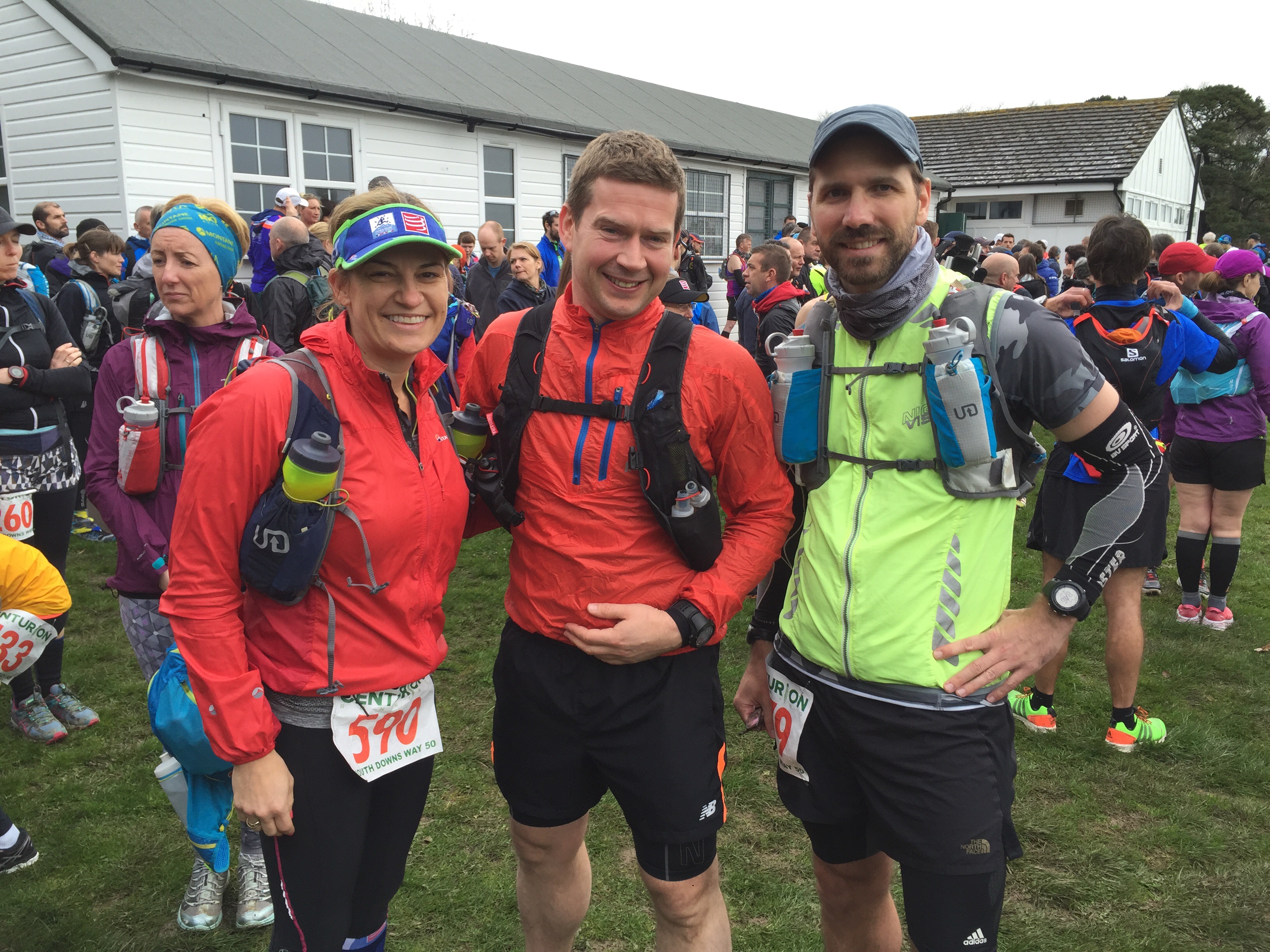
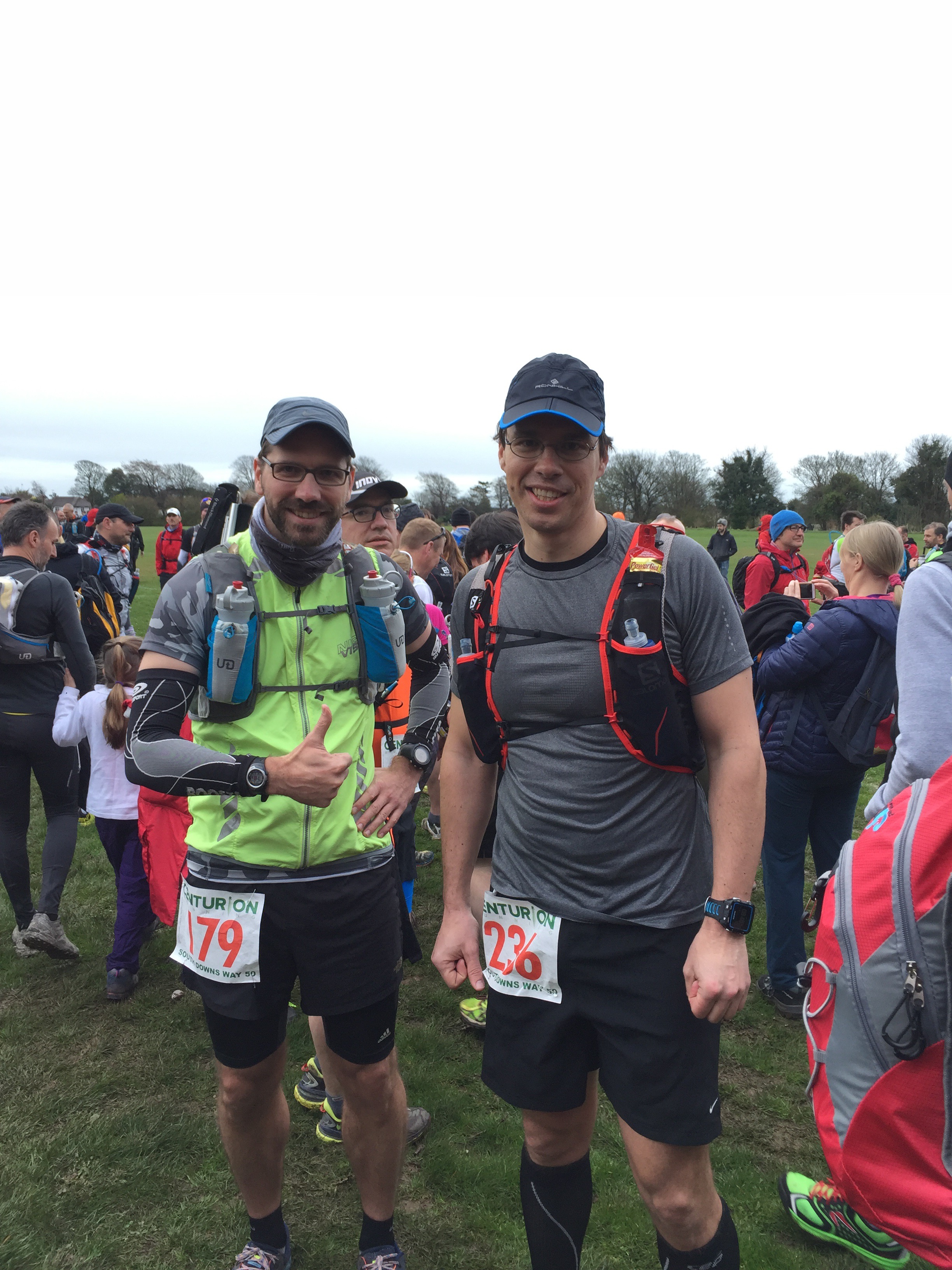
SDW50 – A View From The Stables

pre race

Spring is threatening to show its face in the UK, and as such marks the start of my offices Ultra Squad racing season for 2016.

We’ve got three horses saddled up and ready to hit the trails of the South Downs Way early tomorrow morning.

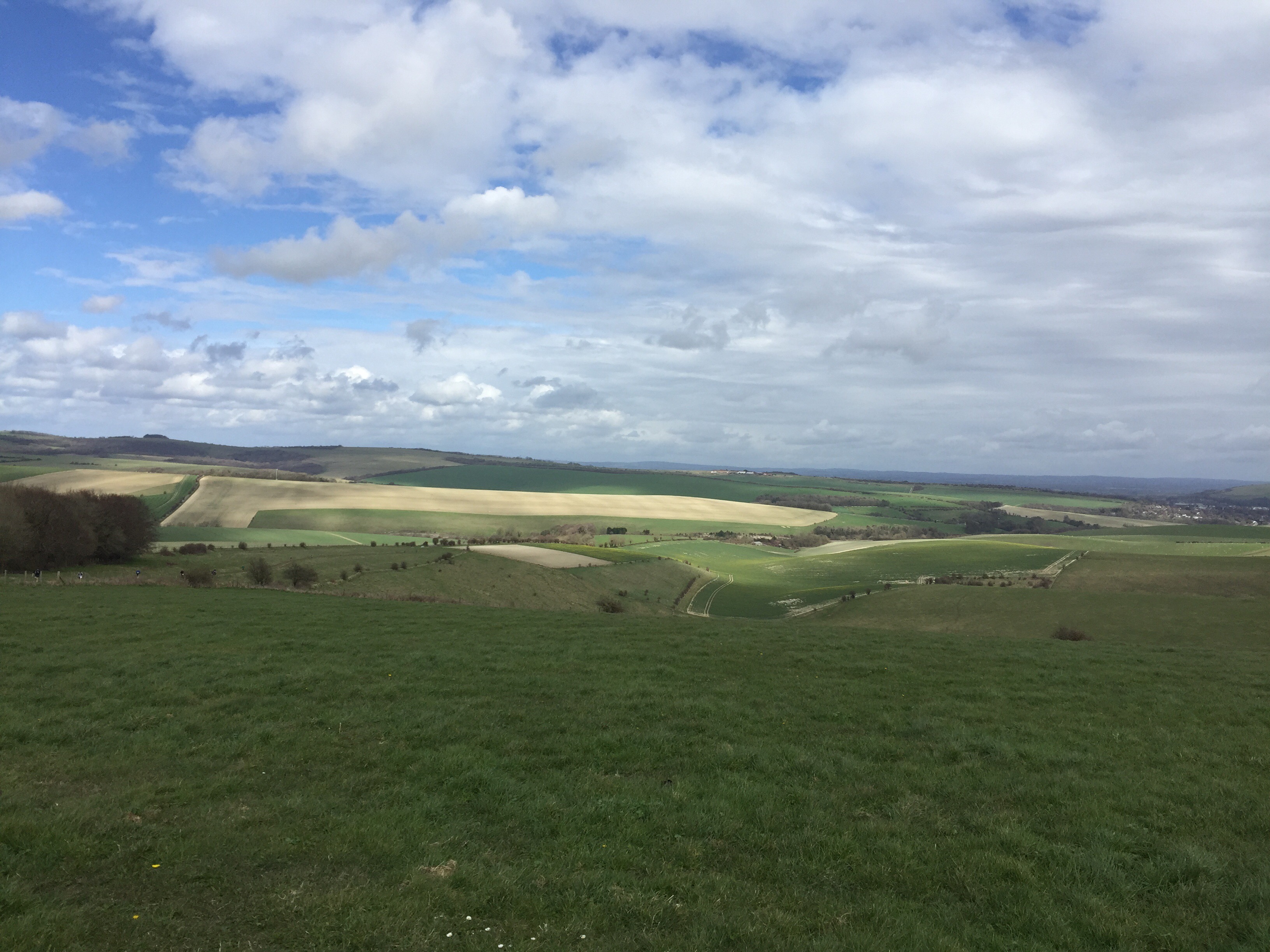
50 miles of well-marked national trail, in a decently sized field. Hosted by Centurion Running, the SDW 50 is quickly becoming very popular, with all places selling out ridiculously fast.

For a bit of fun, here is a bit of pre-race commentary along with some ranking predictions from a horse’s mouth.

Methodology

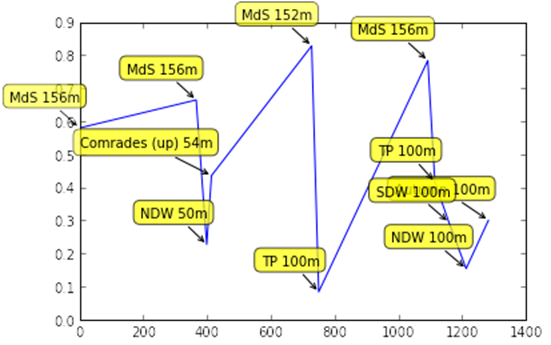
To avoid getting too carried away, the focus is on each animals relative ranking in their gender category from their publically available data on Statistik DUV

A score of 1 translates to a win, score of 0.5 is firmly mid-pack, and a score of 0 gets the last finisher prize.

By supplementing this sparse data set with rumours and observations, I will give my guesses for where our horses will finish in Saturdays race.

First up, TurboHarris

Looking at historical results, it’s clear that Turbo has a preference for long, hot, sandy races, placing highly in the 2012, 2013, 2014 and 2015 Marathon Des Sable races.

  
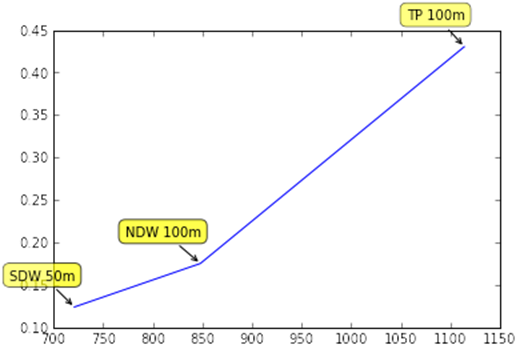
The usually soggy and slippery routes in the UK seem to have slowed the pace somewhat, though having said that, racing a staggering total distance of 556 miles last year didn’t seem to do any harm to the final race, with a 0.3 placing, up 15% from the NDW just a few months earlier.

Turbo doesn’t disclose her training data, but has been quietly putting in some serious training mileage this year, narrowly missing out on completing the whole February “Run Till You Drop” challenge. However the poker faced investment banker has been heard muttering phrases like “this is a pure training race”, and “oh gosh I’m so unfit”.

Take these with a pinch of salt, just look at the raw data:

Race Stats

2012 – 156m

    0.58 (45/107) in MdS (Apr, 156m)

2013 – 261m

    0.66 (48/143) in MdS (Apr, 156m)

    0.23 (17/22) in NDW (May, 50m)

    0.44 (1105/1957) in Comrades (up) (Jun, 54m)

2014 – 252m

    0.83 (22/128) in MdS (Apr, 152m)

    0.08 (22/24) in TP (May, 100m)

2015 – 556m

    0.78 (40/185) in MdS (Apr, 156m)

    0.42 (14/24) in TP (May, 100m)

    0.29 (24/34) in SDW (Jun, 100m)

    0.15 (22/26) in NDW (Aug, 100m)

    0.30 (21/30) in Autumn (Oct, 100m)

Verdict? The SDW doesn’t play to Turbos strengths, being too short and lacking any sand or sun, but don’t be fooled by the self-deprecation, the monikor is no accident and expect a rank of at least 0.4, that translates into a placing of 63/105.

Next out of the stable, RaketeGnodtke

Rakete is something of a wild card here, with only a smattering of races to his name, but a serious uptick in placement since arriving in the ultra-scene in 2014.

  
The only horse to have completed this race before (though all are familiar with the route, from non-public races and the SDW 100), should give a small advantage too.

The word in the stables is that this creature has almost convinced it’s peers (and itself) that not only is it lame, but has a hoof stress fracture. No vet has been contacted yet though, so the jury is out as to whether this falls into the psyche category too – nobody is showing their cards.

The Rocket will be riding tandem with his brother on Saturday, on his inaugural 50 mile race, just to further complicate the data.

Race Stats

2014 – 150m

    0.12 (226/258) in SDW (Apr, 50m)

    0.18 (80/97) in NDW (Aug, 100m)

2015 – 100m

    0.43 (90/158) in TP (May, 100m)

Verdict? The beast has potential, but with a lack of 2016 training and a potentially dodgy hoof, I’m going with a conservative rank of 0.25, a placing of 267/357

Lastly, and most leastly, Latimeistro

This horse was showing incredible potential this time last year, taking a number 3 spot in a 12 hour race.

It all went south after that, with a spate of injuries, gluttony and lethargia all conspiring to massively restrict training.

  
The spine race came and went, a decent placing but it was a slog over a long and cold 7 days (and nights).

Training mileage has picked up in the last month, though a torn glute set things back recently.

The course plays to the nags strengths, wet and cold are predicted, though the field size is large enough to overshadow any half-hearted efforts.

Race Stats

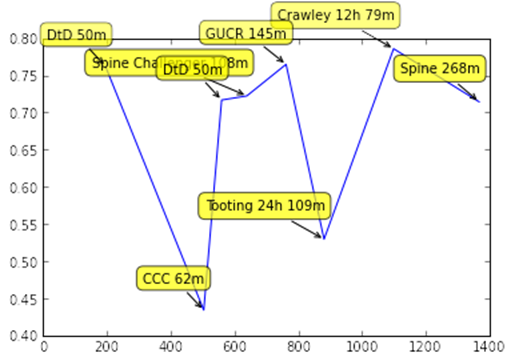
2012 – 50m

    0.76 (10/42) in DtD (Oct, 50m)

2013 – 112m

    0.43 (656/1159) in CCC (Aug, 62m)

    0.72 (17/60) in DtD (Oct, 50m)

2014 – 362m

    0.72 (5/18) in Spine Challenger (Jan, 108m)

    0.76 (12/51) in GUCR (May, 145m)

    0.53 (16/34) in Tooting 24h (Sep, 109m)

2015 – 79m

    0.79 (3/14) in Crawley 12h (Apr, 79m)

2016 – 268m

    0.71 (12/42) in Spine (Jan, 268m)

Verdict? Poker face firmly in place, but the inside view is that if the legs don’t fall off then a rank of 0.7 is attainable, 107/357.


Disclaimer


Past performance is no indication of future performance, various endogenic factors can severely affect an animals ability to race (donuts, Netflix and red wine, for example). None of this is serious and everything should be completely ignored.

South Downs Way 50 – Past results analysis with python

Uncategorized

My first race since the Spine is coming up, and whilst I’m not exactly at peak fitness, I thought it would be interesting to have a look at past results, to get an idea of how long the typical person takes.

If nothing else, it’s an excuse to play around with the tools I normally use at work, but with something less dry than financial time series.

I grabbed the raw data from the mighty D-U-V Statistik, the full code is at the end of the post.

Quick Check

Here’s a quick look at the data, to make sure it looks sensible:

M Winners
     year  age       full_name country        time mins_per_mile mins_per_k
1    2013   35   Perkins, Mark    GBR   6:55:37 h           8:19       5:12
125  2014   30   Navesey, Paul    GBR   6:11:28 h           7:26       4:39
426  2015   22   Mound, Victor    GBR   5:53:19 h           7:04       4:25
F Winners
     year  age        full_name country        time mins_per_mile mins_per_k
8    2013   38    Canvin, Emily    GBR   8:23:30 h          10:04       6:18
133  2014   37   Sutton, Edwina    GBR   7:09:21 h           8:35       5:22
432  2015   33   Morwood, Sarah    GBR   7:19:03 h           8:47       5:29

So far, not all that interesting (but impressive), although seeing the top 3 in terms of average pace is quite illuminating. Victor ran almost the equivalent of two back to back 3 hour marathons, over a hilly trail route.

Lets look at some histograms.

Pace Distribution

sdw50_pace_histogram

Faster than walking pace, but nothing too crazy.

What does it take to get a top 10 spot I wonder?

Top 10, pace must be faster than 9:20 m/m
Top 10, pace must be faster than 5:50 m/k

Pretty brisk then, considering the South Downs Way has some steep bits!

Age Distribution

To finish off, lets have a quick look at the age distribution, mostly because I’m feeling old (turn 40 this year), and I’m hoping that at least I’ll be able to use that as an excuse for being slow.

sdw50_age_histogram

OH, that was’t what I expected…bit late to do any more training, oh well.

For The Nerds

# Stick all the imports in one place, for clarity
%matplotlib inline
import matplotlib.pyplot as plt
import pandas as pd

from collections import defaultdict, OrderedDict
from os.path import join, splitext
from os import listdir
from datetime import datetime, timedelta
from functools import partial

def duration2hours(t):
 """Convert a duration string (eg '6:55:37 h') to a number of hours"""
 ts = t.split(" ")[0].split(":")
 td = timedelta(hours=int(ts[0]), minutes=int(ts[1]), seconds=int(ts[2]))
 return td.seconds / float(60 * 60)

def speed(hours=None, distance=None):
 return distance / hours

def fmt_mins_per_unit(mins_per_unit):
 """Returns a recognisable pace string, eg 6:55"""
 return "{0}:{1:0>2.0f}".format(int(mins_per_unit), 60 * (mins_per_unit - int(mins_per_unit)))
 
def speed2pace(speed):
 mins_per_unit = 60 / speed
 return mins_per_unit

def load_all():
 root = "race_data"
 # Use our own headers, that are easier to refer to in code
 headers = {"Rank": "position", 
 "Performance": "time", 
 "Club": "club", 
 "Nat": "country", 
 "M/F": "gender", 
 "Rank M/F": "gender_position", 
 "Cat": "category", 
 "Cat Rank": "category_position", 
 "Avg.Speed km/h": "speed_kmh", 
 "Age graded performance": "AGP"}
 content = []
 idx = 0
 
 for fname in listdir(root):
 year = splitext(fname)[0].split("_")[1] # Filenames look like 'swd50_2013.csv'
 df = pd.read_csv(join(root, fname))
 df["year"] = [year] * len(df)
 df.rename(columns=headers, inplace=True)
 df["position"] = df.index
 # Make sure the final index is unique
 df.index = df.index + idx
 idx += len(df.index)
 content.append(df)
 
 # Add some additional useful columns
 df = reduce(pd.DataFrame.append, content)
 df["age"] = map(lambda x: datetime.today().year - x, df.YOB)
 df["hours"] = map(duration2hours, df.time)
 df["mph"] = map(partial(speed, distance=50), df.hours)
 df["kph"] = map(partial(speed, distance=50 * 1.6), df.hours)
 df["pace_mpm"] = map(speed2pace, df.mph)
 df["pace_mpk"] = map(speed2pace, df.kph)
 df["mins_per_mile"] = map(fmt_mins_per_unit, df.pace_mpm)
 df["mins_per_k"] = map(fmt_mins_per_unit, df.pace_mpk)
 
 return df
 
data = load_all()

genders = ["M", "F"]
colours = {"Overall": "orange", "M": "blue", "F": "pink"}

# Save a handy lookup of the data too
views = OrderedDict((("Overall", data), 
 ("Overall M", data[data.gender == "M"]),
 ("Overall F", data[data.gender == "F"])))
for y in years:
 views["{0}".format(y)] = data[data.year == y]
 for g in genders:
 views["{0} {1}".format(y, g)] = data[(data.year == y) & (data.gender == g)]

# Print Summary
for g in genders:
 print "{0} Winners".format(g)
 winners = data[(data.gender_position == 1) & (data.gender == g)]
 print winners[["year", "age", "full_name", "country", "time", "mins_per_mile", "mins_per_k"]]
 print

# Print pace distribution
ax = plt.subplot(111, title="Pace histogram of all finishers")
ax.hist(data.pace_mpm, color="orange", label="Overall (mean {0} m/m)".format(fmt_mins_per_unit(data.pace_mpm.mean())))
for g in genders:
 subset = views["Overall {0}".format(g)] 
 ax.hist(subset.pace_mpm, alpha=1, color=colours[g], label="{0} (mean {1} m/m)".format(g, fmt_mins_per_unit(subset.pace_mpm.mean())))
ax.legend(bbox_to_anchor=(1.5, 0.5), loc='lower center', ncol=1)
plt.show()

# Print top 10 pace
tenth = data[data.position == 10]
print "Top 10, pace must be faster than {0} m/m".format(fmt_mins_per_unit(tenth.pace_mpm.mean()))
print "Top 10, pace must be faster than {0} m/k".format(fmt_mins_per_unit(tenth.pace_mpk.mean()))

# Print age distribution
ax = plt.subplot(111, title="Age histogram of all finishers")
ax.hist(data.age, color="orange", label="Overall (mean {0:.0f})".format(data.age.mean()))
for g in genders:
 subset = views["Overall {0}".format(g)] 
 ax.hist(subset.age, alpha=1, color=colours[g], label="{0} (mean {1:.0f})".format(g, subset.age.mean()))
ax.legend(bbox_to_anchor=(1.5, 0.5), loc='lower center', ncol=1)
plt.show()


Fancy an adventure? Maybe the Spine Race is for you!

race

Step.  Step.  Step. Step.

Keep moving.

Keep. Moving.

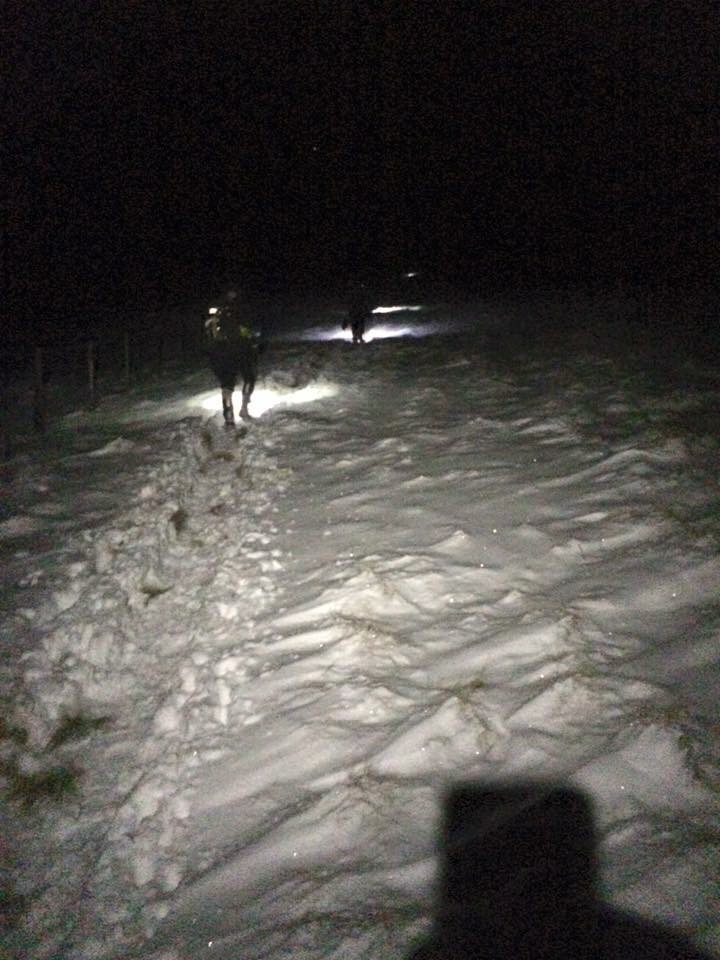
My watch says I’m moving at 1.4 miles an hour, I glance ahead through the swirling snow and mist at the fence and hill visible in the dimming light of my head torch, and doubt I’m even moving that quickly.

This was supposed to be an easy section, just 4 miles between refuge huts somewhere in the Cheviots.  I’d even allowed a small amount of optimism to trickle through the barriers.

No food left in my pack, not much remaining in the group (I’d already done a few rounds up and down the line asking people to share anything they had).  Breaking fresh trail through deep snow drifts was sapping dangerously low energy levels.  The biting cross wind snatched all warmth as soon as movement ceased.

I’d been on the go since 2:30am yesterday morning, a long 18 hours with a brief stop in Bryness for soup, mince, potatoes and a perplexing mandatory foot check.

I hoped my torch battery would last, it was tucked under 4 layers next to my chest, but even fully charged and warm I’d be lucky to get 6 hours out of it.

IMG_5847

This is of course the Spine Race, a foot race that takes on the Pennine Way from Edale in the Peak District to Kirk Yetholm just over the Scottish Border.

It takes place in January, primarily to make it harder; the unpredictable but guaranteed variety of weather turning the easiest trail into a quagmire / river / non-trail under a blanket of snow.

Oh and the 268 miles of mostly rough and occasionally unmarked trail.

Mustn’t forget the hours of darkness, 4pm until 8am, and the time limit of 7 days.

Throw all that together and you’ve got a real challenge, so it’s no surprise that over 60% of the field drop out or get timed out before the finish.

It’s not billed as “Britains most brutal race” for nothing.

IMG_5944

What were we doing here?  Why were we doing this?

These aren’t questions that came to mind, they didn’t matter and wouldn’t change anything even if I had the answers.  All that mattered was that we kept moving, one step at a time, slowly, steadily.  Forward motion.  Just keep moving.

My existence was here and now, everything else was peripheral and forgotten.  In a strange way, this is what I’d been looking for when I signed up for this race, escape from the normal world, pushed to the limits of physical and mental endurance, but still moving, still aware of the need for one more step, and another, and another.

Periodically I checked how Dan was feeling, we’d promised to stick together, and after my petulant foot stamping episode in Greendale the day before, I wasn’t going to renege on it.

At one point he was faltering and we debated bivvying somewhere sheltered and heating up our dried rations, but the double decker from Stuart and the last of my beef jerky had kindled a spark behind his eyes.

Onwards then.

Onwards.

IMG_5976

Dan and Esteve at Gregs Hut

I met Dan Connors a few years ago when we ran nohtaraM ehT together, and we’d since followed each other and chatted on Strava.  We’d leapfrogged each other a few times during the first half of the week, and I was very happy to join his group leaving Alston.

When we finally arrived in Greenhead, hungry and cold, I lost my temper over something daft, and had stormed off up a hill after shouting something like “I don’t fucking care what you do, I’m going this way”.  Dan’s comment that I was behaving like a diva and did I need a snickers bar dissipated the tension and we soon found Tom Jones, some shelter and hot food.

When we were finally nearing CP5 in Bellingham, and were working out the optimal plan for the final section (which Richard Lendon helped us finesse, over mountains of hot food and sweet tea served up by his lovely wife Jenny) I said that we should definitely stick together as a team.

Do you mean as a pair of people who happen to be travelling at roughly the same speed in the same direction, or do you mean actually as a team?

Point well made, and well taken.  We were a team from here to the finish, whatever happened.

IMG_5851

The race is long, and the checkpoints are far apart.  On average around 40 miles.  In good weather a good days hike, in any other conditions, 20 hours isn’t unreasonable.

I spent as much time on my own as I could.  I enjoyed settling into my natural pace, not chasing anyone and not waiting for anyone.  I savoured the pleasure of being outside, the satisfaction of navigating by map and compass, thoughts of the outside world receded and I settled happily into the Spine bubble.

There were moments of course, many ups and many downs.  The first day was such fun, trundling along a ridge buffeted by wind and rain reminded me of my childhood in Scotland, I passed many people here but my cheery greetings were seldom returned.

IMG_5861

Onwards.

Onwards.

Eventually we reached the top of the hill and the long anticipated left turn that would take us down to the second hut with it’s promise of shelter and hot food and drinks.

At this crucial time, I made my first and only serious error of judgement.  I can explain it away using a host of valid excuses, but none of them pass muster under the cold unforgiving eye of hindsight.

Not bothering to take a bearing, I burst through the gate and galloped downhill, deliriously happy to be rid of that uphill slog and just moments away from sustenance.

The frozen crust of snow held my weight for a few minutes before giving way and I sank past my knees.

Surely no, no no no no!

For fucks sake no more of this shit!

I changed course and frantically zig zagged down the hill searching out runnable surface.

I could see a few head torches following me.

Stopping to catch my breath, I looked around and was horrified to discover I was way off course, and teetering on the edge of Hen Hole (or Hell Hole as it will be forever etched in my memory).  Hen Hole is a steep gulley, and with the covering of snow and ice would be next to impossible to climb out of.

Laying my single pole flat on the snow in front of me, I was able to slowly crawl up the hill and get back onto level ground.  I could see the fence and further down a couple of head torches.

Satisfied I was back on track I needed to signal to those behind me to maintain height and not get sucked into the pit of doom.

How do you signal directions with a head torch?  Even if I knew morse code, did anyone else?

I ran/fell/crawled back the way I’d come, desperate to catch sight of someone, a thousand thoughts whirring through my head.  We were all tired and hungry, and I’d just led people the wrong way, potentially putting them in danger.

IMG_5876

My first taste of proper adventure (ignoring the icy scramble over Pen Y Gent in the dark) arrived not long after I almost fell off High Cup Nick in darkness and thick fog, when I decided not to attempt the next section over Cross Fell on my own, at least not in the dark anyway.

My wife was very happy with the decision and I made my way down to the pub in Dufton hoping for something hot to eat.

As luck would have it I found Javed warming himself by the fire, and he was happy for me to tag along. Too late for food but the barman was happy to whack some hot water in a bag so I could enjoy some rehydrated spag bol.

Off we marched into the darkness and I quickly pulled away up the gradual incline, which surprised me as I’d assumed we must have been moving at a similar pace to be at the same point after a few days.

Accepting the advice to plod uphill and conserve energy for the flats and downs, I slowed down and pondered the other useful nugget of advice.

You say one of your achilles tendons really hurts, what happens if you think about the one that doesn’t hurt?

A useful thought, and one I returned to many times over the remainder of the week.

IMG_5856

When you’re moving yourself over long distances, mind games and techniques are incredibly important. Not just to provide motivation, but to avoid the downward spiral of painful introspection and obsession that leaves you slightly unhinged at best.

After a pep talk from Tin and upbeat messages from Marissa on Saturday, I’d relied on some simple but effective methods of avoiding negativity and doubt.

One step at a time, step, step, step. Every step is one step closer.

Every tap of my pole, tap, tap, tap. Every tap is one tap closer.

Disney songs, really. Micky Mouse club house courtesy of my daughter Trixy, and the bare necessities, thanks to Paula who texted the entire lyrics.

When I needed something stronger, I remembered a conversation with my mother in-law on Friday night. I was wittering on about whether I’d make it to the end, and she said, very calmly but with total conviction: “you’ll do it”. Lesley, you saved my race, multiple times.

Sometimes though, the only way to block negative thoughts was to fill my head with a single word, over and over and over again.

Step.

Step.

Step.

IMG_5907

Noodles!

I was feeling impatient and eager to crack on over the hills to the fabled highest noodle bar in the country, but (with some difficulty) chastised myself and resolved to learn as much as possible from my companion. With a wealth of experience on extreme ultra running, and the spine race specifically, there had to be important lessons available, even if only from observation.

We climbed higher and unexpectedly found ourselves in deep snow with a nasty wind picking up and obliterating the footsteps of those ahead of us.

It was next to impossible to stay on the path, and finding ourselves mostly wading through thigh deep snow, progress was slow and getting slower.

Patience grasshopper, patience.

Gentle cajoling didn’t seem to speed Javed up for more than a couple of minutes, Gregs hut was a few miles away but at this pace, several hours.

Confessing that he’d only slept for 3 hours so far, and was planning on doing the “double“, we debated our options (after I’d informed him that he was bat shit crazy of course, which made us both laugh).

One curious aspect of pacing in a race like this, is finding the optimal balance between sleep and speed. I’d slept for 6 hours so far, and was clearly moving faster. Was that because of the sleep or just down to my legs? Hard to say.

With the teary parting phrase of “I’m scared you’re going to lie down on some godforsaken hillside and never wake up” overwhelming my rational mind, I wasn’t keen on sleeping in a snow bunker on the side of a mountain in a storm. The problem was that our current speed meant that our core temperatures were dropping fast.
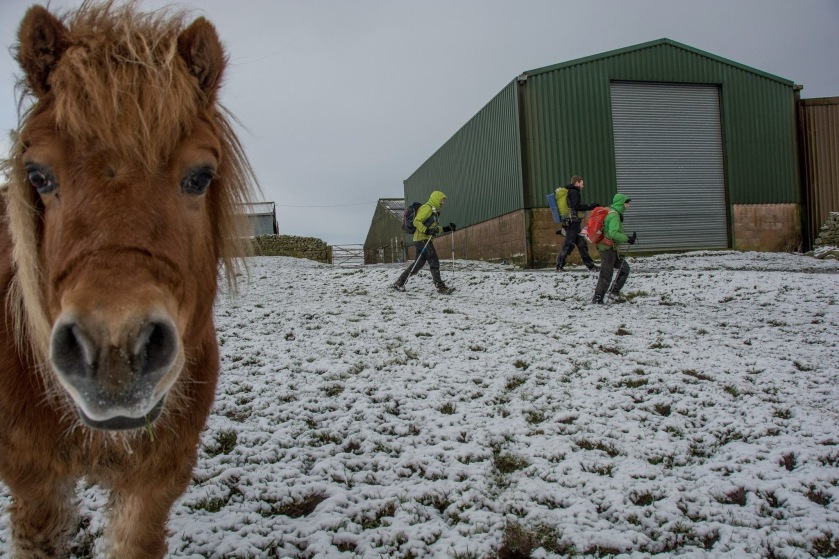
IMG_5982

#photobomb

We needed to make a decision, and the choices weren’t great.  Sleep on the mountain, retrace our steps to Dufton, or find the quickest way down to anywhere there was shelter.

Casting a glance back the way we’d come, the snow and wind had already turned the ground into a pristine blanket with no trace of human activity.

Nearby was a hollow/bunker on the hill and the decision was made for us.

I called HQ to let them know, then grumpily (at least I appeared grumpy, I was actually just scared) followed my bunk mates instructions:

Put on everything you have, dig a coffin in the snow and put your mat in it, get into your bag with everything on and take anything you don’t want to freeze in with you.

Still grimacing from the choice of words, I found myself to be surprisingly snuggly and warm and settled down comfortably, only to start hyperventilating and, for want of a better expression, freaking out.

Headtorch on, and I had a long conversation with myself about the relative perils and merits of the current situation. Assuring myself that if things got really bad I could get myself down to the village very quickly, calling for help on the way if necessary. “Anyway”, the conversation concluded, “you wanted an adventure, and this is pretty exciting”.

Finally calm, I fell asleep for 2 hours, then woke up cold. My companion was in a similar situation and as we debated what to do heard voices calling our names.

I thought I was hallucinating at first but when I saw lights realised it was real.
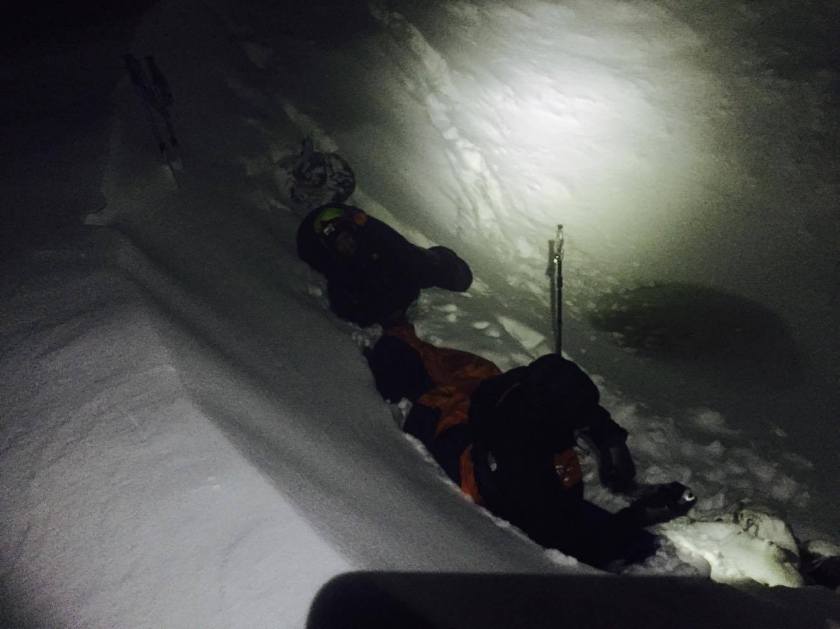
12544270_10207246449313302_695847799_o

As bedrooms go, it was pretty chilly

HQ had sent a couple of chaps up to make sure we were ok, we leapt out of our coffins and within minutes were back on the trail, marching along with fistfuls of mini baby bells and tummies warmed by hot chocolate. The wind had eased off, it had stopped snowing and Gregs Hut and its famous noodles (with fresh chilli, from John Bambers greenhouse) were a hop, skip and daybreak away.
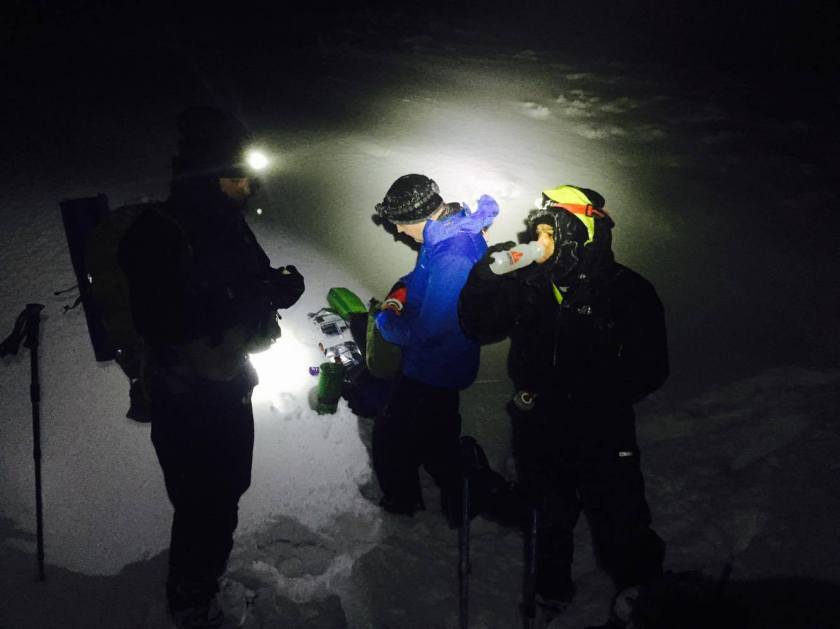
12592027_10207246449073296_1654485811_o

At the time I was upset that my race had been disrupted, had I known Javed was so tired and was planning on returning to Edale along the same route after finishing, I would have got some sleep in Dufton. I knew he was experienced, but I didn’t feel comfortable abandoning him in a storm on a fell.  You have to do what feels right at the time, you look out for each other and make your decisions with collective safety in mind.

It might be a race, but it’s not always about you.

Although we had let everyone know what we were doing, spending 3 hours on the wrong side of a mountain in the middle of the night, in a storm, triggers an alert.  Hence the physical check.

It’s this kind of intervention that makes you realise that you aren’t at the mercy of the wolves, and whilst in danger, there is a very high probability that help would arrive before anything too dramatic happened.

It just feels like you’re on your own and exposed to survival mode choices, this is where the organisers have got it just right.

IMG_5967

Not looking our best, at hut 1

I couldn’t see the head torches that were following me any more, and there was no way I was going back into Hell Hole.

The quiet but must-be-obeyed voice in the deepest part of my mind, took over.  I sat down and got my phone out, calling HQ I let them know my race number, where I was, and that some people behind me had just gone off course.  Swapping my head torch batteries, and resisting the urge to take some layers of clothes off (I was boiling, but wasn’t sure if the feeling was real or imagined, so opted for the safer choice) set off for the hut.

Soon I met some MRT people coming back up the hill, they asked how I was and I think I did a passable impression of seeming normal as they carried on saying they needed to make sure people didn’t take a wrong turn off the route.

Finally arriving at the sanctuary, I stepped into a situation no less surreal than the one I’d just fought my way out of.

Anna was borderline hypothermic and was being manhandled into a blizzard bag, whilst being force fed hot sweet juice.  Douglas was helping sort Anna out, Zoe was asleep and Dan was looking totally spaced out.
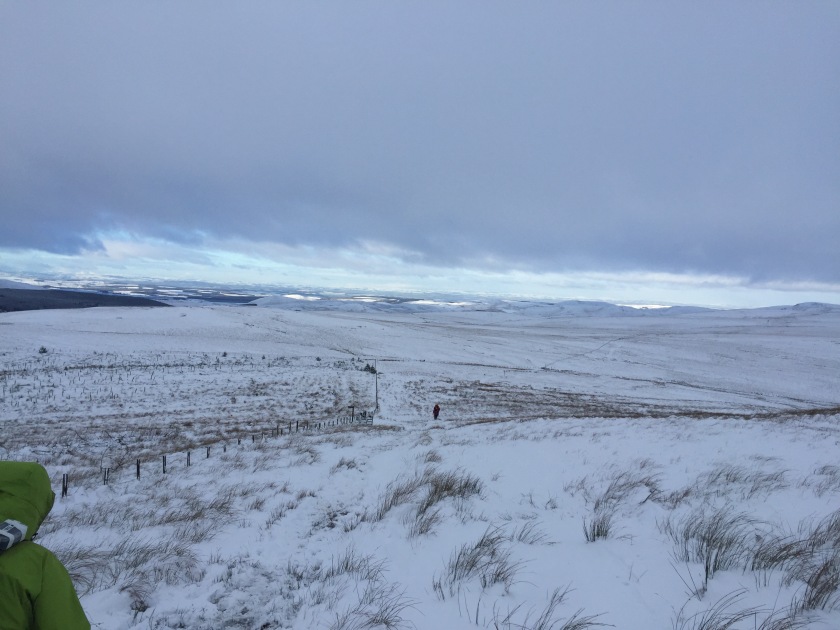
IMG_5934

I made sure all the mountain rescue people knew there were at least two people off course, and eventually our addled minds figured out their names (Stuart and Colin), also that Javed was behind us and in debatable shape given he’d lost his food (though I’d given him most of my meager stash which should have helped).

After a while Stuart appeared, looking hot and relieved.

I sat worrying about Colin, about Anna, about everyone.  I had some hot food.  I got colder not warmer.  I worried and worried.  Tom said we all had plenty of time to make the cut off, I thought he’d lost the plot, talking about the race in this kind of situation, this was survival man, survival!

Eventually Dan and I decided to move on.  There wasn’t anything I could do for Colin now, and we were taking up valuable space.  Realising that I was cold because I had indeed sweated during my feverish efforts earlier, I put on a dry thermal top, lost a mitten, got my spare gloves out and we prepared to head out for the final section.

As we were shuffling out of the hut, Colin arrived looking as if nothing untoward had happened (maybe it was hidden behind the beard), and noting that “reports of his demise had been much exaggerated” joined us.

We saw a chap being brought in by the race MRT, he was wearing a t-shirt and I recognised him from Saturday night (we’d joined forces along with Damon and battled through the blizzard together).  He wasn’t in the race but was covering the route at the same time as us, which had seemed impressive then, but in my now confused state looked risky at best.  He was shortly airlifted off the mountain as was fully hypothermic (a classic sign is believing you’re overheating, as per my caution earlier).

IMG_5921

With Dan and Colin, just leaving Bryness

It’s been a week since I touched the wall of the Border Hotel in Kirk Yetholm, yet life hasn’t quite returned to normal.

I’m still waking up multiple times in the night, drenched in sweat, with visions of the trail fresh in my mind. At least I’m not panicking that I’ve fallen asleep in the snow, those nightmares stopped after about 6 days.

My food intake is approaching normality, though I still feel distinctly weak and faint before I’ve had breakfast, 8 hours without food is now unusual.

Maintaining body temperature is still a manual process, I spend the hours in the office (when I haven’t had to sneak off for a 15 minute nap) without shoes but wearing a scarf.

The damage report from my physio was surprisingly positive, although my super tight achilles bent lots of her needles, I now start the day with a slightly less painful hobble than a few days ago.

The cracks in my fingers have healed, and I’ve de-grimed enough so that my iPhone recognises my thumb again.

Both of my big toes are still mostly numb – some (hopefully temporary) nerve damage.

IMG_5943

Friday afternoon on the Cheviots

When encountering a fellow racer for the first time, every conversation was almost identical: “have you done this race before?”, “will you do it again?”.  Nobody every asked what you did for a living, it was irrelevant.

Until I’d settled into my stride and the rhythm of the event, I found it unfathomable why anyone would want to put themselves through such an unpleasant experience more than once, in fact I was struggling to make sense of the once.

As time passed however, and I’d had more time on my own to reflect on what was going on with my body and mind during those long long hours, I began to understand.

I’ve often said to people, at least in the last year when my running habit took a slightly different tack, that what I really enjoyed about the hours spent on my feet, was the meditative aspect.

When running, and especially when covering long distances, I ease into a mental place where I’m hyper aware of my body and my immediate surroundings, but little else.

How do my feet feel? Any hot spots? Legs? All ok? Are my shoulders relaxed? What’s going on with my stomach? Time for more food? Is that pain something to worry about or just temporary, check back later. How’s my bearing? What does the map say the next landmark is? Am I warm enough? Too hot? Is that something in my shoe? Empty it out at the next stop. How do my feet feel?…

The Spine throws in a few more things to think about, such that the bubble is almost complete, only the thoughts of family and my daily call home really penetrating.

Physically it’s a challenge, being long enough that any slight niggle has the potential to turn into a race ender after a few days.
IMG_5873

My only blister, a good one though

Mentally it’s tough too, sleep deprivation muddles the sharpest mind, and there are so many reasons to stop. I think I called upon some deeply buried part of myself to manage the rest of me, a tiny but powerful voice that forbade giving up, and was rational and calm when everything else went tits up.

My first real encounter with proper sleep deprivation happened on Sunday night on the long and tedious road from Horton to Hawes.

In the absence of any navigation (which I later found be a real help to stay awake), I felt completely drunk, staggering all over the road and desperately fighting the urge to lay down and sleep.

People talk of sleep monsters, I don’t know about monsters, but I had to fight so hard to stay upright and moving in roughly the right direction.

By the time we got to CP2, 108 miles in and the Challenger finish, I’d been awake for 49 hours with a 1/2 hour nap somewhere in the middle.

I felt bloody awful.

IMG_5844

Clean! (in Edale)

My race strategy, if you can call it that, was:

1) It’s not a race
2) Determine pace by terrain and what feels sustainable
3) Stop as little as possible
4) If have to stop, keep faffage to a minimum (apparently this is called “personal admin” – looked like faffing to me)
5) If I get to the last section, and conditions allow, it’s a race

I soon modified this to include:

6) When an opportunity to eat presents itself, take it. If hot food is available, even better.

On the subject of food, people keep asking me what and how much I ate.

It’s very hard to work out how many calories I got through, but it wasn’t nearly enough.

Food is a very personal thing, but what worked for me was a combination of: cold pizza, Lesleys home made fruitcake, fresh beef jerky, wine gums, snickers (no surprise there), pepperami (wouldn’t bother next time, proper salami or kabbanos would be much nicer).
IMG_5867

A massive feed at the awesome Tan Hill Inn

In checkpoints I supplemented the supplied food with pots of rice pudding, and always kept a couple of expedition food packets in my pack. These are super light (~140g), contain 1000kcals and are genuinely tasty. I have a vague memory of Pavel mentioning them on a blog once.

I discovered that I really dislike 9bars, especially out of date ones, and binned my entire stash somewhere around CP4. Far too sweet and sickly somehow.

The General gave me some advice he picked up on the Dragons Back Race, which was to eat something shortly before hitting a checkpoint. Not only does it give you a nice boost, but it helps kick your brain into gear and avoid mindlessly shuffling kit between different bags. There is also the added bonus that you’re not super narky when you arrive so have no excuses for not being smiley and friendly to the support crew, which makes everyone happier.

IMG_5956

After being a bit blasé with gathering all my kit for the challenger in 2014, and suffering with shoulder agony from my horrible and horribly heavy pack, I shelled out for a 22L Aarn Mountain Magic this year.

It didn’t disappoint (once I’d adjusted the 5 thousand straps ‘just so’), and it felt less like carrying a load of kit than having some warm and comfortable creature hug you from behind (nicer than it sounds).

I didn’t take anything superfluous (but making sure I had enough to be safe in an emergency), and with a borrowed PHD sleeping bag got the total weight down to around 7.5KG, including water. This was about half the weight I had last time, and once the pack was on I hardly noticed it. The huge front pockets meant I rarely had to take it off either, double bonus.
IMG_5875

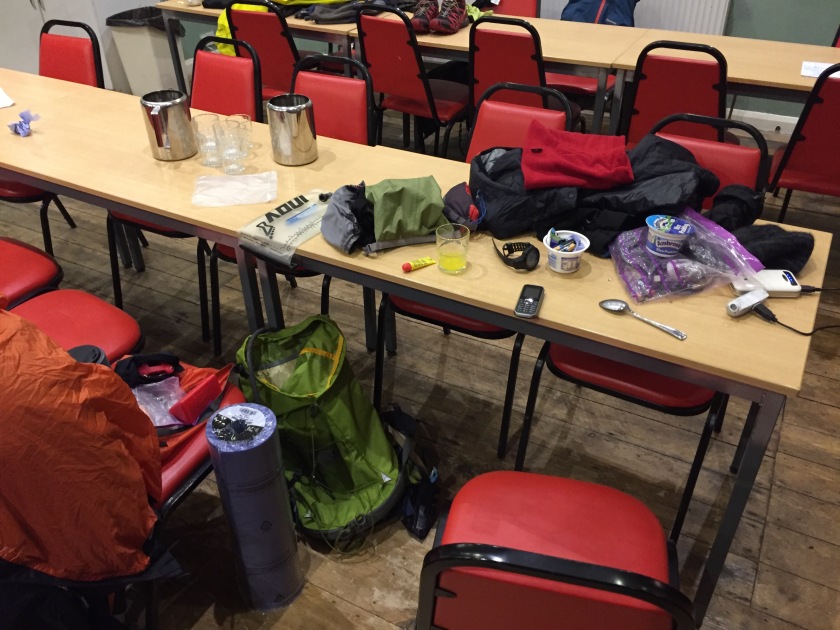
“An explosion of kit”, at Middleton-in-Teeside

Expecting lots of rain my drop bag had a complete change of clothes for each checkpoint. As it happened it didn’t rain that much, I didn’t really move fast enough to sweat much, and the drying rooms worked really well. So I pretty much cycled through two sets of clothes. Basically my best kit. Apologies to the checkpoint volunteers and anyone who ever found themselves downwind of me!

My best kit consists of 2x helly Hansen “warm” merino wool tops, 5x decathlon wicking base layer tops, columbia and Inov8 3/4 leggings, Rab eVent trousers, North Face Summit Series jacket, Patagonia gilet, OMM Rotor smock, Montane Via Trail gloves, Seal Skinz mitts, a wool hat given to me by my mum after a trip to New Zealand, a random buff from snow&rock, 2x sealskinz long socks, 5x injinji liner socks and 5x decathlon wicking pants (some things just shouldn’t be recycled).

Oh and two pairs of Inov8 trailrocs, one pair slightly bigger, which were lent to me by Matty though he refuses to have them back. Can’t really blame him after everything they’ve been through, the snow and ice ripped so many holes in them I’m not sure they’re up for any more outings.

IMG_5969

Just past the massive owls

We left hut 2 and went straight into a short steep hike up the Schill, which was just the job as I was definitely cold by now, if anything I’d got colder sitting down for such a long time, even though I’d had a big bag of warm food.

I was sent off with Dan, Ryan and Colin.  Tailed by a couple of mountain rescue guys we began the simple trudge along the last section.

4 months ago I was probably the fittest and healthiest I’d been since I was a teenager. Training was going brilliantly and I’d had a huge confidence boost by placing 3rd in the Crawley 12 hour race.

What felt like a minor groin strain after a nondescript 20 mile run, escalated over a few days (and some shorter runs) into excruciating shooting pains every time I tried to stand up, start walking or roll over in bed.

Convinced it was a torn something important, I stopped running, enjoyed my holiday in Italy and booked in with a physio on my return to London.

Our sessions were normally chipper and chatty, so I knew something wasn’t right, and I was referred for an MRI scan under the dark cloud of a potential stress fracture and facing at least 3 months of: No Running.

Suspicions confirmed a compression side femoral neck stress fracture (common in the military and old people) and I was handed a pair of crutches.

Super fit to depressed invalid in the space of two short weeks.
IMG_5972

Leaving Gregs hut

All my training and racing plans for the rest of the year went out of the window, but I hoped against hope that the Spine could still be a possibility.

Determined not to turn into a sad, fat and unfit blob before winter even arrived, I solicited advice from anyone who would lend a friendly ear, and devoured lots of books and blogs.

The upshot was that I covered many miles on my crutches (and slowly weaned off them into walking unaided), spent dull hours in the gym building upper body and core strength, changed my eating habits and food intake (again), swapping a kilo of fat for muscle and dropping to my lowest weight in years.

I saw a bone specialist, went for lots of tests, took so many supplements I rattled (vitamin D, K1, probiotics, Omega 3&6).

After 3 months I tried a few runs, but the muscle atrophy was so severe that within a week my knees were agony and it was clear that everything was totally out of balance.

More trips to the physio, more specific exercises, more dull hours in the gym. I didn’t dare try any more runs, and just kept my fingers crossed that nothing else would go wrong before January the 8th.

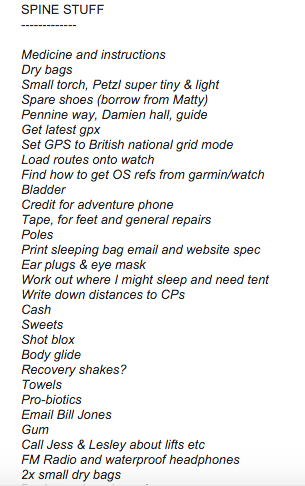
In the meantime I slowly added to the mountain of kit, food, maps, lists of pubs and lists of lists of lists that contribute to the huge amount of preparation that a week long expedition demands. I was pretty sure that if I made any serious cock ups on that front, it would derail my race just as much as any physical ailments. I wasn’t leaving anything to chance.
Screen Shot 2016-01-31 at 11.45.16

One of many

So when I stepped (slipped in ankle deep mud) up to the start line at 10am on Saturday morning, I was under no illusions about how tenuous my situation was.

I’d promised family, friends and physios that I wouldn’t run, this was strictly a walking race, and whilst I expected to be in pain, I would drop out if it got to a worrying level.

Many people urged me to postpone it a year, but given how easy it is to talk oneself out of anything, and post rationalise anything using a host of feasible reasons as excuses, I determined to rock up and race, and see what happened.

Two people saw through my façade, both who apparently know me better than most. One was my wife, for obvious reasons, who worried that my sheer bloody minded stubborn determination would drag me to the finish regardless of what pain my body threw at me.

The other was my boss, which sounds weird until you realise that he has an uncanny ability to figure out what makes people tick. He commented that someone who ran so much they fractured their hip isn’t best placed to judge how much pain is too much. I resolved to avoid all painkillers, and his parting words of “if you were fit, I’d absolutely think you’d do this race, as it is, I can’t see you making it” helped me grit my teeth in some of the lower points of the race,  no doubt as intended.

Coming down the final road to the pub that marked the end of the Pennine Way, I finally allowed myself to accept that yes, I was going to finish. Normally visualising the end of a race is a powerful motivator, but 268 miles is such a long distance, 7 days an eternity, and with so many obstacles to overcome I never allowed myself the luxury of hoping to get there before the cut off.

All the pent up emotion, stress of that tortuous section to hut 2 and serious sleep deprivation surged up through my chest and I sobbed the final hundred yards.

I remember muttering stupid nothings to myself, “you tosser, how the hell did you just walk to Scotland?!”

There was nobody to be seen, and after quietly touching the wall I sat down on an old plough, thinking this was a suitably low key ending to a very low key race, tears still running down my face.

Colin appeared from the darkness and gave me a hug, which was just what I needed.

Dan arrived and touched the pub, I gave him a hug, but I don’t think army men do that sort of thing. Anyway, it had seemed appropriate given what we’d just been though.

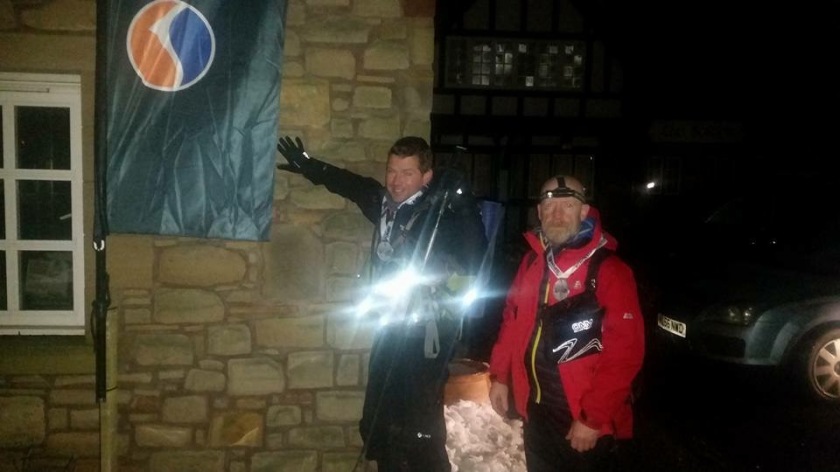
Moments later Lindlay arrived with our medals, apparently our trackers were a bit off and we were early.  No matter, medals and photos were taken and off we went for food and sleep.
IMG_6001

Much has been made of the hardships endured, and it’s easy to overlook how many things made me smile over the week.

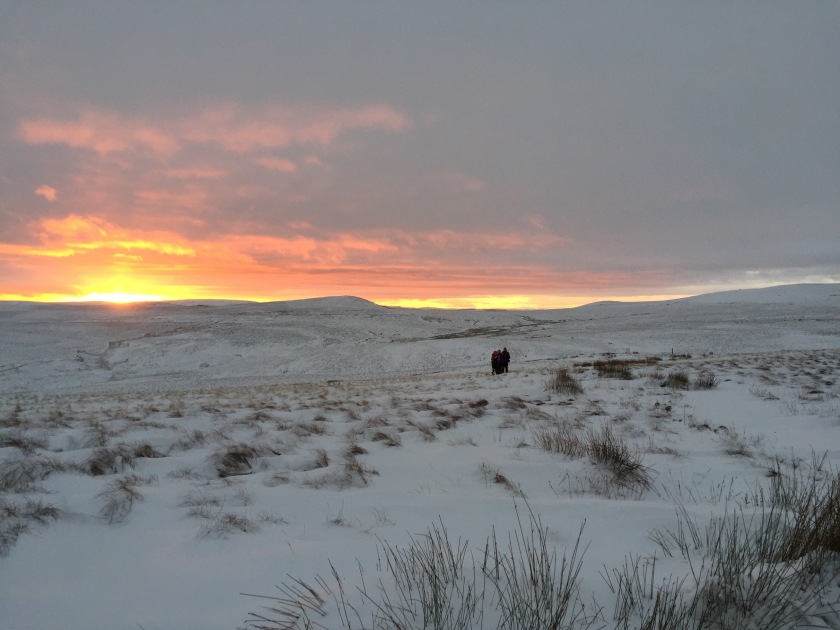
Sun rises and sun sets over frozen mountains were spectacular, the views you only see when you’re prepared to travel by foot overnight.

Low Force and High Force on the river Tees were mesmerising waterfalls, especially given the amount of rain this winter.

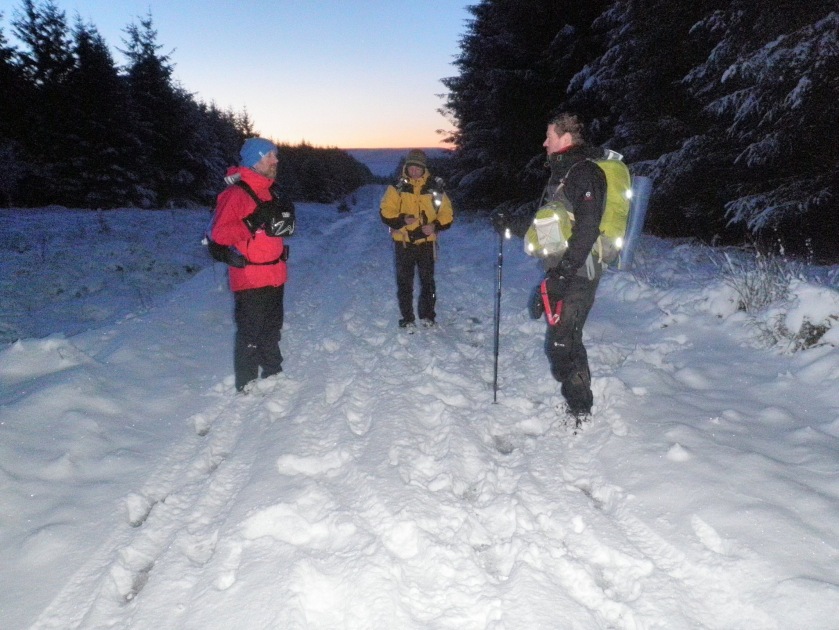
Leaning on a gate, in the middle of a snow laden forest shortly after first light, chatting to an inquisitive, chubby little robin. This wasn’t a hallucination, but the massive house size owls I saw earlier probably were.

Finding a box of flapjacks at the top of a steep field in Thwaite, marked “for Spine racers”, thanks Emily, that got me to Tan Hill.

Being intercepted by family friends Bill & Janet in Lothersdale. They had a warm car, a flask of black coffee and the best chicken sandwiches I’ve ever had (and I’m very particular about my sandwiches). Thank goodness Peter Gold wasn’t slinking around.

IMG_5948

Some parting thoughts.

It’s a long way, the weather changes everything, it needs to be treated with respect.

There is excitement, camaraderie, beauty and pain.

You’ll meet like minded people and will form bonds that will last long after the event has finished.

Some will make it to the end.

Some will succumb to injury.

Some won’t move fast enough.

You’ll have an adventure.

[downloaded my GPS tracker for strava, obviously]

[Kit notes]
SIPR Kit Notes for Runners

kit, Review

Some reviews and notes on what worked and what didn’t, for my future self and other runners.

We did this race earlier this year: my race report is here.

The official required kit list has a very handy photo guide: invaluable.


Rab eVent Bergen Waterproof Trousers

A bit on the expensive side, but well worth the money.
These aren’t flexible, but have plenty of extra knee space so weren’t a hindrance when scrambling or running.
Huge side zips, meant I put them on half way up Ben Mor without taking my shoes off, or having to sit down.
Completely waterproof. Some water leaked in the top from my not-waterproof jacket, and plenty got in the bottom from wading through icy rivers, otherwise my legs were toasty and dry. This makes a massive difference, both physically and mentally.

I bought this for skiing, and it was great. Light enough to fit a couple of layers underneath, and really flexible.
However it didn’t stand up to the deluge on Mull, and I was decidedly damp underneath. In hindsight this would’ve been perfect in light rain (Jura) as it seems to be more breathable than goretex.

This has had numerous outings, and remains my favourite. It’s more like a tent than a coat, and I’ve never had a problem with rain getting in. Sweat getting out is a problem though, the goretex hasn’t a chance when you’re working hard and it’s lashing with rain. It does have side vents which help a lot.

A pair each for Mull and Arran. I saved one till near the end of the race as they help you warm up quickly once back on the boat. Should have brought an extra pair for the final leg to Troon but by that stage I was so knackered I would have slept in a puddle.

Decathlon winter running leggings
Ancient, full of holes, a nightmare to get off but still crazy warm. Sadly I think they went out of production years ago, I keep looking in vain for new ones.

Wicking running t-shirts x3
These are your bog standard technical running tops. The kit list describes them as thermal, which I’ve never seen before. Can something can be thermal and wicking at the same time?

Usually I wear one of these under a t shirt for running to/from work in the winter, and they’re great for that. If you’re not moving very quickly though, and you’re wet, they don’t retain that much heat. I was cold on Mull…

I bought a couple of these for skiing and sailing, and they’re truly amazing. Even when wet you’re nice and warm (as long as something keeps the wind off). Foolishly I wore this on Jura and sweated buckets.

Zero chafing of ones nether regions, say no more.

Not really up to the job, but it helped a bit. Useless after Mull as I had no way of drying it out.

The sizing is a bit mean, and the medium only just (with a lot of persuasion) covers my ears. Actually waterproof though and was a huge help on Arran. Its wind proof too which is great, I’m going to buy a large one and put it in the “kit for extremes” bag.

Easy to get on and off, and seem to be waterproof, as long as you remember to tuck them into your jacket so rain doesn’t run down your arms and fill them up (which happened on the spine challenger)

Some random fleecey gloves
Almost useless in the wet, had to continually wring them out. Fine for popping to the pub when you’re feeling a bit feeble but that’s about it.

Buff x1
This would have been handy on Jura to soak up the sweat caused by my badly chosen top if I hadn’t get it soaked on Mull.

I snagged these in a Pete bland end of season sale ages ago, my second pair. Easily the best fell running shoes I’ve used. Loads of grip on slippery rocks, enough mesh to let water out but sufficient protection for scrambling up and down scree fields.  A lot of people take road shoes for the Mull tarmac section (I did last year), but we decided to save the time and not bother this time.

You just can’t go wrong with these, reasonably priced and they keep your feet sort of warm even if they’ve been soaked in cold water (after a bit of movement anyway). I bought them years ago just before the start of the Borrowdale fell race, the weather took a turn for the worse and I realised that I really didn’t have the right kit!

This has served me well over the years. Being able to focus the beam is really handy for looking ahead for landmarks, and the dimmable feature helps to conserve batteries.  The battery pack is on your head though, which means it gets cold. I had brand new batteries and they only lasted a few hours, luckily I had…

…this spare torch, never used before. I bought it for the CCC after my maglite was deemed to be dangerous. It did the trick nicely, and the strobe mode came in very handy when we were trying to get back on the boat (even if it did make me feel sick).

Flexible, waterproof and a good size, nothing not to be happy with.

An impulsive purchase and used solely for commuting until now. Comfortable and plenty of space, a bit heavy though and no accessible pockets meant I had to take it off to get at water and food. Should really have known better.

You spend a lot of time being wet and cold, an essential bit of kit (normal plasters do the job too).

First aid kit
We took the absolute minimum, which seemed plenty. Make sure you have exactly what’s on the kit list though, the checks are understandably thorough.

Probably the best option for something light but that might actually save your life if you needed it. Would not fancy mucking around with a sleeping bag and thin survival sheet in a gale on the side of some wet mountain.

Spot the strava addict. Seriously though, I changed the settings and used it as an altimeter. It didn’t match the map but was consistently off so did its job. Angus had a dedicated one which could be reset to the actual height, which meant less mental arithmetic, leaving mine in feet mode didn’t help the grey matter either (given elevation is metric these days).
I love this watch, being able to upload results via Bluetooth gives instant gratification.

Eye mask and ear plugs
It’s hard enough to sleep on a boat when you’ve got a bellyful of whisky and it’s not moving. Crashing along with a crew clattering around changing sails, making tea and all the other essential but noisy elements of sailing under strong winds in the dark, make any shut eye for the runners decidedly elusive.

Sailing Waterproofs (Musto MPX Offshore) & Wellies
I’ve had these for years and use them often on sailing races and cruses, for this particular outing I think I only wore them once, on the last leg over to Troon. Glad I did though as everything else was damp and smelly by that point.

Hot food
A must if you’re going to have any chance of not falling by the wayside. We were lucky enough to have such nice sailors that they’d prepared something for us to eat as soon as we got under sail post run. Failing this anything that can be prepared quickly would do the trick, perhaps dehydrated adventure food. Whatever you do, avoid spending any length of time preparing food below decks, I know of at least one person who succumbed to seasickness doing this which wiped out his energy and therefore race.


That’s about it, hopefully this’ll be useful for others, and at any rate it should help me pack a bit better for the next time!

Every tip I can think of for a first ultra

Tips

Written with Jimmy in mind, I’m sure you’re well aware of most of these, but hopefully something will be useful.

The taper

  • The rule of thumb is to reduce your weekly volume by 30% each week. This seems to work well. Really you want to be keeping things loose and making sure you do a lot of stretching (of warm muscles)
  • Avoid any speed work, you don’t want to pull anything, or deplete your glycogen levels
  • I’m not sure excessive eating is all that helpful, normal intake with reduced load should be enough, but it’s your first ultra! Eat what you want!

Mandatory kit

  • Check, check and re-check the race kit list. Make sure you’ve got everything way ahead of time (save yourself anxiety dreams and next day delivery charges)
  • If there is anything you don’t want to splash out for a one time use (eg blizzard bag), borrow it

Kit

  • Only plan to wear stuff you’ve used before, no need to be faffing with unfamiliar straps or getting new chafage on the day (more of that later)
  • Having spare socks (and shoes) can be heavenly to change into half way, but can take time, most likely worth it
  • You will get cold, you will need a hat and gloves 
  • As soon as you finish you’re going to get cold very quickly, a down jacket in your final drop bag will help

Food

  • Don’t try anything new on the day, this includes the piles of lovely looking (but potentially stomach churning) goodies at the aid stations
  • I’m not a fan of gels, proper food (sandwiches etc) might take more chewing but is less likely to send you on sugar high/crash cycles
  • If you get cold, eating helps

Water

  • More and more research suggests that dehydration isn’t the evil fiend we’ve been led to believe, drink to thirst
  • It’s good to have at least one bottle of plain water in your pack, sports mix can get pretty distasteful after a while
  • If you’re using a bladder, beware the danger of it suddenly being empty, again a spare bottle comes in handy here, also easy to fill from streams

Chafing/Blisters

  • As far as I can tell, anything that can rub itself raw, will
  • Body glide, vaseline, use liberally. Under arms, between your arse cheeks. Nobody wants a sore behind for 12+ hours!
  • A wicking, tight t-shirt or long sleeve shirt underneath other kit works well. Similarly for pants. Decathlon do a good cheap range
  • I know you don’t like twin skin socks, but do consider them (hilly do some that aren’t too thick). Some people tape each individual toe and wear injinji toe socks
  • Blisters are probably going to be the main reason you end up in the most pain, if you can possibly prevent them, it might save your race

DNF or die?

  • This is obviously personal, but I think that if there is physically something very wrong, and by carrying on you’re going to make it a lot worse, then you owe it to your body to stop
  • If you’re just a bit tired and sore, then chin up boyo and tough it out
  • On any long race you’ll go through various high and low points, expect these and don’t be put off when things are a bit tough, it’ll get better. Think about how awesome it’ll feel crossing the finish line, how much you’ve trained for this, etc
  • Obsessing about how long it’s going to take you to finish doesn’t help here, think small goals (next tree/hill/ checkpoint)

Enjoy it

  • Look around you, chat to other runners, it’s a fun day out, no computers/traffic/ chores

You’ll be fine, trust in your training and have a cracking day!

Crawley 12 hour race – report

race

You bastard!  I chased you so hard but I just couldn’t catch you!

Now that was a proper fucking race!  I’m knackered!

I staggered into a sunny spot after a surprisingly short 12 hours of running in circles.  I hadn’t eaten nearly enough food, had spent too much time vomiting, was 8.8 miles over my vaguely realistic target distance and was somehow in 3rd place.

IMG_3890

The circles were laps of a standard 400m track in Crawley, West Sussex, with plenty of space to set up your own personal aid station (the stool was a waste of £4 as I didn’t sit in it once).

IMG_3869

The organisers were very…organised.  Pam Storey and her crew made sure everything went smoothly and everyone knew what was what.  I.e they pointed out that each lap only counts as the circumference of the inside lane, we’d be changing direction at half time and after three hours a six hour race would begin and we’d have to share the space with another load of eccentric runners, undoubtably going a lot faster than us.

Faster than everyone apart from Mark Perkins anyway.

This race was the culmination of a training experiment that started towards the end of last year. There are lots of ultra training plans out there, but they’re generally aimed at just getting you round with the minimum amount of mileage. For some reason there is an abundance of sub three hour marathon plans, but no ultra equivalents.

Instead it seems that you either have to know what you’re doing, or employ a coach. Neither of these really fit my situation, and being slightly misery I thought I’d have a crack at designing my own training plan.

First off, there was the question of an inflamed plantar fascia. Long runs made it worse so I spent the months leading up to Christmas clocking up 50 mile weeks with lots of 5-6 mile sessions, usually twice a day (+1 for living 6 miles from work).

My excellent bupa supplied physio / triathlete prescribed an array of stretches and exercises to be performed at least twice a day, to the mild annoyance of my wife.

Once January hit, my body seemed in good shape and it was time to deploy the plan!

It wasn’t complicated:

  1. Increase weekly mileage by 10% each week
  2. One week in 4 should consist of short easy runs, 30-40 miles in total
  3. Aim for 1 sprint and 1 longer tempo per week
  4. Favour several medium distance (10-12) runs a week, longest run around 15 miles, rather than one very long one
  5. Be flexible and prepared to decrease mileage when any niggles appear
  6. Increase the long run in the final few weeks before tapering
  7. Taper for 3 weeks

I also took the opportunity for a diet change, cutting down my intake of sugar (goodbye lovely lovely maltesers), bread, pasta and rice.

After a few months I was 8kg down and my knees seemed happy with the new arrangement.

Fairly early on I had a rather nasty episode one morning at work. After an uneventful run and before I’d eaten breakfast (it was in front of me, I was even holding a fork), I felt incredibly light headed, confused and started pouring with sweat. After a few minutes it subsided enough for me to get some food down, and I quickly felt normal again.

This was a huge wake up call, calories in were much less than those I was burning in training, and I probably doubled my food intake at this point.  It didn’t take long before I felt a lot better (and was much less grumpy too, a bonus for family harmony).

Weekly mileage peaked at a smidge over 100 miles, and I clocked up nearly 1,000 miles in just under 4 months.

No wonder I got a bit dizzy, this was uncharted territory.

The final long training run of 30 miles was horribly painful, punctuated with lots of pit stops to stretch incredibly tight and painful hamstrings and glutes, the foul weather only made me more miserable.

Thankfully a long (and exceptionally painful) sports massage, coupled with a gentle taper left me feeling limber and quietly confident as race day approached.

After a terrible night sleep (does anyone sleep well before a race?), I ambled the mile to the track lugging my picnic table and supplies for the day.

My plan was to settle into what felt like a sustainable pace, and try to gauge when to pick it up such that I finished with nothing in the tank. This was in direct contrast to my disastrous Tooting plan of going out hard and holding on for as long as possible.

9F5A3148-(ZF-0528-86004-1-001)

Once we were off the temptation to chase the leaders was really tough to resist, but Mark Perkins and Max Willcocks were putting down such an incredible pace, one that would quickly be the end of me if I even thought about tagging along.

I reminded myself to run my own race and stick to the plan.

The hours and miles ticked along, I stopped infrequently for water, 3 hourly UCAN replenishment (that stuff is amazing, makes long distance running much easier when you’re not having to eat all the time) and the odd cheese and ham sandwich.

Every hour the leaderboard was updated and I was consistently around 5th place (of 24), with not much between me and Michal Masnik (a friendly face from the Tooting 24h race last year).

Mark was belting it round and it became clear from his 3 hour distances that he was pacing for 100 miles. Incredible to see and humbling to share the same track – I felt exceptionally guilty whenever I failed to hear him coming and he had to dodge around me (being far too polite to call “track”, or maybe just too focused).

IMG_7021-(ZF-0528-86004-1-002)

At some point Max dropped out, someone said he was rolling one of his quads, which was a shame for him as he’d been covering some serious distance. It all made sense in a few weeks when he won the TP100, no point spoiling that opportunity with a track injury.

My brother Toby had turned up for the second 6 hours to count my laps, and quickly turned himself into my support crew. He did such a great job I didn’t need to stop at all, keeping me fully loaded with flat coke, sweet treats and plenty of encouragement.

When he told me I was one lap behind third place, with two hours to go, everything changed in my head.

Physically I felt in great shape; everything had hurt after three hours, but quickly subsided and I’d been happily in the zone, feeling relaxed and keeping an even 9 min/mile pace.

Third place up for grabs?  This was something different.

It was one thing to finish feeling like I’d had a good crack, but to bag a podium spot too? It would validate all those long months of doubt at the back of my mind “am I doing this because I’m maybe not terrible at it, or is it just another obsessive hobby?”

I won’t lie, I felt a huge surge of emotion, and may even have shed a tiny tear.

Or was it dehydration and sweat?  We’ll never know.

Time to channel that energy into my legs and pick up the pace.

Michal looked and sounded surprised as I hared past him putting a couple of laps between us. I’d left this as late as possible figuring that it was going to be a lot easier to chase than be chased. One (of the many) good things about a track was that I could keep an eye on anyone behind me quite easily, just as long as there was half a lap between us.

An hour to go and the race felt like it had only really just begun. Michal wasn’t ceding without a fight (understandably – he’d lost time earlier from sunstroke), and our lap times got faster and faster. My last mile was my quickest at 7:30 and I finished just one mile behind Barry Thornton and half a mile ahead of Michal.

Toby had been fully briefed during the final few laps and when I collapsed in a sunny spot of grass he brought water, cucumber, my down jacket and phone.

IMG_3887

I felt truly elated and like I’d given it everything, such an amazing feeling. 78.5 miles in my legs, very happy.

Mark the metronome just missed the 100 mile point at 12 hours but went on to get an official time, the 4th fastest UK 100 miles, a legend in the making!  His report is a great read: 99.6 miles at the Crawley 12 hour race.

I found Michal and we had a laugh before agreeing to a rematch in Tooting, so it’s back to the home made training plan for me, and with the power of Strava I can keep an eye on the competition.

IMG_3898

Scottish Islands Peaks Race – 2015

race

I’m breaking with tradition and writing this on the same day that the race finished.

As I’m working my way through the buffet car on the Edinburgh to London train, I’ll keep it brief.


First, a little bit of background.  The race itself has been going for over 30 years, involves sailing 160 nautical miles from Oban on the west coast of Scotland, and a less than cheeky 11,500 foot over 60 miles of GPS free fell running.

We attempted the race last year but everything didn’t quite go to plan, so we were back with a vengeance.


Head to Glasgow on Thursday morning with 3 bags of kit including enough snickers bars to feed the entire fleet.

Peaceful train journey rudely interrupted by a broken down freight train ahead, 1.5 hour delay.

Arrive in Glasgow, run (run!) across the city centre scattering peanut based confectionary in my wake to catch the Oban train containing other runner Angus.

Chat to Es Tresidder (who also had an early cross Glagow run, but with a family.  Feel less proud of my achievement). He admires our carb loading pizza and Guinness strategy.

Arrive in Oban, see RMan briefly, met by one of our sailors. Kit check.

Meet rest of team, food, wine.

Miss last ferry, pile into dingy, get wet.

Dent the whisky stockpile (it would only distract the poor sailors), chewey peanutty snack for pudding, bed at 1am.

Morning comes round fast, club vests on and catch up with everyone at the start line. Must find a better photo pose.


Go out hard, hang on to it, speed up at the end, finish in 35 minutes and manage not to be sick.


Energy levels sorted by a popular sweet snack bar, have a bit of a rest and cruise to Mull. Not much wind but everyone in the same metaphorical becalmed boat.


Rain starts as begin running and doesn’t stop for 6 hours, beginning of recurrent sailor joke about skinny wippets and bad hill weather. Almost zero visibility due to wind, rain and mist. We remember the route from last year and carefully make it round in 5h 45m. Back on boat at 22:45.

Hot shower, hot food, snickers, admire Dolphins, help drop the spinny, bed.

Get bounced around the cabin, various sails (in bags) land on me during the night. Maybe get 2 hours sleep before landing on Jura at 05:30. Sailors obviously missed both parts of “smooth sail and full English on arrival”. Forgive them as it’s light and have chocolate based treat to hand.


Head up sunny and rain free (!) paps.

Employ cunning fell race tricks and get us down in super quick time. My sister and family set up a mini aid station and give us some lovely cheers as the heavens opened. we finish in 5h 30m, wet.


Boat, snickers, hot shower (LOVE the shower), hot food, snickers.

Worry as the sailors faff around for ages with ropes and sails whilst big waves splosh over the boat.

They seem to know what they’re doing / I can’t see straight let alone help.  Leave them to it and go to bed.

Get bounced around but this time I land on the sail bags, much better this way round.

Get approx 10 minutes sleep (apparently 2 hours) and roused as we come into Arran at 21:30 on Sunday night.

Sailors swear at the yellow brick tracker as its rebooted (again) so they can see where we are during the run. Pointless as no phone signal but remote families happy with our sudden progress as the website finally updates.


Snickers, ginger cake (from my mum, picked up on Jura, totally hit the spot and a welcome snack alternative), wet wet weather gear, head for the hills.

Rain turns to hail on the Goat Fell ascent. Get lost in this mist on summit. Have a snickers and break out the compass.

Find path, decend briskly, trot back to the boat for 02:30 Sunday.

Sleep deprivation, darkness, wind and no engines allowed make for a hairy pickup. Short wave radios help to get us in the right place to be yanked on board.

Snickers, water, too tired for a shower, in bed fully clothed.

Roused in an hour to don sailing clobber and prepare for final run to the finish line at Troon.

Creaky legs deliver us into the race office for an official finish time of 05:19, 5th in class and 9th overall.


Retire to boat for celebratory snickers, rum & ginger wine, crisps and bed.

Awesome weekend, thanks to the organisers for everything, hope to be back again.


Update: I jotted down some notes on what kit I used, if you’re interested.

Strava: