Shortlisted for the Edinburgh Essay Award 2026, and published in The Lovers: and other stories and essays (The Edinburgh Anthology Series).
I feel sick. Not because of the reindeer pizza I’ve just eaten. It’s the stomach clenching, twisting dread of tomorrows race.
It’s the memory of past encounters with demons that appear from the dark abyss of physical and mental exhaustion.
It’s knowing I won’t allow myself to give up. The empty promises I’ll make my body when it’s screaming to make the pain stop.
Not many people sign up for self supported races in Arctic Sweden.
Less finish.
Only one can win.
It could be me.
Without warning the track I’ve been following splits, I pause to check my map, glancing round to get my bearings. Which way?
The occasional flicker of movement catches my eye as somebody far behind moves over the lumpy terrain. It’s so quiet I can hear my heart pulsating. The lake below groans and creaks threateningly.
My water bottle is full of slush, it was hot when I stopped two hours ago. It’s been under all my layers, next to my core. Frowning, I take a frigid mouthful, trying to decide. My eyelashes keep freezing together, making it hard to focus.
My legs are cold. I feel the vents, but everything is closed. I realise the lake, the meters of frozen water underneath me, is sucking my heat into it’s icy depths. My heart beats out a warning signal, I need to make a decision. The cold is creeping in. It found cracks, freezing anything it touches, stealing warmth. I stopped for too long, fooled into thinking I’d outrun it. It was always there, poised and looking for weakness.
There are no sticks on the flat expanse of ice ahead of me, no wooden poles showing a safe passage.
Shivering, I choose the shortest path to the checkpoint and strike out over the lake.
Once the initial excitement of the start had worn off, I’d settled into a comfortable pace. Moving easily, slowly shedding layers as my body warmed, until I was just in a base layer and shell jacket, despite the -18 °C air.
Stopping to eat and drink as little as possible, I felt the distance tick by. Slowly I started to overtake people, exchanging a few happy words as I passed, inwardly celebrating the minor win as I moved up the field.
Keep eating. Keep drinking. Keep moving.
My hands were the biggest unknown. They’d refused to retain heat during three days of training, relinquishing their warmth with carefree abandon. I’d been forced to jump around, desperately trying to fill them with warm blood.
Every time I stopped I had to remove huge gloves to gain the dexterity needed to open flasks and sachets of dried soup. Within minutes my fingers became painfully cold. I’d stuff them into my armpits and scowl at the invisible presence surrounding me, waiting maliciously for them to be exposed again. Maybe they just needed time to get used to this.
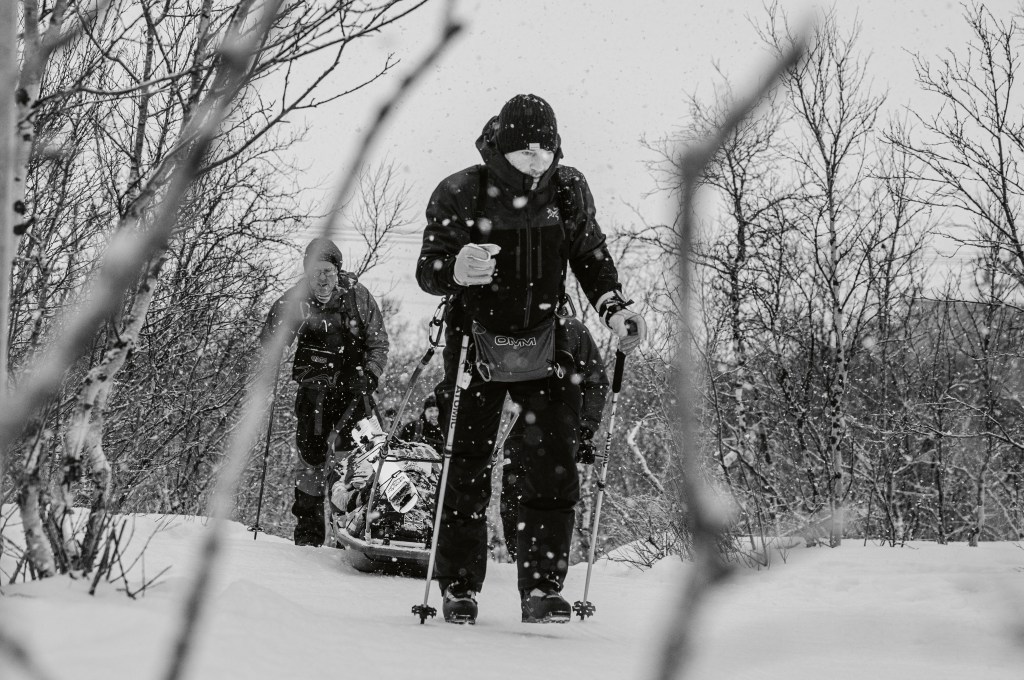
The trail started winding through a forest, I could see red Kungsleden markers recede behind a high ridge above, long shadows darkening on the white slopes. As the incline increased I kept my pace. Sweat started dripping from my forehead. When I noticed it freezing instantly as it hit my skis I froze mid stride.
You sweat, you die.
All I had to do was roll an ankle and I’d be immobile. Then the water in my clothes would conduct my body heat efficiently and swiftly into the patient maw of the hungry valley.
Insulation is trapped layers of air, permeable material lets water vapour move away from your skin. Once my body cooled that water would condense and freeze, accelerating heat loss. Your body temperature only needs to drop by 2 °C for hypothermia to set in. The accompanying feelings of ambivalence and confusion snowball a minor accident into a major incident.
Suddenly a flashing red light pops into view, much higher up, it must be the checkpoint, but how far? I glance at my watch and resume the relentless slide upwards. It should be near.
The light disappears into the inky blackness. I try and remember the contours, the false summits. Shaking my head I dig out my water bottle, mercifully not frozen. It feels too light.
Pointing my torch uphill the clouds of vapour streaming from my body catch me by surprise. My mouth is emptying billowing swirls into the sub zero air. Air so dry and cold that the moisture instantly turns to frost on everything it touches.
Resuming my determined motion I’m aware of how dry my mouth feels, my last pee was the wrong colour of yellow, but it hadn’t registered. I was feeling invincible but also dimly aware that that was a bad sign.
If I ran out of water I knew I’d slow down. Energy levels fall quickly without hydration. Slowing down meant less body heat deployed in the battle against the cold. High up on this ridge I could feel a sinister breeze.
This was terrible place to stop and melt snow.
Eventually the red light grew closer; I swallowed my last mouthful of water, ate a handful of nuts and gratefully unclipped myself. Wrapped in my down jacket I shakily found the haven containing people and hot water. Opening the door released a wall of thick humid air. It surged past me into the vast dark night. I felt a twinge of guilt at letting such precious cargo escape.
Handing my flasks over I learned that I wasn’t far behind the leader. It was only a couple of hours to the pass, a tricky steep descent, then downhill all the way to the finish. Just another fifty kilometres.
I could catch him, I’ve gone days without sleep before. I was ahead of my plan. My legs felt fine. I could win this.
Leaning against the wall I closed my eyes and savoured the delicious contrast to the last thirteen and a half hours. The tension in my neck dissolving in the warm calm hallway.
‘Here you go lad,’ a voice says gruffly, thrusting full bottles into my arms. I nod and smile thanks, turning to leave. My eyes lock onto a board with the weather forecast: ‘-27 °C and dropping’.
Underneath it were the words: ‘Make good decisions’.
Trudging through the deep snow towards my sledge I noticed a quiet voice in the back of my head.
Make good decisions? it said gently, yes you could win, but at what cost?
I knew from experience that my core body temperature would plummet as the night went on. I’d have to add layers and work hard to keep warm. The little information I knew about this race included people falling on the other side of the pass, becoming dangerously tangled in their sledge traces. Unable to reach warm clothes or call for help.
When I struggle to put a hand through the loop on my ski pole, the voice becomes louder.
You’re more tired than you think you are.
I stop and stare at a flat patch of snow next to the trail. Fifteen minutes later I’m inside my tent. A petrol stove blasts enough heat to dry out my sweaty base layer, gloves and hat. The latest I can get to the next checkpoint, thirty km away, is 4pm tomorrow afternoon. I set my alarm for 6am and smile at the warm pouch of bolognaise in my lap, food is morale.
My thick sleeping bag beckons, I can hardly keep my eyes open.
The sun hasn’t quite risen above the range of mountains surrounding me as I glide into a frozen morning. I can see one person a kilometre ahead of me, everywhere else is empty. Just a vast expanse of unblemished porcelain, the pale blue and pink sky shimmering in reflections around me. Sliding gently upwards, my belly full of warm porridge. I smile through my ice encrusted beard. This is what it’s really about.
Pausing at the highest point I lean on my poles and just look. A huge valley carved by an ancient and forgotten glacier drops away below me, stretching miles into the distance. Apart from the small dots of two other racers it’s completely empty. It’s called Europes last wilderness and I’ve never felt further away from my London life. There is nowhere else I’d rather be.
Quickly removing the skins from my skis, I clip my heels in and let gravity pull me gracefully over the unbroken powder. With wide swinging turns to avoid tipping my sledge I thank myself for not doing this in the dark.
I don’t have anything to prove. I am here. That’s enough.
The days are short, darkness arrives quickly as I climb up to the last pass before the final push. I’m grateful for the rest last night, this hill was unexpected and I’m hot as I reach the ridge. As I descend I can feel ice cold fingers pushing through my clothes, poking and prodding, sliding around my sides, creeping up my back. Hunting for skin. Searching for warmth.
Fully alert I pull off a glove, then the liner, and stuff my hand inside my jacket, pushing through to my base layer.
It’s wet.
Keep moving. Think on your feet. Focus. No mistakes.
It’s -33 °C and dropping, the valley holds the cold. A huge bucket of death. The nearest shelter is miles away, too far for hope and bravado.
I pull my buff over my face and tighten the cords on my hood. Trap the heat. I give myself twenty minutes to warm up, to evaporate the water and return my layers to a functional state. If it doesn’t work I’ll pitch my tent, fire up my stove and dry everything. The stakes are high.
Fifty three hours and nineteen minutes after I left Abisko, I cross the finish line in Nikkaluokta. With 130 km in my legs, and over a thousand meters of elevation, I survey myself.
I’m not broken. I didn’t drag myself through this, pushing through pain and misery.
I feel energised and alert. I feel alive in a way I never usually do.
Somehow I’m in second place, far behind the leader, but a podium spot. The best I’ve ever placed. Perhaps not obsessing about the competition opened up space for me to move naturally, sliding through nature in harmony. Not clawing my way over the route.
I feel a warm calm feeling of deep satisfaction. Looking back, a herd of reindeer cross the trail, moving quickly back into the shelter of the forest, I can see wolf prints in the soft white snow. The suns last rays sparking on the frost that’s already formed on the trees.
Shouldering my skis, with all my fingers intact, I walk slowly towards the glowing windows, the promise of a hot shower and a warm bed waiting.
This essay appears in The Lovers: and other stories and essays (The Edinburgh Anthology Series), alongside the other winning and shortlisted entries.


Leave a Reply